
Macro & closeup - explanation please.
Discussion


I don't really think that "close-up" is an actual term for a lens... It might be used as a simplified term for "macro" in P&S lingo, but not really a type of lens.
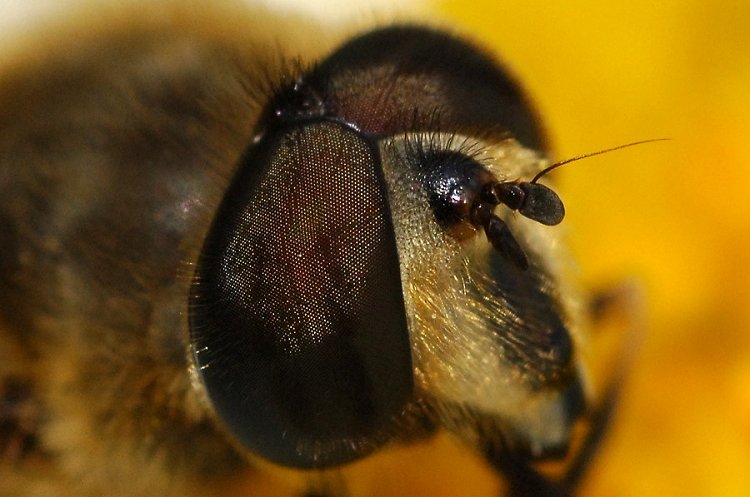
To get shots that are close-up, one would use a macro lens. Macro lens can either focus on a smaller subject at distances from, let's say, 3"-24", or can work to focus obscenely close, but from far away, in the case of a tele-macro lens. A tele-macro would allow you to, let's say, stand 4 feet away from a bee on a flower, but still have the bee fill much of the frame. One could also use extension tubes to bring the minimum focal distance closer for any lens, so that you could use an 18-70mm lens that will focus on the surface of the front element of the lens itself. If you're a complete idiot you could use extension tubes with a super-wide lens and have a nice focal point inside the lens itself.
To get shots that are close-up, one would use a macro lens. Macro lens can either focus on a smaller subject at distances from, let's say, 3"-24", or can work to focus obscenely close, but from far away, in the case of a tele-macro lens. A tele-macro would allow you to, let's say, stand 4 feet away from a bee on a flower, but still have the bee fill much of the frame. One could also use extension tubes to bring the minimum focal distance closer for any lens, so that you could use an 18-70mm lens that will focus on the surface of the front element of the lens itself. If you're a complete idiot you could use extension tubes with a super-wide lens and have a nice focal point inside the lens itself.
imperialism2024 said:
If you're a complete idiot........
Yup, that would be me.

Very new to all this photography malarky. Currently using a Fuji S5000 with fixed lens but have just bought a set of macro/close up lenses. Don't seem to be able to get really really clear close up shots either with or without any of the additional lenses.
Wondered if it was me doing something wrong by using the wrong things for the wrong shots.
speedychrissie said:
and my followup question would be:
is there a major benefit in getting a separate macro lens over getting some extension tubes for an 18-70?
is there a major benefit in getting a separate macro lens over getting some extension tubes for an 18-70?
Macro lenses are prime lenses (not zoom) therefore the optical quality is generally superior and they usually have f2.8 aperture, which means brighter viewfinder, faster shutter speed, added AF benefit (faster and more accurate) in some models, etc.
They make a bloody good portrait lens too.
Edited by Gemm on Friday 14th July 20:56
speedychrissie said:
and my followup question would be:
is there a major benefit in getting a separate macro lens over getting some extension tubes for an 18-70?
is there a major benefit in getting a separate macro lens over getting some extension tubes for an 18-70?
Short Answer: No.
You could disregard my opinion as just very cynical, but I'll toss in my 2 cents...
The only time one would really need a dedicated macro lens is if he would find that, oh 50% or more of his shots are with extension tubes. Then it might make more sense to go to a dedicated macro lens. But short of that, there are many advantages to using extension tubes instead. First, you can use your higher-end lenses with extension tubes to yield a high-end macro lens, so to speak. A decent extension tubes set will run $150 or so, or less, and even macro lenses twice that price will give little image quality improvement over the 18-70mm f/3.5-4.5 D70(s) kit lens with extension tubes. Also, with extension tubes, you can more or less make any lens into a macro. For $150, I can have an 18-70mm macro, a 50mm f/1.8 macro, a 55-200mm f/4-5.6 macro, and a 300mm f/4 macro. I would be spending thousands of dollars to get the equivalent of those in dedicated macro lenses.
To get off topic... it's kind of like the big draw to getting zoom lenses. 95% of the time, you'll get better image quality, and lower prices, for prime lenses (those have a single focal distance); to make up for the zoom factor, just walk closer or further away. That's the best zoom you'll ever have. It's similar to the attraction to long telephoto lenses; the only people who need a dedicated long telephoto lens are nature photographers, sports photographers, spies, and perverts. Otherwise, for the occasional long shot, your money would be better spent on a decent $150-$200 teleconverter that will give you quite a bit of extra reach from your existing lenses. And do you really want to carry around a 10-15lb lens?
That being said, if you come across a great deal for a good-quality specialty lens, go for it!
Gemm said:
speedychrissie said:
and my followup question would be:
is there a major benefit in getting a separate macro lens over getting some extension tubes for an 18-70?
is there a major benefit in getting a separate macro lens over getting some extension tubes for an 18-70?
Macro lenses are prime lenses (not zoom) therefore the optical quality is generally superior and they usually have f2.8 aperture, which means brighter viewfinder, faster shutter speed, added AF benefit (faster and more accurate) in some models, etc.
They make a bloody good portrait lens too.
 On Fullframe bodies anyway - just a touch too far away for practicality on a 1.6 APS imho

In my opinion a proper macro lens is one that is designed to produce a life-size reproduction of the subject on your film/sensor. This would be a reproduction ratio of 1:1. So for example if you took a shot of a 2cm long beetle on film, had it developed, then took the negative and placed it on top of the original beetle it would match precisely.
A lot of manufacturers claim to have macro features on their lenses and then quote a reproduction ratio of 1:4 or 1:6 etc. which means that if you took a snap of the same 2cm beetle you'd find it only came out at 5mm or 3.3mm on film - which is much smaller than the original and hardly what you would call macro !
There seem to be a lot of adverts for close-up lenses on ebay, these look like magnifying glasses in the form of filter attachments to me. The quality won't be particularly good, you'll be more susceptible to flare and other contrast-reducing issues. I tried one when I first started many years ago and found that it would give an OK image in the centre of the frame but it would be decidedly iffy with strange optical effects towards the edge. I gave up on them very quickly.
Extension tubes will work with just about any interchangeable lens camera though they give the most dramatic magnification with 'standard' length lenses, e.g. 50mm focal length lens on a 35mm camera. They effectively spread out the light coming through the lens over a wider area but as your film/sensor is a fixed size it sees a smaller proportion of the now enlarged image and hence you see a magnified image through the viewfinder.
Hope that helps.

V6GTO said:
imperialism2024 said:
A tele-macro would allow you to, let's say, stand 4 feet away from a bee on a flower, but still have the bee fill much of the frame.
Got any examples of a lens like that?
Martin.
Mmm not off the top of my head.
But I just went outside and took this shot from about 5 feet away:

300mm w/ 68mm in extension tubes
f/4, 1/160, ISO 200, Cloudy white balance setting, Aperture priority, Manual focus
As it's a small flower, I'm thinking a large bee would certainly fill that frame...
Gassing Station | Photography & Video | Top of Page | What's New | My Stuff