
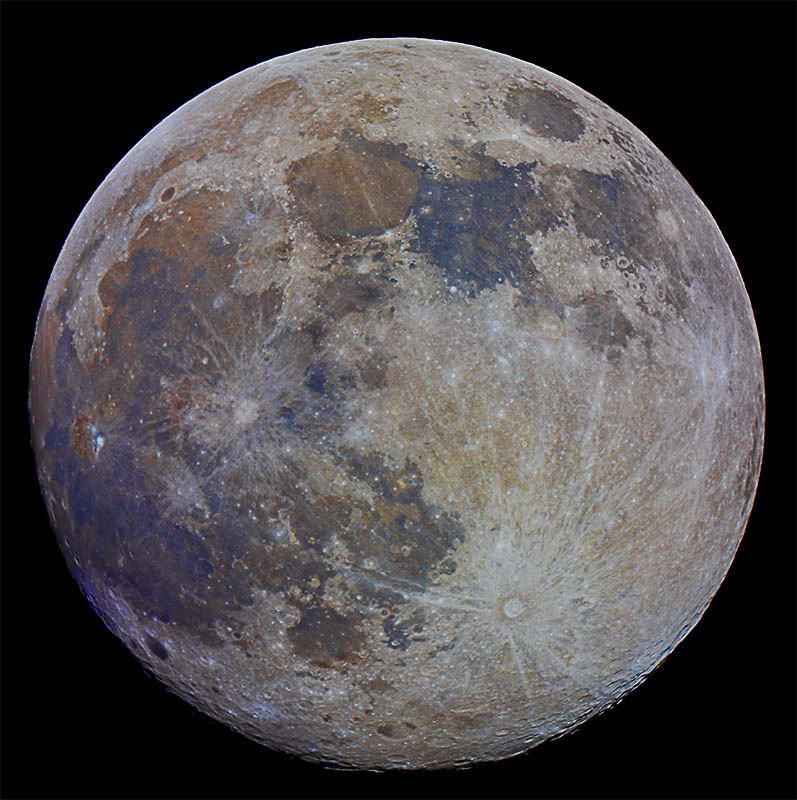
Full moon from the other evening.
Discussion


The moon was both full and at it's closest point to earth the other evening, so I thought I'd take a few shots and stitch them together.
I should mention that I haven't added the colours in this shot, they were already there. I've just brought them out in post processing.
I should mention that I haven't added the colours in this shot, they were already there. I've just brought them out in post processing.
Edited by DIW35 on Sunday 14th December 01:16
That is a montage of 5 photos that were taken with my Canon 40D attached to a telescope at prime focus. ISO was set at 160 with a shutter speed of 1/250s. Effective aperture was f/10. I dropped the exposure by about 1/2 stop in post processing after the images were stitched together, but before making any other changes.
Edited by DIW35 on Sunday 14th December 01:26

Despite the moon looking like a white blob, it is actually quite colourful. A correctly exposed image of the moon will capture those colours, but they are extremely faint and washed out, and can only be fully appreciated if they are given some help to stand out by careful post processing.
All that means is that software for photographic imaging (I personally use Adobe Photoshop) can be use to tweak various aspects of the image to improve or enhance what came out of the camera. In this case I've used Photoshop to enhance the colours to make them appear stronger.
All that means is that software for photographic imaging (I personally use Adobe Photoshop) can be use to tweak various aspects of the image to improve or enhance what came out of the camera. In this case I've used Photoshop to enhance the colours to make them appear stronger.
Well done. There's some more mooning pictures here.
http://www.dailymail.co.uk/sciencetech/article-109...
Er, is your moon the right way round?
http://www.dailymail.co.uk/sciencetech/article-109...
Er, is your moon the right way round?

DIW35 said:
That is a montage of 5 photos that were taken with my Canon 40D attached to a telescope at prime focus. ISO was set at 160 with a shutter speed of 1/250s. Effective aperture was f/10. I dropped the exposure by about 1/2 stop in post processing after the images were stitched together, but before making any other changes.
Just wondered what telescope you have, as i am looking to buy a Meade ETX125PE with the eyepiece set. Just wanted to compare and see what the scope could be capable of, once i gt to grips with it.Edited by DIW35 on Sunday 14th December 01:26
Cheers
Steve


jackal said:
thats amazing
i'd love to get a telescope one day
do yuo know what all those lines are radiating outwards from the 2 craters(?)
An object in space travelling at 20,000+mph hitting a dense object travelling at 0mph - makes a bit of a mess and I assume bits fly at all sorts of angles - I would assume it's probably debris causing marks on the surface.i'd love to get a telescope one day
do yuo know what all those lines are radiating outwards from the 2 craters(?)
Edited by jackal on Sunday 14th December 20:59
Edited by Bernie-the-bolt on Sunday 14th December 21:17
Bernie-the-bolt said:
jackal said:
thats amazing
i'd love to get a telescope one day
do yuo know what all those lines are radiating outwards from the 2 craters(?)
An object in space travelling at 20,000+mph hitting a dense object travelling at 0mph - makes a bit of a mess and I assume bit fly at all sorts of angles - I would assume it's probably debris causing marks on the surface.i'd love to get a telescope one day
do yuo know what all those lines are radiating outwards from the 2 craters(?)
Edited by jackal on Sunday 14th December 20:59
Gassing Station | Photography & Video | Top of Page | What's New | My Stuff