
Sunrise / Sunset photo advice
Discussion


Driving in this morning on the M180 was dull - it always is - frankly, I'd rather shove wasps... Anyway...
When I left home and drove to the motorway I noticed that the sunrise was, to be honest, fantastic and it made me want to pull over and take a photo of it - overlooking the fact that that would have been dangerous, I'd not scoped out where I'd photograph from and, most crucially, I didn't have my camera with me.
But it set me thinking - Last year, not long after I got my camera, I made an attempt at sunset photos and, to be honest, the results were poor - the best one was this:

All I'd achieved was to get very cold and very pissed off.
I've learnt a lot about photography in the past year so I at least now know how to focus and a bit about exposure times and that, a cloudless sky will not necessarily produce nice photos and to shoot in RAW. I've read a bit about sunset and sunrise photos, but I've made the mistake of reading more than one source about this and the advice is slightly different between the articles and that's left me slightly confused.
So, my question is this - are there any good general points that I need to remember when I'm stood, freezing my ass off at dawn/dusk taking sunrise/sunset photos?
Thanks
JTW
When I left home and drove to the motorway I noticed that the sunrise was, to be honest, fantastic and it made me want to pull over and take a photo of it - overlooking the fact that that would have been dangerous, I'd not scoped out where I'd photograph from and, most crucially, I didn't have my camera with me.
But it set me thinking - Last year, not long after I got my camera, I made an attempt at sunset photos and, to be honest, the results were poor - the best one was this:
All I'd achieved was to get very cold and very pissed off.
I've learnt a lot about photography in the past year so I at least now know how to focus and a bit about exposure times and that, a cloudless sky will not necessarily produce nice photos and to shoot in RAW. I've read a bit about sunset and sunrise photos, but I've made the mistake of reading more than one source about this and the advice is slightly different between the articles and that's left me slightly confused.
So, my question is this - are there any good general points that I need to remember when I'm stood, freezing my ass off at dawn/dusk taking sunrise/sunset photos?
Thanks
JTW
Check this page out: http://www.pistonheads.com/gassing/topic.asp?h=0&a...
And especially this!
And especially this!
GetCarter said:
If you get a grad grey, you will darken the sky, so the camera will under expose the foreground less. The only other way of doing it is to take multiple shots and HDR or digitally blend.
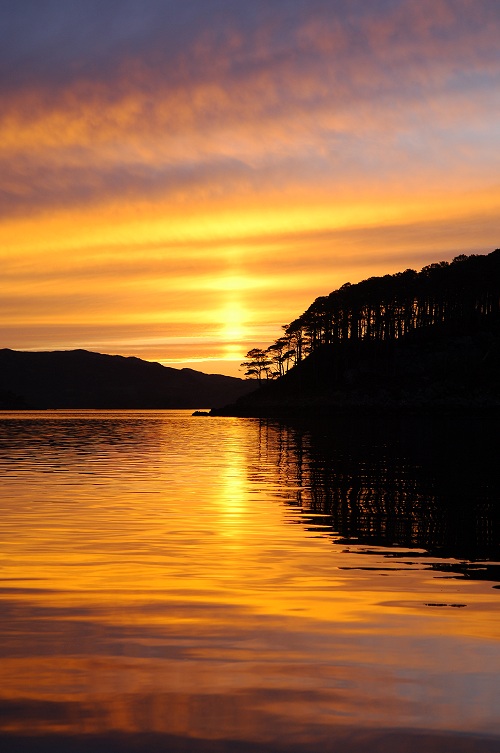
Why water is so good is that the bright sky is reflected, so the forground doesn't under expose.
ETA - this was taken using a grey grad, as the sky was much brighter than the sea.. but the grey evens it out
Why water is so good is that the bright sky is reflected, so the forground doesn't under expose.
ETA - this was taken using a grey grad, as the sky was much brighter than the sea.. but the grey evens it out
Edited by GetCarter on Wednesday 20th May 13:44
Don't make the mistake of seeing a pretty sunset and just photographing the sky; you've got to have something good in the foreground too. Your photo is boring because although the sky is nice, you've just got a big slab of silhouetted land filling the bottom half of the frame; there's nothing interesting there.
As with most photography, composition is the most important thing.
As with most photography, composition is the most important thing.
SamHH said:
Don't make the mistake of seeing a pretty sunset and just photographing the sky; you've got to have something good in the foreground too. Your photo is boring because although the sky is nice, you've just got a big slab of silhouetted land filling the bottom half of the frame; there's nothing interesting there.
As with most photography, composition is the most important thing.
That is something I've learned - mostly the hard way - that seeing something nice, doesn't necessarily mean a nice photo...As with most photography, composition is the most important thing.
I picked up a good tip from the Lee Filters MD at the TP conference.
Two ND grads, one 'upside down' will give you a stripe on the overlap that you can line up on the sun, and the sky and the land can then fall into the less nd'ed bit.
So potentially a .3 covering the landscape/sea, a .6 one the sky and with the overlap .9 on the middle where the sun is.
(He was talking about seascapes and smoothing hence the nd on the foreground)
Two ND grads, one 'upside down' will give you a stripe on the overlap that you can line up on the sun, and the sky and the land can then fall into the less nd'ed bit.
So potentially a .3 covering the landscape/sea, a .6 one the sky and with the overlap .9 on the middle where the sun is.
(He was talking about seascapes and smoothing hence the nd on the foreground)
SamHH said:
Don't make the mistake of seeing a pretty sunset and just photographing the sky; you've got to have something good in the foreground too. Your photo is boring because although the sky is nice, you've just got a big slab of silhouetted land filling the bottom half of the frame; there's nothing interesting there.

You don't need HDR or a grad IF you've something interesting to silhouette against. I've used plants, a gas torch, a ruined abbey/church - anything which has an interesting shape to 'frame' the colours.
And as mentioned above, water is very good - balances a picture beautifully.

Gassing Station | Photography & Video | Top of Page | What's New | My Stuff