
Photographing the moon.
Discussion


/\ actually, that advice is missing one vital point. You need to be on spot exposure setting, or you'll just get an overexposed disk on a black sky.
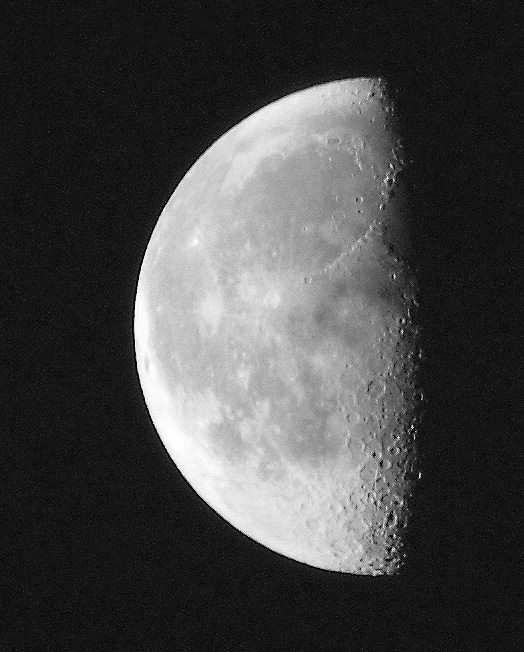
There are many that have taken better pics of the moon on here - some with very long lenses, some with scopes. I post this as it was taken with a 300mm lens (as you have) - as an example of what you can get. As stated below (this is an edit) I was on mirror lock up, bracketing 3 frames at .3 ev, on a tripod, 200 ISO, spot metering. Then desaturated to B&W post production. Full moons generally make worse pics as you don't get the relief of the craters.
There are many that have taken better pics of the moon on here - some with very long lenses, some with scopes. I post this as it was taken with a 300mm lens (as you have) - as an example of what you can get. As stated below (this is an edit) I was on mirror lock up, bracketing 3 frames at .3 ev, on a tripod, 200 ISO, spot metering. Then desaturated to B&W post production. Full moons generally make worse pics as you don't get the relief of the craters.
Edited by GetCarter on Wednesday 18th August 14:45
The good thing about photographing the moon is that you generally have all the time in the world (unless you are shooting between clouds).
As the moon is in direct sunlight, try starting with the sunny 16 rule - F16, ISO 100, 1/100th S, then adjust as is necessary. Can't remember what I used here - Flickr not telling, and I can't put my finger on the original.

As the moon is in direct sunlight, try starting with the sunny 16 rule - F16, ISO 100, 1/100th S, then adjust as is necessary. Can't remember what I used here - Flickr not telling, and I can't put my finger on the original.
Gassing Station | Photography & Video | Top of Page | What's New | My Stuff