
Air Flow Meters and fast idle
Discussion


Air Flow Meters - why does one lead have 3 connections and the other have 4? Does it matter which way round they are connected? I have seen various threads that say that the 4 pin one should be on the top and the 3 pin on the bottom but mine are the other way round (have it would seem been like that from the beginning).
Car is still running a (more often than not) fast idle of 1200-1500 and sometimes 2000rpm so now questioning everything.
Having cleaned and swapped out the following:
- vacuum hoses (plenum/servo and plenum/offside rocker cover)
- TPS
- AFMs
- Idle Control Valve
- fuel rail
- fuel regulator
- distributor cap and rotor arm
- spark plugs
- Injectors
- Throttle assembly
- associated gaskets (plenum and fuel rail) - electrical contact cleaner sprayed around engine bay found a couple of small intake air leaks
I have run out of ideas. Next thought is to delve into the tappet clearances (not checked for a number of years but not sure whether this will have any affect at all in idle speed although it will probably help the emissions which are higher than I'd like.
I note that there seem to be a number of cars this year showing the same fast idle issues so someone somewhere must have found the answer buy now - do please share, traffic lights are a little like a race track starting grid before the lights go out and rear tyre ware is a little on the high side!
Car is still running a (more often than not) fast idle of 1200-1500 and sometimes 2000rpm so now questioning everything.
Having cleaned and swapped out the following:
- vacuum hoses (plenum/servo and plenum/offside rocker cover)
- TPS
- AFMs
- Idle Control Valve
- fuel rail
- fuel regulator
- distributor cap and rotor arm
- spark plugs
- Injectors
- Throttle assembly
- associated gaskets (plenum and fuel rail) - electrical contact cleaner sprayed around engine bay found a couple of small intake air leaks
I have run out of ideas. Next thought is to delve into the tappet clearances (not checked for a number of years but not sure whether this will have any affect at all in idle speed although it will probably help the emissions which are higher than I'd like.
I note that there seem to be a number of cars this year showing the same fast idle issues so someone somewhere must have found the answer buy now - do please share, traffic lights are a little like a race track starting grid before the lights go out and rear tyre ware is a little on the high side!
Edited by White S3 on Tuesday 9th June 12:45
When I had fast idle issues it was the throttle stop setting at fault. At idle the engine should get all its air through the idle speed control valve, the throttle butterfly should be completely closed. If the idle speed control valve gets blocked up there is a tendency for people to adjust the throttle stop to maintain the correct idle speed, when the idle valve then gets cleaned or replaced you can end with a fast idle.
May not be your problem but worth a look.
Rob.
May not be your problem but worth a look.
Rob.
Griffinr said:
When I had fast idle issues it was the throttle stop setting at fault. At idle the engine should get all its air through the idle speed control valve, the throttle butterfly should be completely closed. If the idle speed control valve gets blocked up there is a tendency for people to adjust the throttle stop to maintain the correct idle speed, when the idle valve then gets cleaned or replaced you can end with a fast idle.
May not be your problem but worth a look.
Rob.
I can second this. That's what happened to me.May not be your problem but worth a look.
Rob.
I have a similar issue with mine that I took over (openly) from the previous owner. What does your's do with the ISCV disconnected? Mine sits at a perfectly steady 900 ish rpm with it disconnected and runs fine but displays similar symptoms with it reconnected. In my investigations around the internet I bumped into this which seemed to provide some useful info...
http://www.granada-and-scorpio.com/phpbb/viewtopic...
It agrees with the idea that if the ISCV is plugged in and working and the idle is high, air is likely to be getting in elsewhere; if the ISCV is disconnected/blocked closed and it still continues to idle properly (i.e. doesn't just run down and stop) then you definitely have a leak letting air in elsewhere. I haven't tested this all with mine (it's running fine with the ISCV disconnected so not brave enough to play with it until autumn!) but will be the start of my investigations when I do!
But you are right, high idle does seem to be a recurring theme on here!
http://www.granada-and-scorpio.com/phpbb/viewtopic...
It agrees with the idea that if the ISCV is plugged in and working and the idle is high, air is likely to be getting in elsewhere; if the ISCV is disconnected/blocked closed and it still continues to idle properly (i.e. doesn't just run down and stop) then you definitely have a leak letting air in elsewhere. I haven't tested this all with mine (it's running fine with the ISCV disconnected so not brave enough to play with it until autumn!) but will be the start of my investigations when I do!
But you are right, high idle does seem to be a recurring theme on here!
Barkychoc said:
I believe one has 4 wires and the other 3 as the temperature of the incoming air is only taken from one air flow meter - although I believe both are identical - it only uses the input from one.
I think they both do something?there was a handy little article about "trouble shooting the 2.9 management system" in Car Mechanics (February 1995), copies still crop up on Ebay or there were some photocopies kicking around a while back


phillpot said:
I think they both do something?
there was a handy little article about "trouble shooting the 2.9 management system" in Car Mechanics (February 1995), copies still crop up on Ebay or there were some photocopies kicking around a while back
Article is available on my web site here;there was a handy little article about "trouble shooting the 2.9 management system" in Car Mechanics (February 1995), copies still crop up on Ebay or there were some photocopies kicking around a while back
[url/]http://www.andrewc.org.uk/tvrgit/ford29diagnostics.pdf[/url]
I had these symptoms for ages, turned out that the plenum gasket had been almost entirely sucked into the inlet for cylinder 1.
tvrgit said:
I had these symptoms for ages, turned out that the plenum gasket had been almost entirely sucked into the inlet for cylinder 1.
So fundamentally the problem is almost certainly too much air getting in somewhere, its just a matter of finding the why or where. I don't think the ECU is smart enough to compensate for air leaks and adjust the tickover accordingly, it probably just measures temperature and then supply's fuel and a pre-set amount of air through the ISCV which barring other faults, gives approximately 850 rpm. Thanks All.
Throttle stop not the issue (unless there is something else other than the linkage assembly grub screw)as that is fully wound out and not touching.
Both of the ISCV used have had a good clean and are free to move but disconnecting it doesn't change the engine revs strangely. I have yet to try just blanking it to see if there is any change.
When I had the throttle assemble off to clean it, I noticed that after the clean I could see a ring of light around the brass butterfly valves - could this be the cause? It is the same with the other second hand bit that I have but I haven't sourced a brand new one yet to check what the tolerances are.
Spraying electrical cleaner around the gaskets shows no leaks so confident there.
Induction hoses look intact but does anyone know where you can get new ones these days at a sensible price?
Throttle stop not the issue (unless there is something else other than the linkage assembly grub screw)as that is fully wound out and not touching.
Both of the ISCV used have had a good clean and are free to move but disconnecting it doesn't change the engine revs strangely. I have yet to try just blanking it to see if there is any change.
When I had the throttle assemble off to clean it, I noticed that after the clean I could see a ring of light around the brass butterfly valves - could this be the cause? It is the same with the other second hand bit that I have but I haven't sourced a brand new one yet to check what the tolerances are.
Spraying electrical cleaner around the gaskets shows no leaks so confident there.
Induction hoses look intact but does anyone know where you can get new ones these days at a sensible price?
White S3 said:
When I had the throttle assemble off to clean it, I noticed that after the clean I could see a ring of light around the brass butterfly valves - could this be the cause?
Sounds a possibility, worth a bit of further investigation to see if you can get them closing better.White S3 said:
When I had the throttle assemble off to clean it, I noticed that after the clean I could see a ring of light around the brass butterfly valves - could this be the cause? It is the same with the other second hand bit that I have but I haven't sourced a brand new one yet to check what the tolerances are.
Possibly. Depends how wide the "ring" is.White S3 said:
Spraying electrical cleaner around the gaskets shows no leaks so confident there.
so did I. I was confident too, but I was wrong.Can you do a vacuum test? If there's an air leak vacuum will be low. how about a smoke test? That was pretty conclusive! I made a tester for pennies - see my website last January (2014) There are videos on YouTube showing other ways.
White S3 said:
When I had the throttle assemble off to clean it, I noticed that after the clean I could see a ring of light around the brass butterfly valves
Hasn't come out to well in the photo but the butterflies are not a perfect fit, held up to the light some "leakage" is visible, I wouldn't think that's critical because there's a big hole in one of them!
White S3 said:
Induction hoses look intact but does anyone know where you can get new ones these days at a sensible price?
Think they're a bit hard to find but if yours are not too bad wrapping them with self amalgamating tape will give 'em a bit more life.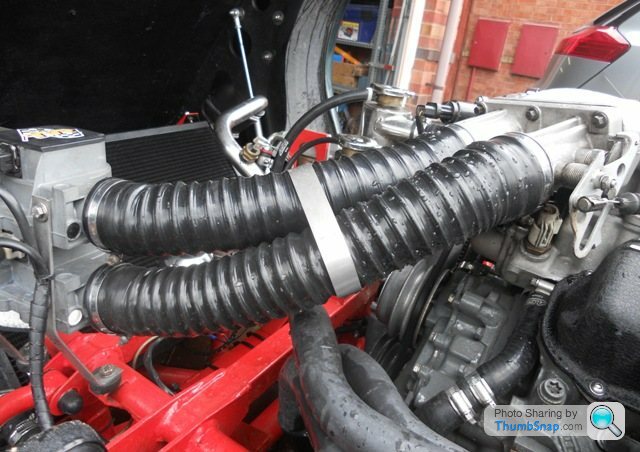
White S3 said:

Interesting as both the on-car and the spare look like this - no hole just a .5mm gap!
Nice thought with amalgam tape, will try as I have loads of it.
AJC77 said:
Having recently cleaned my throttle pot (and then suffered from a fast idle only to find out fine adjustment of both the throttle stop and roller wheel on the sliding arm (as that also prevented the flaps from sitting tight shut as it affected the arms resting position)) I have to say there is still a lot of light seeping from around your butterflies.
Looks pretty normal to me. Even new tb's will show light. These are probably a little worn and you could replace the flaps but I wouldn't expect it to make any real difference.Thanks
Damian S3
Going to try blanking off the ISCV next - just unplugging it doesn't seem to make any difference once the engine it up to temp. After that it'll be a full new set of gaskets above and below fuel rail if I get time/inclination.
Someone (sorry cannot remember who) said that there was a sensor or input to the ECU from somewhere that keeps the revs slightly above idle when the car is rolling - does anyone know where this is? Is this something that is an easy replacement job?
Someone (sorry cannot remember who) said that there was a sensor or input to the ECU from somewhere that keeps the revs slightly above idle when the car is rolling - does anyone know where this is? Is this something that is an easy replacement job?
I think the fast idle is down by ECU speed sensor...
I found an old school ford guy who set mine up (in the end) but to get it spot on we ended up putting new (yes new) AFMs on.
I kept these and all associated HW when I sold my engine so let PM me if you eliminate all else..
Cheers
Damian S3
I found an old school ford guy who set mine up (in the end) but to get it spot on we ended up putting new (yes new) AFMs on.
I kept these and all associated HW when I sold my engine so let PM me if you eliminate all else..
Cheers
Damian S3
Damian where is the ECU speed sensor? So far unable to locate it from SH's Bible. AFMs swapped out with spares (not new but working) without change. Car is trying to get to idle but the you can hear a sucking noise from air filter and the ECU obviously thinks the engine is about to stall so boots the revs up again (not as fast as a hunting engine). Might try taking the top off the AFM and checking cleanliness of track inside although have already given them a carb cleaner bath.
Gassing Station | S Series | Top of Page | What's New | My Stuff