
350 i Manual fan overide
Discussion


Hi All,
First thing I want to do is have a little switch to manually turn the cooling fans on. The new wedge showed no signs of overheating throughout the journey home either on the open road or around the centre of towns so it really is more for my piece of mind and that I want to take the wedge to goodwood classic show in Sep.
I have an old kenlowe manual switch with amber light that i can fit very discreetly under the dash, at the top of the footwell, thinking close to the bonnet release. I was hoping that someone could give me the idiots guide as to how to connect the wiring. Mechanics I am ok with, electrickery is something else.
Apologies of this has been covered before but when I try and do a search pistonheads throws you out into google and that has given me some weird and wonderful results, lots of chimp references
Cheers all
First thing I want to do is have a little switch to manually turn the cooling fans on. The new wedge showed no signs of overheating throughout the journey home either on the open road or around the centre of towns so it really is more for my piece of mind and that I want to take the wedge to goodwood classic show in Sep.
I have an old kenlowe manual switch with amber light that i can fit very discreetly under the dash, at the top of the footwell, thinking close to the bonnet release. I was hoping that someone could give me the idiots guide as to how to connect the wiring. Mechanics I am ok with, electrickery is something else.
Apologies of this has been covered before but when I try and do a search pistonheads throws you out into google and that has given me some weird and wonderful results, lots of chimp references
Cheers all
 the plug on rad,
There's usually a relay (sometimes two) labelled 'Cooling Fan' which is actuated by the temperature switch ('Otter' switch) in the radiator and powers the radiator fan. The tidiest way to add an over-ride is simply to poke 12v into the coil of the relay. Keeps all wiring in the cabin, nothing unsightly around the engine bay, no extra fuses to add etc etc.
It's common to add a light (or have an illuminated switch) so you can see the over-ride is on (though you can usually hear the fan when stopped anyway).
I have a Kenlowe thermostat in the radiator top hose that was wired to power the fan directly when I got the car... proper bodgy lash-up that was. I modified it so that the Kenlowe 'stat now switches the twin relays, this saves the Kenlowe contacts from arc damage that repeated switching of a 25A inductive load would cause. It's configured so that the fan can run-on when the engine is turned off.
This sketch shows standard arrangement: the 12v rail is ignition-switched so the fan goes off when engine stopped.

Here's the over-ride switch and a warning light added:

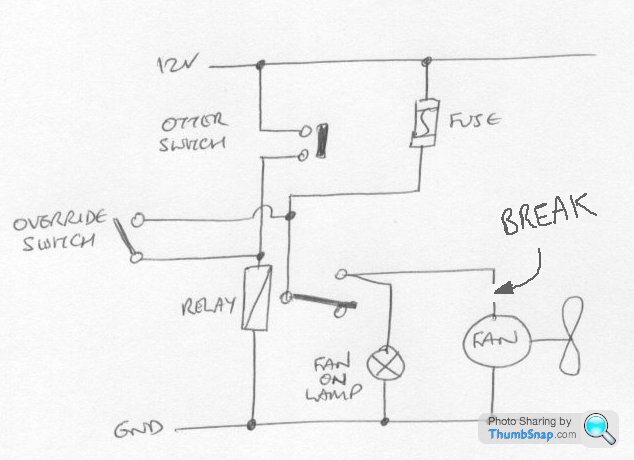
One drawback of the warning light is that it only tells you the relay is switching, it doesn't prove 12v is reaching the fan. Same circuit, note break in wire. In the cabin the light still shows the fan 'on'...
In similar fashion, here's the warning light in completely the wrong place; you could throw the relay away (ie it could fail!) and the light would still have you thinking the fan was running...

Here's a practical solution: the feed from relay to fan is broken and routed to a small circuit board, on which is mounted a glass reed switch connected so as to supply the warning light as shown. Around the switch are wound half a dozen or so turns of 2.5mm copper wire (strip a bit of twin and earth). The fan current passes through the 'coil' of wire, creating an electromagnetic field that magnetizes the switch contacts, forcing them to close and put the light on.
Reed switches are commonly used as door triggers in house alarm systems; there's a magnet on the door that closes the switch as you close the door. Opening the door removes the magnetic field and the switch 'breaks', triggering the alarm. Here the electromagnetic field from the copper coil replaces the magnet.
Sketch shows Otter switch closed, relay activated and fan running. If you were really paranoid about your fan you could arrange things so that if the relay is on but the fan takes no current, an alarm sounds in the cabin...

It's common to add a light (or have an illuminated switch) so you can see the over-ride is on (though you can usually hear the fan when stopped anyway).
I have a Kenlowe thermostat in the radiator top hose that was wired to power the fan directly when I got the car... proper bodgy lash-up that was. I modified it so that the Kenlowe 'stat now switches the twin relays, this saves the Kenlowe contacts from arc damage that repeated switching of a 25A inductive load would cause. It's configured so that the fan can run-on when the engine is turned off.
This sketch shows standard arrangement: the 12v rail is ignition-switched so the fan goes off when engine stopped.
Here's the over-ride switch and a warning light added:
One drawback of the warning light is that it only tells you the relay is switching, it doesn't prove 12v is reaching the fan. Same circuit, note break in wire. In the cabin the light still shows the fan 'on'...
In similar fashion, here's the warning light in completely the wrong place; you could throw the relay away (ie it could fail!) and the light would still have you thinking the fan was running...
Here's a practical solution: the feed from relay to fan is broken and routed to a small circuit board, on which is mounted a glass reed switch connected so as to supply the warning light as shown. Around the switch are wound half a dozen or so turns of 2.5mm copper wire (strip a bit of twin and earth). The fan current passes through the 'coil' of wire, creating an electromagnetic field that magnetizes the switch contacts, forcing them to close and put the light on.
Reed switches are commonly used as door triggers in house alarm systems; there's a magnet on the door that closes the switch as you close the door. Opening the door removes the magnetic field and the switch 'breaks', triggering the alarm. Here the electromagnetic field from the copper coil replaces the magnet.
Sketch shows Otter switch closed, relay activated and fan running. If you were really paranoid about your fan you could arrange things so that if the relay is on but the fan takes no current, an alarm sounds in the cabin...
Edited by Wedg1e on Tuesday 7th August 01:31


OK, have had a think about this and my small peasize brain may have got it.
In simple terms if I take a feed off of the cooling fan fuse and run it to my new switch and another from the switch to the cooling fan relay would that work ie does it give me the live feed ? Or do I need a permanent live from the battery or ignition ?
Also sorry to be so thick (please bare with me) but how do you attach the lead into the relay coil ?
Any simpleton's advice really gratefully received
Cheers All
In simple terms if I take a feed off of the cooling fan fuse and run it to my new switch and another from the switch to the cooling fan relay would that work ie does it give me the live feed ? Or do I need a permanent live from the battery or ignition ?
Also sorry to be so thick (please bare with me) but how do you attach the lead into the relay coil ?
Any simpleton's advice really gratefully received
Cheers All
Gassing Station | Wedges | Top of Page | What's New | My Stuff