
Plenum air issue..over run valve??
Discussion


Hey guys!
Took the plenum off last week to do some painting and now I've put it all back on I took it for a blast and it was running strange...
It was a little rough on cold start but the main issue was that when it seemed like it was on choke the whole time. The revs were falling very slowly when I lifted off or revved it.
So, cutting a long story short I took the air pipe from the overrun valve off and it runs perfectly. So, looks like I have an air problem...
Took it for a drive without this connected and it went really well! Only difference was that it didn't pop or bang at all on the overrun which is strange!
So, how should the overrun valve work? I blew in / sucked on it and Its solid - is this right??
Jack Valiant said:
Just a thought when you were painting etc did you take the throttle pot off? If you did is it in the right place and did you seat it back in correctly as it has a seal that has to be good?
Chris
I didn't take it off for that reason...i will check its still reading right and I didn't move it.Chris
How do you set the mixture then???
Question - if you take the pipe off the plenum valve and blow/suck it should there be any air flowing?? I can't get any...
matt-man said:
So, how should the overrun valve work? I blew in / sucked on it and Its solid - is this right??
I doubt the normal human body has sufficient blow or suck to activate the overrun valve?Check out my article on this clever little jigger:
http://www.vintagemodelairplane.com/pages/Rover_Te...
Especially my in-depth interpretation in this second essay.
http://www.vintagemodelairplane.com/pages/Rover_Te...
They may help you retrieve your crackling exhaust, too!
Now that is a very interesting read...amazing how these articles make sense after you've been playing about with the pipes!
So, half explains it...although I don't get why removing it makes it better...I'm going to check for leaks.
Another question - when I take the valve cover off, the spring mech is well and truly in the plenum - is this right?? Cheers all
So, half explains it...although I don't get why removing it makes it better...I'm going to check for leaks.
Another question - when I take the valve cover off, the spring mech is well and truly in the plenum - is this right?? Cheers all
matt-man said:
when I take the valve cover off, the spring mech is well and truly in the plenum - is this right??
Has someone used way too much sealant and gummed up the valve, or has it been assembled arsey tarcy?This is the right way!?

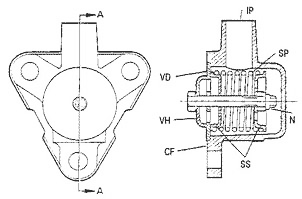
Sealant must only be applied to the connection face CF.
instructions said:
.... the connection face (CF) must be airtight. A trace of "instant gasket" when fitting may be used.
matt-man said:
How do you set the mixture then?
As AQ says there is clearly another issue going on, removing that pipe would normally cause the engine to stall with an uncontrolled weak mixture. He suggests an existing over rich mixture.If its a flapper, the idle mixture is adjusted from the AFM hex screw, about five turns out from fully home is a good place to start. But with a larger engine check the CO spec and you can use a Gunson CO meter to get it spot-on.
Two pages of stuff here: http://www.vintagemodelairplane.com/pages/Rover_Te...
That takes you on to what might be happening when driving regarding correct mixture. The above links will help you find an answer but be careful.
As a further "aid memoir" it would seem you might want to mug up on all the Efi system components, this is not the exact same layout as yours, but no doubt similar

and the archive of components:
http://www.vintagemodelairplane.com/pages/Rover_Te...
and for good measure an in depth study of your (probable) electronic ignition system
http://www.vintagemodelairplane.com/pages/Download...
http://www.vintagemodelairplane.com/pages/Download...
Don't be put off by the seemingly impossible complexities of electronics, etc, all the descriptions are written in plain speaking English for the Owner/Enthusiast such as yourself. There is also a manual!
I think that the valve should not open in normal idle situations, only when the vacuum in the intake is very low (such as going downhill with the throttle closed). I believe the purpose is to stop the higher vacuum being created which can suck oil past the valve seals etc.
If the valve can flutter during normal idle then it could lead to variations in speed or hunting.
But how do you test it properly?
Russ
If the valve can flutter during normal idle then it could lead to variations in speed or hunting.
But how do you test it properly?
Russ
Gassing Station | Wedges | Top of Page | What's New | My Stuff