
Geometry again
Discussion


I've been trawling through the previous posts and collected the following together.
A couple of years ago I phoned Wedge Automotive/RT to get the front tracking and was told 2.0(mm)don't know how this relates to degrees.
Though I've formatted it to show the author and quoted source I have edited it to ease comparisons.
Comments, corrections, additions, all gracefully received.
I'm about to book a full alignment at Micheldever and would like to give them the correct numbers
Leo
Edited to add hamish400's model information 1/12/04 8:36
>>> Edited by leorest on Wednesday 1st December 08:41
Shpub said:
Quoted source Shpub
Model Not Specified
F, caster 3.0(deg) ±0.5(deg)
F, camber 0(deg) ±0.5(deg)
F, Track 3.2(mm) toe in ±1.5(mm)
F, kingpin 6.0(deg) incline (No tolerance specified)
R, camber 0.5(deg)±0.5(deg)(surely this should be -ve?)
R, track 4.5(mm) ±1.5(mm)
paul gotts said:
Quoted sourceFactory
Model 89 400SE
F, caster 3.5(deg) +0.5(deg) - 0.0(deg)
F, camber -1.0(deg) (No tolerance specified)
F, Track 0.5(deg) (No tolerance specified)
F, kingpin Not Specified
R, camber -1.0(deg) +0.0(deg) -0.5(deg)
R, track 2(mm) toe in (No tolerance specified)
hamish400 said:
Quoted sourceFactory
Model 1990 400SE
F, casterSame both sides
F, camber5.5(deg) ±0.5(deg)
F, Track"Parallel to 10-20 minutes toe in (total)"
F, kingpin Not Specified
R, camber-0.75(deg) (No tolerance specified)
R, track"5 to 10 minutes toe in at each wheel"
A couple of years ago I phoned Wedge Automotive/RT to get the front tracking and was told 2.0(mm)don't know how this relates to degrees.
Though I've formatted it to show the author and quoted source I have edited it to ease comparisons.
Comments, corrections, additions, all gracefully received.
I'm about to book a full alignment at Micheldever and would like to give them the correct numbers
Leo
Edited to add hamish400's model information 1/12/04 8:36
>>> Edited by leorest on Wednesday 1st December 08:41
It all depends......
More -ve camber better cornering at high speed but reduced grip when level and increased wear on inside edges and in the wet.
Toe-in should be small. Increased amounts will reduce turn in. Toe out will increase turn in at the expense of twitchiness on straights. Car will jump around in response to contact with bumps. Excessive toe-in/toe out will reduce straightline speed.
Castor will affect how heavy the steering is. More castor the better to a point.
Before spending money at Micheldever...
Rear camber adjustment requires shims between disk and drive shaft. No shims no adjustment and it involves dissambling the rear drive shafts etc to fit them.
Front camber is not adjustable.
Front camber and track is adjustable.
More -ve camber better cornering at high speed but reduced grip when level and increased wear on inside edges and in the wet.
Toe-in should be small. Increased amounts will reduce turn in. Toe out will increase turn in at the expense of twitchiness on straights. Car will jump around in response to contact with bumps. Excessive toe-in/toe out will reduce straightline speed.
Castor will affect how heavy the steering is. More castor the better to a point.
Before spending money at Micheldever...
Rear camber adjustment requires shims between disk and drive shaft. No shims no adjustment and it involves dissambling the rear drive shafts etc to fit them.
Front camber is not adjustable.
Front camber and track is adjustable.
Many thanks
I'm doing this following Driveshaft and trailing link/tie rod replacement on the rear.
I've used the same shims as was fitted to the old driveshafts. Which is an alarming amount on one side only!
What I wanted to do was get the rear camber equal on both sides using the shims available. Set the rear toe and check that the trailing links are set to the correct length (I just set them to the same length as the one remaining good one and they went on easy enough)
When this is all done then I'll see how she handles before doing anything else.
Q1 Is it likely that I have set the rear tie rods up correctly? If not then how is this done?
Q2 Which of the geometry settings is affected by replacing the chassis mounting bushes on the front suspension leading link/tie rod? The MOT man said this needed doing.
Leo
I'm doing this following Driveshaft and trailing link/tie rod replacement on the rear.
I've used the same shims as was fitted to the old driveshafts. Which is an alarming amount on one side only!
What I wanted to do was get the rear camber equal on both sides using the shims available. Set the rear toe and check that the trailing links are set to the correct length (I just set them to the same length as the one remaining good one and they went on easy enough)
When this is all done then I'll see how she handles before doing anything else.
Q1 Is it likely that I have set the rear tie rods up correctly? If not then how is this done?
Q2 Which of the geometry settings is affected by replacing the chassis mounting bushes on the front suspension leading link/tie rod? The MOT man said this needed doing.
Leo
Hi Leo,
Front tie rod bushes and link help set the front castor angle. I love castor, as I like the wheels to straghten up quickly after after a turn ,so I go for something close to 6 degrees ( I used to go 8 on my old v8 fords, but have calmed down a bit these days) . It makes the steering a bit heavy at low speed, as steve says, but it does take the stress out of prolonged high speed stints. Of course you do loose out on top end speed and the cornering in the wet is a little less able, so it's not a racing setting. I'd suggest you get a £50 camber/castor gauge from Demon Tweaks, and have a play to see what you personally prefer, as everyone has different tastes. I found the most important thing is to have the same setting on each side.
-Jim
Front tie rod bushes and link help set the front castor angle. I love castor, as I like the wheels to straghten up quickly after after a turn ,so I go for something close to 6 degrees ( I used to go 8 on my old v8 fords, but have calmed down a bit these days) . It makes the steering a bit heavy at low speed, as steve says, but it does take the stress out of prolonged high speed stints. Of course you do loose out on top end speed and the cornering in the wet is a little less able, so it's not a racing setting. I'd suggest you get a £50 camber/castor gauge from Demon Tweaks, and have a play to see what you personally prefer, as everyone has different tastes. I found the most important thing is to have the same setting on each side.
-Jim
jchase said:
Hi Leo,
Front tie rod bushes and link help set the front castor angle. I love castor, as I like the wheels to straghten up quickly after after a turn ,so I go for something close to 6 degrees ( I used to go 8 on my old v8 fords, but have calmed down a bit these days) . It makes the steering a bit heavy at low speed, as steve says, but it does take the stress out of prolonged high speed stints. Of course you do loose out on top end speed and the cornering in the wet is a little less able, so it's not a racing setting. I'd suggest you get a £50 camber/castor gauge from Demon Tweaks, and have a play to see what you personally prefer, as everyone has different tastes. I found the most important thing is to have the same setting on each side.
-Jim
Thanks again Jim
I have a digital inclinometer, which can read to 0.1 degrees, but I lack the knowledge of how to do camber castor set-up. A quick Internet search didn't turn anything up. Do you have instructions for one of these camber gauges?
Leo
On my gauge, when setting castor there is a special scale. You turn the wheels 10 degrees left, measure the camber, then 10 degrees right and measure the camber. Then it says the castor is the difference of the two measures previously taken. I'm not sure of the maths, but the camber scale is different to the castor scale. Hope this helps.
-Jim
-Jim
The castor setting on the Wedge does have some drawbacks which I have spent the last 3 months sorting out as it is the next obstacle in the 520's path to world domination... .
As the castor increases, it starts to play havoc with the dynamic camber because the tie rod is essentially fixed and any movement is against the bushes. This means that the camber control through the suspension is not well controlled and the toe also changes. End result is not good for maximum performance.
For road cars, setting the camber to about 3 to 4 degrees is probably the best compromise.
As the castor increases, it starts to play havoc with the dynamic camber because the tie rod is essentially fixed and any movement is against the bushes. This means that the camber control through the suspension is not well controlled and the toe also changes. End result is not good for maximum performance.
For road cars, setting the camber to about 3 to 4 degrees is probably the best compromise.
jchase said:
On my gauge, when setting castor there is a special scale. You turn the wheels 10 degrees left, measure the camber, then 10 degrees right and measure the camber. Then it says the castor is the difference of the two measures previously taken. I'm not sure of the maths, but the camber scale is different to the castor scale. Hope this helps.
-Jim
Jim YHM
shpub said:
The castor setting on the Wedge does have some drawbacks which I have spent the last 3 months sorting out as it is the next obstacle in the 520's path to world domination... .
As the castor increases, it starts to play havoc with the dynamic camber because the tie rod is essentially fixed and any movement is against the bushes. This means that the camber control through the suspension is not well controlled and the toe also changes. End result is not good for maximum performance.
For road cars, setting the camber to about 3 to 4 degrees is probably the best compromise.
Ok, mr Heath, this is interesting. I´m currently not 100% happy with the difference in how my lowered and stiffened 350(aframe) is behaving in low vs high speed cornering. The car feels juust slightly oversteered during high speed cornering, but a bit to understeered in low speed sections(one could think that the opposite would be a bit safer..). I am currently using 6 deg castor and around - 0.5 to -1deg camber in the front area. I was thinking of a rear roll bar(??) since the rear end is stiff enough as it is, and the damper is quite stiff on the rebound too. What do you think a 3 deg castor would change ?
/Bengt
>> Edited by tvr350i on Tuesday 30th November 16:26
Tried the rear ARB... well several in fact and it does make the car as twitchy as hell so stopped any further development.
The understeer/oversteeryou describe is what I would expect a road car to be set up for. Reducing the castor will make the steering lighter and less like fighting the car which may be making you feel like the car is understeering. Try it and see if you like it.
The real problem is the Mk 4 Cortina design. I have just replaced the whole load with a fully adjustable wishbone that does some clever things so that the twisting that the old design induces is removed. Spent yesterday at Silverstone testing it and it was quite a revelation. Bearing in mind I am running 650 lb springs etc, the car simply flowed through bumps including the track curbs and didn't bounce off the road like it normally does in such situations. Taking curbs were no longer a grin and bear it . Still needs a bit of work as the new shocks/springs didn't arrive in time and so I was using the old ones and without the correct set up. No corner weighting etc.
To say I'm pleased is an understatement. However breaking the gearbox has brought me down to earth.
The understeer/oversteeryou describe is what I would expect a road car to be set up for. Reducing the castor will make the steering lighter and less like fighting the car which may be making you feel like the car is understeering. Try it and see if you like it.
The real problem is the Mk 4 Cortina design. I have just replaced the whole load with a fully adjustable wishbone that does some clever things so that the twisting that the old design induces is removed. Spent yesterday at Silverstone testing it and it was quite a revelation. Bearing in mind I am running 650 lb springs etc, the car simply flowed through bumps including the track curbs and didn't bounce off the road like it normally does in such situations. Taking curbs were no longer a grin and bear it . Still needs a bit of work as the new shocks/springs didn't arrive in time and so I was using the old ones and without the correct set up. No corner weighting etc.
To say I'm pleased is an understatement. However breaking the gearbox has brought me down to earth.
For clarification purposes my car is a 1990 400SE
Hamish
Hamish
leorest said:
I've been trawling through the previous posts and collected the following together.
Shpub said:
Quoted source Shpub
Model Not Specified
F, caster 3.0(deg) ±0.5(deg)
F, camber 0(deg) ±0.5(deg)
F, Track 3.2(mm) toe in ±1.5(mm)
F, kingpin 6.0(deg) incline (No tolerance specified)
R, camber 0.5(deg)±0.5(deg)(surely this should be -ve?)
R, track 4.5(mm) ±1.5(mm)
paul gotts said:
Quoted sourceFactory
Model 89 400SE
F, caster 3.5(deg) +0.5(deg) - 0.0(deg)
F, camber -1.0(deg) (No tolerance specified)
F, Track 0.5(deg) (No tolerance specified)
F, kingpin Not Specified
R, camber -1.0(deg) +0.0(deg) -0.5(deg)
R, track 2(mm) toe in (No tolerance specified)
hamish400 said:
Quoted sourceFactory
Model Not Specified
F, casterSame both sides
F, camber5.5(deg) ±0.5(deg)
F, Track"Parallel to 10-20 minutes toe in (total)"
F, kingpin Not Specified
R, camber-0.75(deg) (No tolerance specified)
R, track"5 to 10 minutes toe in at each wheel"
A couple of years ago I phoned Wedge Automotive/RT to get the front tracking and was told 2.0(mm)don't know how this relates to degrees.
Though I've formatted it to show the author and quoted source I have edited it to ease comparisons.
Comments, corrections, additions, all gracefully received.
I'm about to book a full alignment at Micheldever and would like to give them the correct numbers
Leo
The wishbones require no mods to the chassis or upright. Might need to enlarge a hole or two to take a thicker mounting bolt. It takes a coil over shock/spring and as I was bending the top turret, I have changed/strengthened the top shock mounting point. Worth doing but not totally essential.
Tower View plan to make/sell them.
Tower View plan to make/sell them.
Some old info but some good Caster info for all those changing the tie rod bushes.
ETA some info posted by mark
Here are the generic settings for all Wedges:
The tracking should be set at 3.2mm toe-in +/- 1.5mm
Caster: 3.5 - 4.0 deg. pos.
Camber (F) 1.0 deg. neg.
Camber (R) 1.0 - 1.5 deg. neg.
Toe (in) (F) 0.50 deg.
Toe (in) (R) 2MM - don't know why MM not deg!
2mm on 15inch rims = 0.30 degrees = 18 minutes
2mm on 17inch rims = 0.27 degrees = 16 minutes
Either way it's just a smidge toe in.
15 inch rims 3.2mm toe gives 0.24 degrees wheel to vehicle center-line or 0.48 degrees wheel to wheel.
14 inch rims 3.2mm toe gives 0.26 degrees wheel to vehicle center-line or 0.52 degrees wheel to wheel.
ETA some info posted by mark
Here are the generic settings for all Wedges:
The tracking should be set at 3.2mm toe-in +/- 1.5mm
Caster: 3.5 - 4.0 deg. pos.
Camber (F) 1.0 deg. neg.
Camber (R) 1.0 - 1.5 deg. neg.
Toe (in) (F) 0.50 deg.
Toe (in) (R) 2MM - don't know why MM not deg!
2mm on 15inch rims = 0.30 degrees = 18 minutes
2mm on 17inch rims = 0.27 degrees = 16 minutes
Either way it's just a smidge toe in.
15 inch rims 3.2mm toe gives 0.24 degrees wheel to vehicle center-line or 0.48 degrees wheel to wheel.
14 inch rims 3.2mm toe gives 0.26 degrees wheel to vehicle center-line or 0.52 degrees wheel to wheel.
Edited by TVRleigh_BBWR on Thursday 10th September 13:23
Wedgefan said:
Hi Leigh - thanks for that. Good information for ensuring good handling.
Have any of the trackday wedge owners worked out where the roll centres are at "normal" ride height?
Pete
Not 100% sure what you mean by roll centres, but if you explain a bit more I could measure it on my FHC racer.Have any of the trackday wedge owners worked out where the roll centres are at "normal" ride height?
Pete
Sorry for delayed reply Leigh
I thought it would be easiest to do a little drawing to explain roll centres:
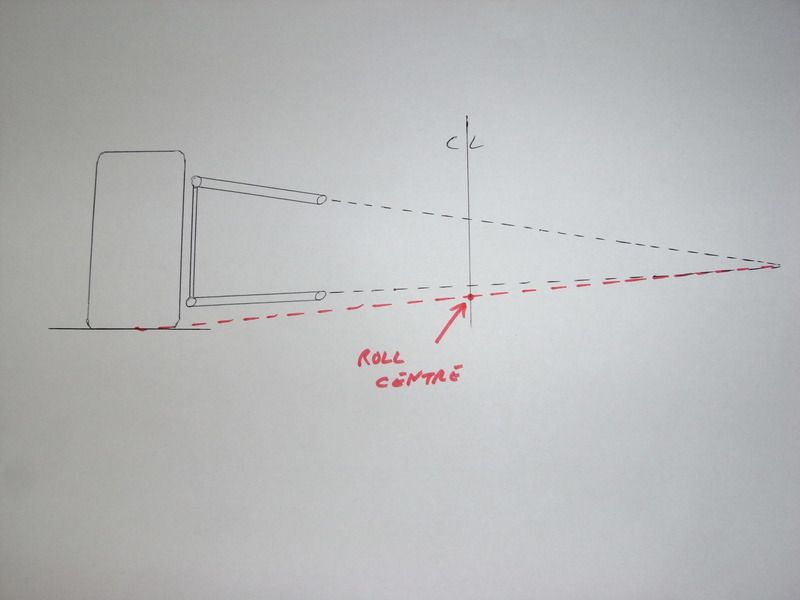
It's a point in space about which the car "rotates" while cornering and is dictated by the geometry of the suspension links. Generally the lower it is the less roll you get. It's tricky to measure, and you can only get a "static" reading. I'm hoping to get it done when the body is off mine and you've got good access to the suspension. I just wondered if anyone had already done it to save me the effort! My idea is to copy or improve the original when I build my new rear suspension (trailing arm model).
Pete
I thought it would be easiest to do a little drawing to explain roll centres:

It's a point in space about which the car "rotates" while cornering and is dictated by the geometry of the suspension links. Generally the lower it is the less roll you get. It's tricky to measure, and you can only get a "static" reading. I'm hoping to get it done when the body is off mine and you've got good access to the suspension. I just wondered if anyone had already done it to save me the effort! My idea is to copy or improve the original when I build my new rear suspension (trailing arm model).
Pete
Gassing Station | Wedges | Top of Page | What's New | My Stuff