
Discussion


I got a set off ebay a couple of years ago that had been breifly fitted to a custom spec engine during a dyno test, they were replaced with higher flow one's to get more power from the reported very highly tuned engine being built? They were fitted to a custom made fuel rail so require the black rubber pipes for connection to a standard rail. If of any interest email with an offer, they don't fit the griff so are no use to me anymore. These are standard 350i injectors that have had the rubber pipes removed, i also have somewhere a set of pipe clips and new seals to fit them.
Edited by dwgriffith on Thursday 13th August 01:38
Mac: you sure you need new injectors are are you looking to replace 'just in case'?
They have to be pretty bad to be unsaveable. I have a few spares if you just need to replace a couple of dribbly/ sticking ones.
I got a set of higher-flowing ones from an Ebay seller, think they were £60 for 8 (new). But as DW says, I had to modify them to fit the earlier fuel rail as they were the O-ring type designed to plug into the hotwire system's rail.
They have to be pretty bad to be unsaveable. I have a few spares if you just need to replace a couple of dribbly/ sticking ones.
I got a set of higher-flowing ones from an Ebay seller, think they were £60 for 8 (new). But as DW says, I had to modify them to fit the earlier fuel rail as they were the O-ring type designed to plug into the hotwire system's rail.
If they standard grey ones? (ballast resistor on nearside wing)use a 1.5V AA battery connected across the two small spade terminals. 1.5V should be high enough to operate as there is no fuel pressure to overcome, they should click when the battery is connected and again when removed if operating. From memory??????? I think the coil resistance is about 2.4 Ohms. Also check them for coil short circuits to earth, i.e. resistance from each teminal to metal part of body should be infinity.
I find this useful:
Identify and remove the Fuel Pump Relay.
Disconnect all 8 injector electrical plugs.
Disconnect the feed hose from the cold start injector and connect the hose to a 0-5 Bar pressure gauge.
Use a wire link across the Fuel Pump Relay socket (pins 30/51 and 87) for a few seconds to prime the Fuel Rail, then disconnect the link.
Disconnect the HT lead between the coil and distributor (at the coil, preferably!).
Once satisfied that the Fuel Rail pressure is holding (ie no leaking injectors), reconnect any ONE injector plug.
Observing the Pressure Gauge, crank the engine. Every time the connected injector fires, the rail pressure will drop a little. Note the trend of the gauge.
Unplug that injector, connect the next one. Re-prime the fuel rail using the wire link.
Repeat, looking for an identical trend on the Pressure Gauge for each injector. No movement of gauge means the injector isn't firing, a significantly larger drop of pressure could indicate an injector that isn't snapping closed as quickly as it should.
Of course you now have lots of fuel lying around in the inlet tracts so once you reconnect everything and turn the key, you'll probably get some rich fumes out of the back
Identify and remove the Fuel Pump Relay.
Disconnect all 8 injector electrical plugs.
Disconnect the feed hose from the cold start injector and connect the hose to a 0-5 Bar pressure gauge.
Use a wire link across the Fuel Pump Relay socket (pins 30/51 and 87) for a few seconds to prime the Fuel Rail, then disconnect the link.
Disconnect the HT lead between the coil and distributor (at the coil, preferably!).
Once satisfied that the Fuel Rail pressure is holding (ie no leaking injectors), reconnect any ONE injector plug.
Observing the Pressure Gauge, crank the engine. Every time the connected injector fires, the rail pressure will drop a little. Note the trend of the gauge.
Unplug that injector, connect the next one. Re-prime the fuel rail using the wire link.
Repeat, looking for an identical trend on the Pressure Gauge for each injector. No movement of gauge means the injector isn't firing, a significantly larger drop of pressure could indicate an injector that isn't snapping closed as quickly as it should.
Of course you now have lots of fuel lying around in the inlet tracts so once you reconnect everything and turn the key, you'll probably get some rich fumes out of the back
If you really want to know whether the injectors have the right spray pattern and flow rate, and aren't leaking, there's no substitute for actually testing them to check the pattern and measure the flow rate. And if you're prepared to spend a couple of hours at it it's not that hard to do.
The simplest way is to take the fuel rail off the engine, leave it plumbed up to the fuel supply system, make up a test harness to power the fuel pump and one injector straight from a 12V supply, and find something to catch the petrol spray (I use a plain old jam jar with a strip of masking tape down the side, let each injector run for a minute and see how much it has produced).
You can quickly see whether the spray patterns are all the same, whether they're all flowing at the same rate and whether any of them leak.
You need to be a bit careful because petrol under pressure is a fire hazard, it would only need a spark in the wrong place to ignite the vapour, but with sensible precautions there's nothing particularly difficult or dangerous about it. That's basically all these flow test rigs are, at the end of the day.
The simplest way is to take the fuel rail off the engine, leave it plumbed up to the fuel supply system, make up a test harness to power the fuel pump and one injector straight from a 12V supply, and find something to catch the petrol spray (I use a plain old jam jar with a strip of masking tape down the side, let each injector run for a minute and see how much it has produced).
You can quickly see whether the spray patterns are all the same, whether they're all flowing at the same rate and whether any of them leak.
You need to be a bit careful because petrol under pressure is a fire hazard, it would only need a spark in the wrong place to ignite the vapour, but with sensible precautions there's nothing particularly difficult or dangerous about it. That's basically all these flow test rigs are, at the end of the day.
tempus said:
153`s are 247cc @three bar,2.4 ohm,157`s are 242cc @3 bar,2.4 ohm,166`s are now XJ6 recomended injectors,hope that confuses matters. 
Hmmm, everything I've seen says that 157s are 214cc/ 2.5Bar ... but yes, low impedance (2.7 Ohms or so). They're the later plug-in design with O-rings, so fitting them to a standard flapper system means some mods to the injectors to allow attachment of rubber fuel hose in order to connect them to the early fuel rail: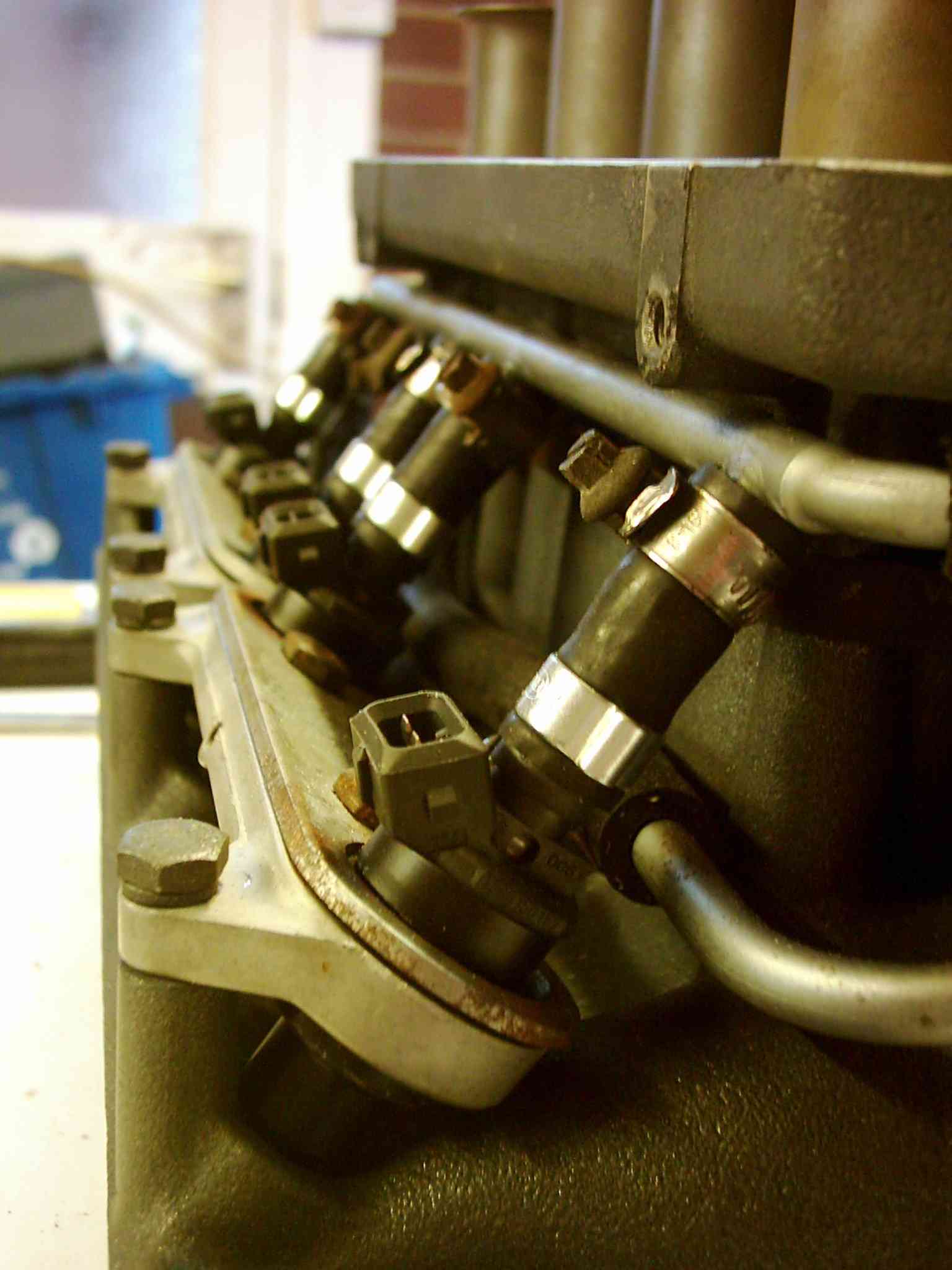
If you can zoom in you can read the part number on the nearest injector...

It is a very confusing issue,Bosch don`t use a volume based flow rate at all,so figures get messed up in conversions,also Bosch don`t use fuel so that adds more confusion,they use a chemical N-Heptane and measure the flow in grammes per minute,everything else is calculated from that,yours will be the later EV-6 injectors so will give a better spray pattern than the earlier "pintle"type EV1 which are more sensitive to operating pressure.your head is making me feel guilty now as I know my hoses need changing
tempus said:
It is a very confusing issue,Bosch don`t use a volume based flow rate at all,so figures get messed up in conversions,also Bosch don`t use fuel so that adds more confusion,they use a chemical N-Heptane and measure the flow in grammes per minute,everything else is calculated from that,yours will be the later EV-6 injectors so will give a better spray pattern than the earlier "pintle"type EV1 which are more sensitive to operating pressure.your head is making me feel guilty now as I know my hoses need changing
In return, I defer to your greater depth of knowledge on the issue I bought an XJS V12 complete fuel rail assembly some years back, thinking that I'd scored some fatter injectors but they turned out to be the same type as used on the RV8. Doh...

Still, I have one and a half engines-worth of spare injectors!
Gassing Station | Wedges | Top of Page | What's New | My Stuff