
Cat d advice please
Discussion


Any advice would be greatly appreciated. For example would you go for a Cat d, what are the pitfalls. Should they be avoided. How does it affect the insurance. I am looking at the yellow Chimaera on ebay. Does anyone on here know the history of this car, any previous owners on here. Can you tell me what you would consider to be the correct price for this car.
Many thanks...
https://www.ebay.co.uk/itm/1997-TVR-Chimaera-4-0/3...
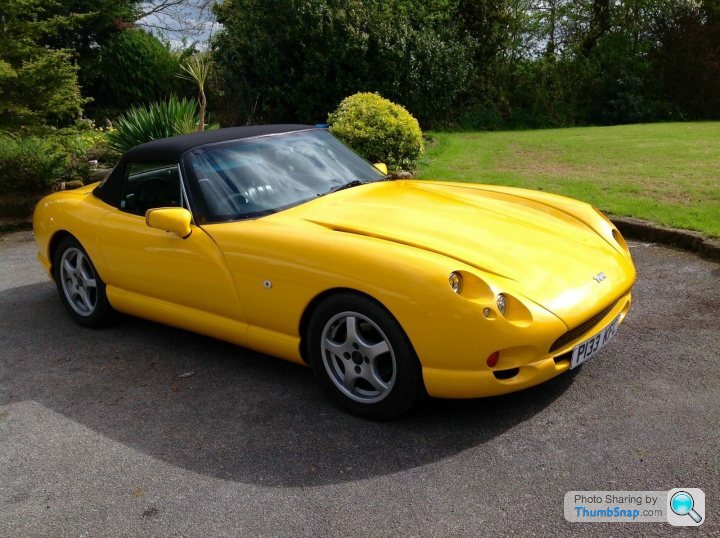
Many thanks...
https://www.ebay.co.uk/itm/1997-TVR-Chimaera-4-0/3...
Personally I would not buy CAT recorded car, even if its CAT D.
Cars are harder to sell and will be considered cheaper compared to non recorded car, there are loads of Chim 400's around so lots of choice.
I would say stress cracks on a Chimaera is not the norm, the body is generally very strong.
Cars are harder to sell and will be considered cheaper compared to non recorded car, there are loads of Chim 400's around so lots of choice.
I would say stress cracks on a Chimaera is not the norm, the body is generally very strong.
As far as you can, check what the damage was and whether the repairs were done properly.
Was it repaired by a known specialist or an enthusiast doing it as a hobby?
If the damage was cosmetic, then as long as it looks OK now you should be OK. Suspension etc is easy to replace. If the chassis was damaged I would avoid unless it had a replacement chassis.
The advantage is that it will be around 10 to 20 % cheaper to buy. The disadvantage is when you come to sell you will get 10 to 20 % less for it. This is simply supply demand and many people wont touch a car that they know has been in an accident.
Your insurance company may ask whether the car has ever been written off, in which case answer honestly. I have never had a problem insuring a cat C or cat D car.
GRP can be expensive to repair and many insurance assessors are scared of spiralling costs. They also know that there is a high salvage value to these cars so if they sell at a salvage auction they will get a fair bit of their "total loss" pay out back. This is safer for them than authorising a repair when they are not sure how much it will cost. Therefore the reality is that many TVRs that involved in anything other than a very minor bump are written off as the insurance assessors cannot easily estimate repair costs like they can on a normal car when they know the price of each panel etc. As long as it was properly repaired then you should have nothing to worry about.
Was it repaired by a known specialist or an enthusiast doing it as a hobby?
If the damage was cosmetic, then as long as it looks OK now you should be OK. Suspension etc is easy to replace. If the chassis was damaged I would avoid unless it had a replacement chassis.
The advantage is that it will be around 10 to 20 % cheaper to buy. The disadvantage is when you come to sell you will get 10 to 20 % less for it. This is simply supply demand and many people wont touch a car that they know has been in an accident.
Your insurance company may ask whether the car has ever been written off, in which case answer honestly. I have never had a problem insuring a cat C or cat D car.
GRP can be expensive to repair and many insurance assessors are scared of spiralling costs. They also know that there is a high salvage value to these cars so if they sell at a salvage auction they will get a fair bit of their "total loss" pay out back. This is safer for them than authorising a repair when they are not sure how much it will cost. Therefore the reality is that many TVRs that involved in anything other than a very minor bump are written off as the insurance assessors cannot easily estimate repair costs like they can on a normal car when they know the price of each panel etc. As long as it was properly repaired then you should have nothing to worry about.
A cat D will most likely not have had chassis damage at least nothing too major. If the price is right and any repair has been done well then all should be good. When you consider the age of these cars and the fact that the majority will have had some fibreglass work, Paint work and rusty chassis repairs anyway buying a Cat D at 20% behind non car D that’s probably had just as much major work done sounds like a bargain. If you know your cars just give it a good check over if you don’t get someone who does but then that goes for all older cars whether categorised or not.
Does look nice in yellow.
Would be a bit more wary of a Cat C as that will most likely have had a chassis bash
Chris
Does look nice in yellow.
Would be a bit more wary of a Cat C as that will most likely have had a chassis bash
Chris
my S1 was a Cat C and took me a while to sort it - including a second hand chassis which apart from outriggers was excellent.
Delve into the history but take all answers with a pinch of salt especially if it looked good from the outside.
My S1 was a total mess inside / chassis etc. but as it had a repaint and a new hood everyone said it was an excellent car.
Still after a great deal of time and effort (not much money) it works fine but interior still a bit wanting.
Delve into the history but take all answers with a pinch of salt especially if it looked good from the outside.
My S1 was a total mess inside / chassis etc. but as it had a repaint and a new hood everyone said it was an excellent car.
Still after a great deal of time and effort (not much money) it works fine but interior still a bit wanting.
personally I would be much much more wary of a car that isn't recorded on an insurance register!!!! 
As with anything. Inspect and buy on condition...... Lots of pitfalls but also lots of advantages, it just depends on how you look at things.....
ALL TVR's are all of an age now where you need to inspect everything carefully then take a view??
Some people run a mile from insurance recorded cars, some see the advantages
Over time the stigma diminishes as the cars history is further documented...
I find it comical that people won't have a Cat S/ N....formerly C/D car but will quite happily purchase something that may have been dragged out of a wet field and restored
N.
As with anything. Inspect and buy on condition...... Lots of pitfalls but also lots of advantages, it just depends on how you look at things.....
ALL TVR's are all of an age now where you need to inspect everything carefully then take a view??
Some people run a mile from insurance recorded cars, some see the advantages
Over time the stigma diminishes as the cars history is further documented...
I find it comical that people won't have a Cat S/ N....formerly C/D car but will quite happily purchase something that may have been dragged out of a wet field and restored
N.
My first TVR was a 400SE and that was a Cat D. It was very cheap to buy, in 1998 I paid £7500 when they were selling for £10,000. It was a great car, never went wrong for the 7 years I owned it and I never even found any signs of the previous damage/repairs.
As above be careful when buying and check and double check everything especially underneath and the chassis etc. Also stand on the brakes on an empty, level (ie no camber), smooth road and make sure it pulls up straight - that is always a good test of chassis, suspension etc being correct and true.
Be careful when you do it though some of the griffs and chims (early 500's mainly) are overbraked at the rear as standard so they can be inclined to try and swap ends unless the front brakes have been upgraded.
As above be careful when buying and check and double check everything especially underneath and the chassis etc. Also stand on the brakes on an empty, level (ie no camber), smooth road and make sure it pulls up straight - that is always a good test of chassis, suspension etc being correct and true.
Be careful when you do it though some of the griffs and chims (early 500's mainly) are overbraked at the rear as standard so they can be inclined to try and swap ends unless the front brakes have been upgraded.
Gassing Station | General TVR Stuff & Gossip | Top of Page | What's New | My Stuff