
How far do you think I can wind it out?
Discussion


I have RS-R suspension fitted to my car and it has adjustable length shockers and also adjustable pre-load.
I am wanting to take off some of the pre-load which means using the c-spanners to move the seat of the coils further down the length of the shocker.
This also has the effect of lowering my ride height, so to couter this I have to lengthen the shocker by winding out more thread at the base.
Please see pics :
Diagrammatic

Photo of shocker base
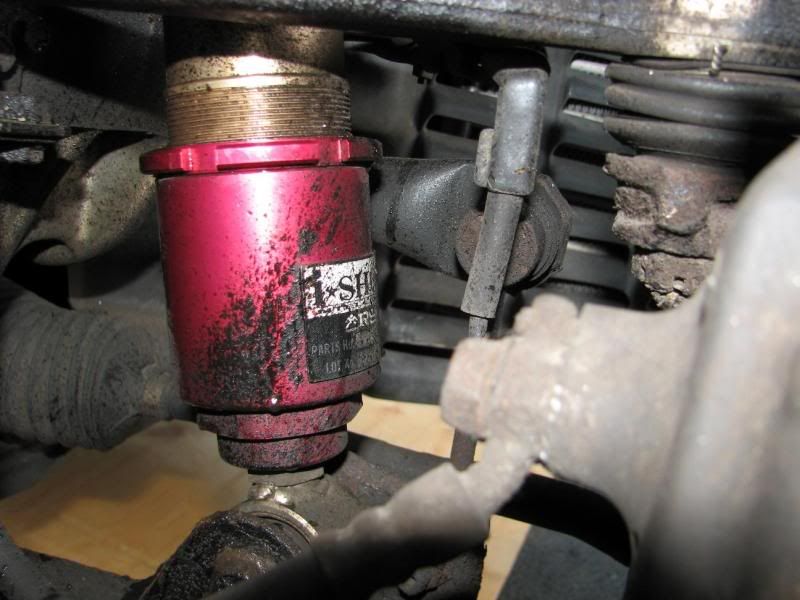
My question is....how far can I wind out the threads from the base??
2nd picture shows maybe a 3rd of the height of the red base depth is already wound out..... in theory should I be able to wind out the full base depth??
Is there usually a safety stop on adjustable suspension to prevent me from winding the base off alltogether?
Any help is muchly appreciated.
I am wanting to take off some of the pre-load which means using the c-spanners to move the seat of the coils further down the length of the shocker.
This also has the effect of lowering my ride height, so to couter this I have to lengthen the shocker by winding out more thread at the base.
Please see pics :
Diagrammatic
Photo of shocker base
My question is....how far can I wind out the threads from the base??
2nd picture shows maybe a 3rd of the height of the red base depth is already wound out..... in theory should I be able to wind out the full base depth??
Is there usually a safety stop on adjustable suspension to prevent me from winding the base off alltogether?
Any help is muchly appreciated.
Edited by AJI on Saturday 2nd May 18:52
I haven't entirely made sense of that diagram, but the legends on it seem non-sensical to me.
I don't see how moving a spring seat up or down is going to change the ride firmness. The only effect I would expect is changing the ride height.
By the same token, both those two adjusters would seem to have the same effect on the ride height. The only difference I can see between them is that one of then affects the position of the bump/droop stops, and the other doesn't.
I don't see how moving a spring seat up or down is going to change the ride firmness. The only effect I would expect is changing the ride height.
By the same token, both those two adjusters would seem to have the same effect on the ride height. The only difference I can see between them is that one of then affects the position of the bump/droop stops, and the other doesn't.
Edited by GreenV8S on Saturday 2nd May 19:07
By changing the ride height, you can easily upset the corner weights, if they had already been set. These are the weights applied to the floor by each spring individually. Imagine a 4 legged chair rocking because one leg is shorter than the others on a level surface. Do some research or get someone with the equipment to assist i.e. either scales or a simple corner weight scale on a very level surface. Do this if you intend using the car aggressively. Good luck.
GreenV8S said:
I don't see how moving a spring seat up or down is going to change the ride firmness. The only effect I would expect is changing the ride height.
Pre-load certainly does affect ride. Whilst it doesn't change the spring rate per se, it adds an offset e.g. with 100kg of pre-load, you have to apply 100kg to the strut before it starts moving.Within the useful range it will affect how compressed the damper is under static conditions. Too much pre-load means the damper is working near the top of it's stroke so you have virtually no rebound movement, too little and it may be in danger of hitting the bump stops frequently.
I wouldn't count on there being any kind of stop to the bottom threads, but if you jack the car up prior to adjusting it then you should be safe to wind it all the way out to check. However, a quick email to info@rs-r.com should get you the required information.
Mr2Mike said:
GreenV8S said:
I don't see how moving a spring seat up or down is going to change the ride firmness. The only effect I would expect is changing the ride height.
Pre-load certainly does affect ride. Whilst it doesn't change the spring rate per se, it adds an offset e.g. with 100kg of pre-load, you have to apply 100kg to the strut before it starts moving.Within the useful range it will affect how compressed the damper is under static conditions. Too much pre-load means the damper is working near the top of it's stroke so you have virtually no rebound movement, too little and it may be in danger of hitting the bump stops frequently.
The suspension I have fitted is for hard track use and as such is very stiff and 'crashy' on the road in its present setting (even with bump and rebound set to full soft).
There is an amount of pre-load on the springs which once wound off would allow the springs to take in more of the bumpy 'a' and 'b' roads.
With most (or all) the pre-load taken off I am 99% sure that there will be no chance of it ever reaching full spring compression... well unless I am getting fully airbourne, which is something I plan NOT to do on public roads !
There is an amount of pre-load on the springs which once wound off would allow the springs to take in more of the bumpy 'a' and 'b' roads.
With most (or all) the pre-load taken off I am 99% sure that there will be no chance of it ever reaching full spring compression... well unless I am getting fully airbourne, which is something I plan NOT to do on public roads !
AJI said:
The suspension I have fitted is for hard track use and as such is very stiff and 'crashy' on the road in its present setting (even with bump and rebound set to full soft).
There is an amount of pre-load on the springs which once wound off would allow the springs to take in more of the bumpy 'a' and 'b' roads.
With most (or all) the pre-load taken off I am 99% sure that there will be no chance of it ever reaching full spring compression... well unless I am getting fully airbourne, which is something I plan NOT to do on public roads !
If you reduce the preload (wind the spring seats down) the spring length at rest will be exactly the same, the stiffness will be exactly the same, the car will just sit lower, which will affect suspension geometry and ground clearance, but won't affect much else unless you start hitting the bump stops. And if you are hitting the stops, everything changes dramatically for the worse.There is an amount of pre-load on the springs which once wound off would allow the springs to take in more of the bumpy 'a' and 'b' roads.
With most (or all) the pre-load taken off I am 99% sure that there will be no chance of it ever reaching full spring compression... well unless I am getting fully airbourne, which is something I plan NOT to do on public roads !
GreenV8S said:
It will only affect the ride if you are hitting the bump / droop stops, which would have a severe effect on the comfort, handling and safety. A properly setup suspension will not hit the end stops in normal use.
And to properly set up the suspension you select the correct spring rate and pre-load...GreenV8S said:
If you reduce the preload (wind the spring seats down) the spring length at rest will be exactly the same..
I think you may be misundferstanding the concept of preload.A fitted spring is normally preloaded to some extent, yes? (ie. even with the damper at full extension, off the car, the spring is still slightly compressed between the upper and lower spring seats).
Fit the sping/damper to the car and gradually lower the car onto its wheel. The spring will not startdeflecting until the amount of weight on it equals the pre-load?
Take an eztreme example: fit 500lb/inch springs and screw up the spring seat so that they are compressed by 2", even with no load on them at all, simply because the spring has been compressed 2" further than the damper will extend.
You now have 2 x 500 = 1,000lbs of preload.
Fit said spring and damper to a 'Seven' with 250lb wiehgt on each corner and the spring will not deflect at all, because the weight imposed on it won't come close to equalling the preload.
Now, I can't make any sense of the diagram above, either, but if you design a damper so that you can screw it in and out to adjust the actyal length between top and bottom mounting eyes at full extension, you can adjust the ride height independently of the preload. Well... semi independently, anyway, because unless there is so much preload that the spring isn't compressed at all when the full weight of the car is sitting on it, the two will remain inter-related.
...or I could be talking complete b
 ks (it happens quite a lot when I'm most of the way through my second bottle of wine of the eveninf).
Apologies for spelling. Tried to correct most of it, but I really can't be arsed any more.

What I mean is, the spring length under load is a constant in practical terms. If you adjust the spring seats to change the preload (spring load at full droop) all you're really doing is changing the ride height. Given the two adjusters shown in the OP's pictures, they both seem to have the same effect of changing the ride height, and I would expect one of them to move relative position of the damper end stops and the other not.
Getting the damper end stops right seems like a good idea so you have the correct working range of bump and droop travel, but unless the vehicle actually runs out of travel and hits the stops I don't see how either of these adjustments are going to affect the ride quality as implied by the OP's post. And if it is hitting the end stops then ride quality and handling are out the window anyway.
Getting the damper end stops right seems like a good idea so you have the correct working range of bump and droop travel, but unless the vehicle actually runs out of travel and hits the stops I don't see how either of these adjustments are going to affect the ride quality as implied by the OP's post. And if it is hitting the end stops then ride quality and handling are out the window anyway.
GreenV8S said:
What I mean is, the spring length under load is a constant in practical terms. If you adjust the spring seats to change the preload (spring load at full droop) all you're really doing is changing the ride height. Given the two adjusters shown in the OP's pictures, they both seem to have the same effect of changing the ride height, and I would expect one of them to move relative position of the damper end stops and the other not.
Getting the damper end stops right seems like a good idea so you have the correct working range of bump and droop travel, but unless the vehicle actually runs out of travel and hits the stops I don't see how either of these adjustments are going to affect the ride quality as implied by the OP's post. And if it is hitting the end stops then ride quality and handling are out the window anyway.
I see where you're coming from; if you've only got the spring seat then adjusting the height of that will certainly ajust sthe ride height, but if you can then correct the rideheight by altering the distance between the top and bottom damper mnounts (ie. effectively changine the length of teh damper itsedlf) then the preload you've put into the springs will iunfluence ride quality and weight transfer.Getting the damper end stops right seems like a good idea so you have the correct working range of bump and droop travel, but unless the vehicle actually runs out of travel and hits the stops I don't see how either of these adjustments are going to affect the ride quality as implied by the OP's post. And if it is hitting the end stops then ride quality and handling are out the window anyway.
Simplistically...
Think about that 1000lb preload example again. If that wheel bounces clear of the road on a bump or a pothole, then the suspension is not gointo start deflecting at all until a 1000lb of force is being fed into it. With no preload, it would start deflecting the instant the wheel came back into contact with the tarmac.
I agree that the OP's diagram makes no sense, though.
eta...
No! Wait! Enlightenment has just emerged through the fog of alcohol, I think!

The 'shocker length control ring' on the OP's diagram screws the whole bottom mounting up and down, thereby lengtheing/shortening the damper. It will, indeed, as it says on the diagram, alter the ride height without (significantly) altering the spring compression (except from the relatively small change in compression on the spring from change in corner weight). You would use the two rings to juggle ride height and preload.
Or something.
Edited by Sam_68 on Tuesday 5th May 22:13
Thanks for the replies so far, it makes interesting reading.
Is it fair to say however, that if I were to take off some of the pre-load that I have on my suspension at current, that it would absorb more of the bumps on the likes of 'b' roads?
I am thinking that I have too much pre-load for the weight of my car at present for use on 'b'/'a' roads as the springs seem unable to 'take in'/absorb the bumps..such as pot holes, higher rised patches of re-surfacing etc. etc.
I have driven the car on a few track days and also the nurburgring and its perfect on a track such as silverstone where it is smooth, it is ok on a track like nurburgring where it is more bumpy... but too crashy over a/b roads here in the uk.
I could go out and buy softer springs, but if its just a case of altering the pre-load then I would like to try this first.
But obviously I'd like to understand what is happening with the pre-load settings, hence this thread.
Is it fair to say however, that if I were to take off some of the pre-load that I have on my suspension at current, that it would absorb more of the bumps on the likes of 'b' roads?
I am thinking that I have too much pre-load for the weight of my car at present for use on 'b'/'a' roads as the springs seem unable to 'take in'/absorb the bumps..such as pot holes, higher rised patches of re-surfacing etc. etc.
I have driven the car on a few track days and also the nurburgring and its perfect on a track such as silverstone where it is smooth, it is ok on a track like nurburgring where it is more bumpy... but too crashy over a/b roads here in the uk.
I could go out and buy softer springs, but if its just a case of altering the pre-load then I would like to try this first.
But obviously I'd like to understand what is happening with the pre-load settings, hence this thread.
Edited by AJI on Wednesday 6th May 13:55
AJI said:
Is it fair to say however, that if I were to take off some of the pre-load that I have on my suspension at current, that it would absorb more of the bumps on the likes of 'b' roads?
Yeah, if you're driving hard, that's a reasonable assumption, I'd say.AJI said:
Just to add.... a spring requires and increasily higher force the further it is compressed.
If pre-load is taken off then smaller forces can be absorbed and as a result the ride is smoother.
Would this be a true statement?
Not sure I understand you correctly, but not necessarily, I don't think.If pre-load is taken off then smaller forces can be absorbed and as a result the ride is smoother.
Would this be a true statement?
You can get rising-rate springs (ie. springs that get stiffer the more you compress them), but normal springs are pretty much linear in rate. They compress so a certain force will compress the spring one inch. Twice that force will compress it 2 inches and so on.
If you have preload, you can say (simplistically) that the spring won't begin to compress until that preload is reached, but once the preload has been reached, the spring's response becomes linear again.
So... say you have 250lb preload. That preload is being 'held' by the damper shaft, in tension. Any load up to 250lb. is only relieving some of the strain on the damper shaft, not actually compressing the spring. But once you reach 250lb, all strain is removed from the damper shaft, which can now compress freely (apart from the designed damping resistance, of course) and the spring begins to compress in a linear fashion.
If there's more weight on the wheel than there is preload in the spring, the preload won't make a blind bit of difference to the ride quality, it's only when the wheel becomes unloaded to the point beyond which the damper shaft is taking a strain that it will become 'harsh', so unless you're running a fairly big preload it'll only be when you're driving hard enough that the wheel is virtually losing contact with the ground that you'll notice a big difference to ride quality.
Edited by Sam_68 on Wednesday 6th May 18:04
Besides what I mentioned earlier on being careful not to upset the corner weight setting, you may consider just lowering the tyre pressures a bit. The amount would depend on your original pressure, and the profile of the tyre. This may be a simple solution to town driving, but still fine for track days by getting the tyre pressure to the required amount. Keep a careful look out for tyre wear, and either adjust pressures accordingly or then take the big step to change spring rates to keep the partner from having chipped teeth. Remember that suspensions are very delicate and precise in high speed handling and small changes can make a big difference to cornering ability and improve or worsen in a particular direction. Good luck with your choice.

Thanks for all the comments and suggestions... they have been most helpful.
I'm going to have a play around with the settings to see what difference it all makes.
I think I got lucky when I set it up originally for the track. But to get a confortable setting for the road is going to be very much trial and error I think.
After reading the replies on here at least I have a better understanding of what is going on and can make a much better educated guess at what to change and by how much.
I'm going to have a play around with the settings to see what difference it all makes.
I think I got lucky when I set it up originally for the track. But to get a confortable setting for the road is going to be very much trial and error I think.
After reading the replies on here at least I have a better understanding of what is going on and can make a much better educated guess at what to change and by how much.
AJI said:
I'm going to have a play around with the settings to see what difference it all makes.
I would strongly suggest that you do NOT mess around with things unless you have the tools and ability to check both the amount of preload on each spring and the corner weight settings. As Espritment suggested earlier, the scope for fking things up good and proper by tinkering at random when you've got that range of adjustment is enormous!Sam_68 said:
AJI said:
I'm going to have a play around with the settings to see what difference it all makes.
I would strongly suggest that you do NOT mess around with things unless you have the tools and ability to check both the amount of preload on each spring and the corner weight settings. As Espritment suggested earlier, the scope for fking things up good and proper by tinkering at random when you've got that range of adjustment is enormous!Its going to be a few months until I'm back on the track so I really need to find a more comfortable road setting.
I won't be driving at any real speed on the roads anyway.
I'm guessing any better setting I can find, even if the corner weights become messed up, will be a safer setting than what is currently on the car for road use.
If its one thing I'm good at is getting a good feel for the car and what its doing...hence why I have been 'successful' at racing. Although in the past I have been removed from the mechanics side of setting up cars. Something which I am now getting much more involved in.
ETA...fully appreciate what you are saying Sam...although I do need to find a softer setting....if it turns out that it is not possible with my current set up then I will purchase some new springs and then take the car to be re-corner weighted and lazer aligned etc.
Edited by AJI on Thursday 7th May 09:05
AJI said:
Well I am measuring the amount of threads turned and also trial and error for feel of the car on the road.
Counting threads won't necessarily work (except to allow you to return to your original settings).Unless you've specifically had them tested and matched, spring rates between individual springs can vary quite a bit, in practice. And, of course, you'll probably have different spring rates front and rear, by design, anyway.
So screwing the spring seats/adjusters up by 5 threads, or whatever, on each corner will not necessarily result in equal effects on corner weigh/preload.
There's only one way to do it, unfortunately, and that's properly.

Gassing Station | Suspension, Brakes & Tyres | Top of Page | What's New | My Stuff