
Machine Polishers - What to use?
Discussion


The paint on my car is in pretty good condition, and i want to keep it that way, and was wondering is a machine polisher is a worthwhile investment as i clean the car most weekends and it seems to take a lot of time. I also have a corsa on which the paint is s t, and would like to get this up to an acceptable standard.
At the moment i am using Halfords shampoo and protecting the paint using Collinite 476s (right number??) and always use microfibre cloths
What would be an acceptable cheap machine polisher to get, and what products, heads etc would i need to clean the car properly. The corsa is my daily banger as well and i would like to experiment possibly using cutting compounds for the paint to get the best finish i can (would be a handy skill to have experience in, and i cant realy make it look worse than the peeling laquer on the roof )
)
I am also looking for a decent shampoo and polish so where would be a good place to start?
Thanks in advance
t, and would like to get this up to an acceptable standard.At the moment i am using Halfords shampoo and protecting the paint using Collinite 476s (right number??) and always use microfibre cloths
What would be an acceptable cheap machine polisher to get, and what products, heads etc would i need to clean the car properly. The corsa is my daily banger as well and i would like to experiment possibly using cutting compounds for the paint to get the best finish i can (would be a handy skill to have experience in, and i cant realy make it look worse than the peeling laquer on the roof
)I am also looking for a decent shampoo and polish so where would be a good place to start?
Thanks in advance
Machine polishing takes time, so go down this route for paint correction not maintenance.
Many beginners get a 'dual action' (DA) random orbital polisher, like the Meguiars G220, yet this is quite an investment for a beginner, being 100-200 GBP in cost. Cyclo polishers are lovely but even more expensive at 2 or 3 times the cost. However, you can get a cheap *rotary* polisher where the head isn't orbital, like a Silverline, for about 40 GBP new on ebay.
The rotary can be more aggressive to the paint, but allows more control in the hands of someone who knows what they are doing. With a bit of practice that could be you

As well as a decent rotary (I wouldn't go less than a Silverline but the sky's the limit above that - I use a Chicago Pneumatic CP8210 which is about 180 GBP and my preferred polisher) you need at least one backing plate (a 3M 125mm one for the correct thread of your machine would be a good start) and a couple of foam pads - one polishing pad, one finishing pad. I wouldn't worry about the heavy duty cutting pads just yet.
Then get a couple of compounds, one polishing, one finishing. Maybe try Menzerna 3.02 Intensive Polish and Menzerna PO85RD Final Finish respectively. There are hundreds of others out there, but these are stalwarts and all you'd really need. Be careful near that peeling lacquer - the machine polisher can't fix that and will just lift more of it. You need to take the loose lacquer off, sand it back to a clean edge, re-lacquer a couple of times, and then only machine polish when it's fully cured.
When using your wax, make sure you polish the surface beforehand. If you machine polish, great. If not, use a hand applied polish like Autoglym SRP or - pardon the plug - Dodo Juice Need for Speed. Shampoo wise, just make sure the Halfords stuff doesn't strip wax due to detergents or a very acidic formulation (pH neutral is the key here). Or you could try the Zymol Auto Bathe (the stuff Halfords sells) which will be fine, or we do a couple of super concentrated pH-neutral shampoos (Dodo Juice Born to be Mild and Dodo Juice Sour Power).
Products you can't find in Halfords can be found online at specialist resellers like cleanyourcar.co.uk, elitecarcare.co.uk, carnaubawaxshop.co.uk, theultimatefinish.co.uk etc.
my advice - unless you are skilled leave the rotary alone
they are excellent tools for a pro but to maintain your own car stick to a dual action - porter cable/udm/megs
with these unless you are a total idiot its virtually impossible to damage paintwork
but get it wrong with a rotary and you can soon burn through the clearcoat etc - and thats from experience having this week had a rear quarter panel resprayed after rotary burn through!!
sadly too many amateur 'detailers' seem to want to progress to a rotary when a dual action will do everything they need - the above post being a reason why when referring to dual action use for 'beginners'
they are excellent tools for a pro but to maintain your own car stick to a dual action - porter cable/udm/megs
with these unless you are a total idiot its virtually impossible to damage paintwork
but get it wrong with a rotary and you can soon burn through the clearcoat etc - and thats from experience having this week had a rear quarter panel resprayed after rotary burn through!!
sadly too many amateur 'detailers' seem to want to progress to a rotary when a dual action will do everything they need - the above post being a reason why when referring to dual action use for 'beginners'
Edited by grand cherokee on Sunday 3rd May 12:18
The only problem is cost of the DA machines vs Rotaries (but then burning through a panel isn't cheap!) and the fact they really struggle to remove swirls quickly with hard paints. The risk of burn through really depends on the paint type and car surface being corrected. Tough german paint on a flat metal panel is less likely to have a strike through than the concave curve of a plastic bumper of a Japanese car... but sure, all machine polishers have their place and uses. I quite like the Cyclo
domster said:
The only problem is cost of the DA machines vs Rotaries (but then burning through a panel isn't cheap!) and the fact they really struggle to remove swirls quickly with hard paints. The risk of burn through really depends on the paint type and car surface being corrected. Tough german paint on a flat metal panel is less likely to have a strike through than the concave curve of a plastic bumper of a Japanese car... but sure, all machine polishers have their place and uses. I quite like the Cyclo
risk of burn through depends on the operator!!i've just had a 'detailer' burn through clearcoat!!
so is it not safer to use the slower but safer UDM type machine?
Edited by grand cherokee on Tuesday 5th May 12:28
The only way to learn is to practise, have a go, practise on your run about or buy a panel from the scrappy before getting stuck into your pride and joy.
Checkout 'detailingworld' web site for lots of advice on machine polishing and paint correction, if you start with a mild cut product ( eg 3M finesse-it) on a polishing head (eg 3M or Farecla)burning through shouldn't be an issue, I've actively tried to burn through and it's not that easy, you've really got to abuse it holding it in one position till the heat builds up, if you keep the machine moving, regularly spray the area your working with water and are extra carefull on edges and swage lines you shouldn't have any problems and soon build in confidence.
The main point is don't be afraid of it, buy a cheap machine and have a go.
Checkout 'detailingworld' web site for lots of advice on machine polishing and paint correction, if you start with a mild cut product ( eg 3M finesse-it) on a polishing head (eg 3M or Farecla)burning through shouldn't be an issue, I've actively tried to burn through and it's not that easy, you've really got to abuse it holding it in one position till the heat builds up, if you keep the machine moving, regularly spray the area your working with water and are extra carefull on edges and swage lines you shouldn't have any problems and soon build in confidence.
The main point is don't be afraid of it, buy a cheap machine and have a go.
grand cherokee said:
risk of burn through depends on the operator!!
i've just had a 'detailer' burn through clearcoat!!
so is it not safer to use the slower but safer UDM type machine?
Compound, pad, machine and paint type all contribute towards the possibility of strike through - as well as the operator. A rotary in cautious hands could be safer than a UDM/DA style machine operated by a gibbon i've just had a 'detailer' burn through clearcoat!!
so is it not safer to use the slower but safer UDM type machine?

Detailers burning through clearcoat... hazard of the profession sadly. But you normally remove 1-2 microns from 40 microns of clear, in a typical example... so that's 20+ machine polishes. It's normally on edges where the paint is thin, places like that, that can catch people out. Rare in the middle of a panel (unless it's plastic).
It is *safer* to use the slower UDM machine, but it may not be better. As I mentioned, the cost of the cheapest UDM/DA style machine can be 2-3x the cost of a cheap rotary. If you ignore the cost, the only issue is that the DA polishers may not be able to tackle very tough paint. You'll be at the panel for hours not doing anything at all. That's safe, but pretty stupid. Grab a rotary, load up a wool pad with some Menz 3.02 and you could sort it in minutes. But it would be dangerous using that technique on a Subaru bumper (unless you like the look of primer).
There is really no need to be afraid of heavy cut polishers, pads and compounds. With a little care and training they can achieve fantastic results very quickly in absolute safety. You just have to start with the finishing pads and fine compounds and work your way up to the heavier duty stuff...
Edited by domster on Tuesday 5th May 23:05
domster said:
grand cherokee said:
risk of burn through depends on the operator!!
i've just had a 'detailer' burn through clearcoat!!
so is it not safer to use the slower but safer UDM type machine?
Compound, pad, machine and paint type all contribute towards the possibility of strike through - as well as the operator. A rotary in cautious hands could be safer than a UDM/DA style machine operated by a gibbon i've just had a 'detailer' burn through clearcoat!!
so is it not safer to use the slower but safer UDM type machine?
Detailers burning through clearcoat... hazard of the profession sadly. But you normally remove 1-2 microns from 40 microns of clear, in a typical example... so that's 20+ machine polishes. It's normally on edges where the paint is thin, places like that, that can catch people out. Rare in the middle of a panel (unless it's plastic).
It is *safer* to use the slower UDM machine, but it may not be better. As I mentioned, the cost of the cheapest UDM/DA style machine can be 2-3x the cost of a cheap rotary. If you ignore the cost, the only issue is that the DA polishers may not be able to tackle very tough paint. You'll be at the panel for hours not doing anything at all. That's safe, but pretty stupid. Grab a rotary, load up a wool pad with some Menz 3.02 and you could sort it in minutes. But it would be dangerous using that technique on a Subaru bumper (unless you like the look of primer).
There is really no need to be afraid of heavy cut polishers, pads and compounds. With a little care and training they can achieve fantastic results very quickly in absolute safety. You just have to start with the finishing pads and fine compounds and work your way up to the heavier duty stuff...
Edited by domster on Tuesday 5th May 23:05
very valid points
domster said:
...Rare in the middle of a panel (unless it's plastic).
Could you elaborate on this? Do you mean fibreglass body panels? I am interested because I have am planning to arm myself with a rotary and a range of polishes and practice on my skoda s**t box, before venturing onto my Cerbera. Obviously one is steel (well, foil!!) and the other is plastic, so if there are specific issues with fiberglass I would love to know before I get in too deep!
Fibreglass is often gelcoat, which is a different finish, but if painted, yes, it can be easier to strike through on a plastic or fibreglass surface. I am not sure of the technical reasons; possibly heat issues or it could be that the paint has to be softer and more flexible on these panels. Not sure, but it is a general rule that seems to apply. And I've seen a bumper being struck through in front of me... the rest of the car didn't pose a problem but the curve of a plastic rear bumper caught the guy out
TVR’s don’t use the gel coat to provide the colour they are painted in the normal way. But extra care should be taken as fibreglass allows the heat to build up quickly and can’t dissipate it very well compared to steel, so it’s a lot easier to seriously damage your paintwork. Build up some technique and confidence on an old panel preferably a plastic bumper or similar.
But before jumping in with the compound and rotary you need to examine the paint work to find out exactly what is required.
By analysing the exact condition of the paint work you can determine the best course of action eg it is often necessary to wet sand RDS prior to using a cutting compound,
also each product as a different level of cut to cope with different situations, the general rule is start with the least abrasive product (you can always change to a stronger product if required)
Using a rotary machine and cutting product is primarily intended to correct specific problems with the paint finish, (holograms, swirl marks, RDS etc) sometimes all that is required to achieve a decent finish is a good claying and hand polish.
But before jumping in with the compound and rotary you need to examine the paint work to find out exactly what is required.
By analysing the exact condition of the paint work you can determine the best course of action eg it is often necessary to wet sand RDS prior to using a cutting compound,
also each product as a different level of cut to cope with different situations, the general rule is start with the least abrasive product (you can always change to a stronger product if required)
Using a rotary machine and cutting product is primarily intended to correct specific problems with the paint finish, (holograms, swirl marks, RDS etc) sometimes all that is required to achieve a decent finish is a good claying and hand polish.
Thanks for the info chaps. Much appreciated.
My practice car has some rather nasty overspray of white stonechip paint on a dark green car which I suspect will require a touch more brutality than the TVR.
On the Crebera I have already gone down the route of washing, claying, hand polishing (AG SRP) and waxing (Megs Gold Class) and still have holograms in the clearcoat that I am hoping to do something about. There are a few RDSs most of which have reduced quite nicely by hand with Scratch-X.
There are also one or two areas of slight orange peel that I would guess could theoreticaly be wet sanded, but that feels rather like diving in at the deep end!
My practice car has some rather nasty overspray of white stonechip paint on a dark green car which I suspect will require a touch more brutality than the TVR.
On the Crebera I have already gone down the route of washing, claying, hand polishing (AG SRP) and waxing (Megs Gold Class) and still have holograms in the clearcoat that I am hoping to do something about. There are a few RDSs most of which have reduced quite nicely by hand with Scratch-X.
There are also one or two areas of slight orange peel that I would guess could theoreticaly be wet sanded, but that feels rather like diving in at the deep end!
Tanguero said:
Thanks for the info chaps. Much appreciated.
My practice car has some rather nasty overspray of white stonechip paint on a dark green car which I suspect will require a touch more brutality than the TVR.
On the Crebera I have already gone down the route of washing, claying, hand polishing (AG SRP) and waxing (Megs Gold Class) and still have holograms in the clearcoat that I am hoping to do something about. There are a few RDSs most of which have reduced quite nicely by hand with Scratch-X.
There are also one or two areas of slight orange peel that I would guess could theoreticaly be wet sanded, but that feels rather like diving in at the deep end!
To achieve the desired results you’ll need several different products, as with most things you get what you pay for, that said unless you planning to go into the detailing business I wouldn’t bother splashing out on a professional rotary like a Makita or similar, expect to pay £30 -£50 for a cheap but adequate mode, you will often find hem bundled with a set of cheap polishing/cutting heads which are great for practising. When choosing a rotary buy a full size model and ensure it as the following basic features, m14x2 male thread (UK & EU industry std for backing plates mops etc Yanks use 5/8UNC), motor size of around 1200w it should be soft start and speed variable (aprox 800-3000rpm) there’s plenty on ebay under various brand names.My practice car has some rather nasty overspray of white stonechip paint on a dark green car which I suspect will require a touch more brutality than the TVR.
On the Crebera I have already gone down the route of washing, claying, hand polishing (AG SRP) and waxing (Megs Gold Class) and still have holograms in the clearcoat that I am hoping to do something about. There are a few RDSs most of which have reduced quite nicely by hand with Scratch-X.
There are also one or two areas of slight orange peel that I would guess could theoreticaly be wet sanded, but that feels rather like diving in at the deep end!
If you get a polisher bundled with mops etc these are great for practise, if not buy a cheap pack of polishing heads (these are foam on a fixed backing plate usually available in white/blue/pink the colour shows it’s type cut>polish ) another one for ebay.
You now have almost everything you need to begin working on that finish, the final item is your refinishing product, there are literally 100s available, which is best is largely down to personal preference but I’d recommend Farecla G3 as a multi purpose re-finishing product. (although be careful if using it on the TVR 3M finesse-it would be more suitable).
There are plenty of specialist websites selling a huge range of detailing products and this is undoubtedly the easiest way to buy (I’d avoid Halfrauds and the like they don’t usually carry sufficient range) but my advise would be to find a local motor factors that supply to local paint shops they will carry a range of professional products from respected manufacturers like 3M, Farecla etc plus they are generally a lot cheaper then other outlets due to supplying to the trade, to keep costs down buy ½ litre bottles until you find a product that suits you and your needs.
Ask to look at the trade product brochures, the Farecla one is excellent detailing each product, it’s uses and even a basic step by step guide on how to use it.
Once you’ve practised using the different grade cheap mops on a donor panel or your run about you’ll need a proper flexible backing plate I use the 3M 125mm Perfect-it backing plate with different grade pads from 3M and Farecla, of all the backing plates I’ve used this is easily the best, the backing plate has a hook and loop (Velcro) surface to allow rapid pad changes, pads come in all shapes and sizes (thick, thin, smooth, dimpled etc) for the TVR choose a soft polishing pad (3M waffle pad is perfect) used with 3M finesse-it for initial paint rectification other products and pads can be used if required.
I’ve recommend a few products that I find work for me as a pro valeter /detailer, but there’s a massive range out there, to find out what other people use register on detailingworld website, using the forum describe your paint problem and ask for recommendations,
You may be surprised at the amount of different product recommended, people swear by certain products and hate others, there’s a wealth of experience on there and good advise is very forthcoming and is a great help for wading through the morass of products available, trail and error is the only way to find a product that suits you and your needs but you should be able to come up with a short list of highly recommended products.
Once you’ve got that perfect finish you’ll need a decent sealant/polish/wax to protect it , now that subject is even more interesting and much debated, IMHO you can’t go for wrong with Collinite 476/915 as a FSP but I’m sure someone will come up with another choice.
Hope this helps
Edited by budd on Thursday 7th May 12:19
Brilliant  thanks for all your answers
I think the way i will go about it is get a cheap rotary package from ebay as described above and have a crack at playing around with the runabout. The paint on that is far worse and it really doesnt matter if it goes tits up then.
The TVR one has a few minor scratches and minimal swirling, but has quite a bit of orange peel. I will make sure that i am really confident with the polisher before working on that though.
Will log onto detailing world and have a look
PS i already use Collinite 476 So im off to a good start it seems
thanks for all your answersI think the way i will go about it is get a cheap rotary package from ebay as described above and have a crack at playing around with the runabout. The paint on that is far worse and it really doesnt matter if it goes tits up then.
The TVR one has a few minor scratches and minimal swirling, but has quite a bit of orange peel. I will make sure that i am really confident with the polisher before working on that though.
Will log onto detailing world and have a look
PS i already use Collinite 476
So im off to a good start it seemsbrakedust said:
Keep us posted on what you get and how you get on with it, I want one to do my TVR as well!
dont press to hard while wet sanding or this can happen 
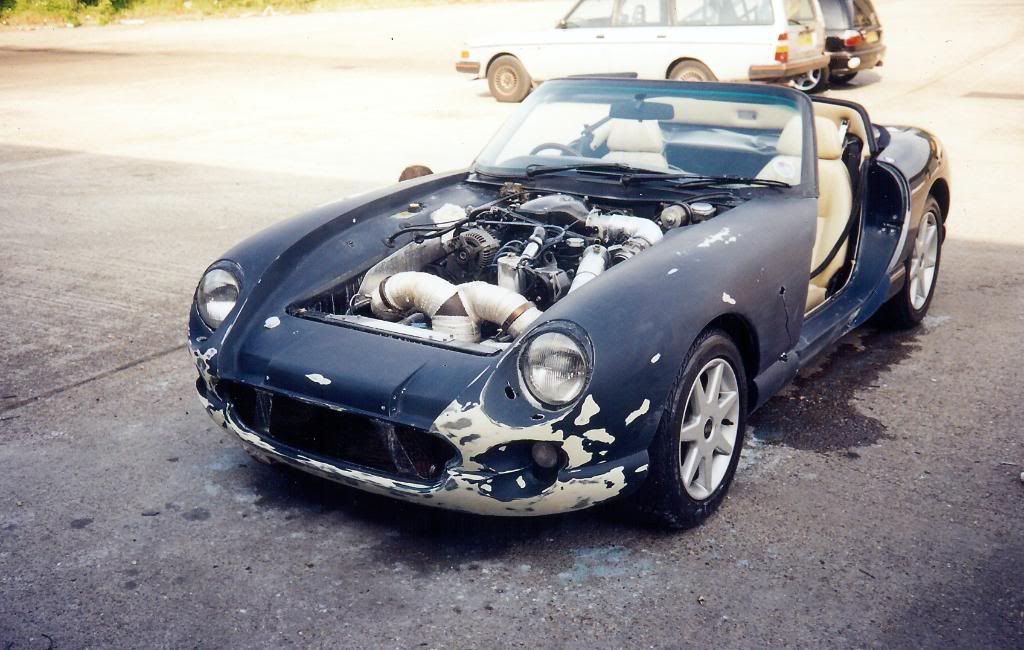
sorry could not resist
Wet sanding and machine polishing a TVR can be actually slightly easier than a family car just because of the lack of mouldings , egdes , door handles, locks and no crease lines in the panels .
The main thing is to know how much paint (laquer) you have to play with ,then be more carefull with any machine polishing due to the heat bulid up due to the fact fibreglass body can not dispurse the heat like on metal body's and be very carefull of the bonnet which is very thin and light weight .
OK, just had a look on ebay and the first thing that caught my eye was this:
http://cgi.ebay.co.uk/3-In-1-CAR-POLISHER-BUFFER-S...
What does everyone think? Good value as a starter?
http://cgi.ebay.co.uk/3-In-1-CAR-POLISHER-BUFFER-S...
What does everyone think? Good value as a starter?
Gassing Station | Bodywork & Detailing | Top of Page | What's New | My Stuff