
SAAB front drive arrangement
Discussion


SAABs in the 1950/60s were excellent rally cars winning many races. The coil springs all around helped but front wheel drive was the key. The Mini is supposed to have perfected front wheel drive in introducing the constant velocity joints. So what did SAAB use in their front drive arrangement? Anyone know?
Pothole said:
They used these, it seems:

Interesting. Judging by the part number that is a part for the 90s Saab 9-2 rather than the 50s Saab 92. Still, if my memory from ,er 40 years ago, is correct the drive shaft of a 60s Saab 96 looked similar, so perhaps it goes right back to the 50s.!RayTay said:
SAABs in the 1950/60s were excellent rally cars winning many races. The coil springs all around helped but front wheel drive was the key. The Mini is supposed to have perfected front wheel drive in introducing the constant velocity joints. So what did SAAB use in their front drive arrangement? Anyone know?
You have to remember the SAAB wasn't transverse engine, it was longitudinally mounted with the gearbox ahead of the engine, [edit: engine ahead of the gearbox I should have written  ] and thus has equal length driveshafts.
 The early ones also were 3 cyl, 2-strokes as well, which added to the driving fun. Worth googling Erik Carlsson's writings on rally the 2-strokes back in the day.
Edited by aeropilot on Friday 7th December 10:07
aeropilot said:
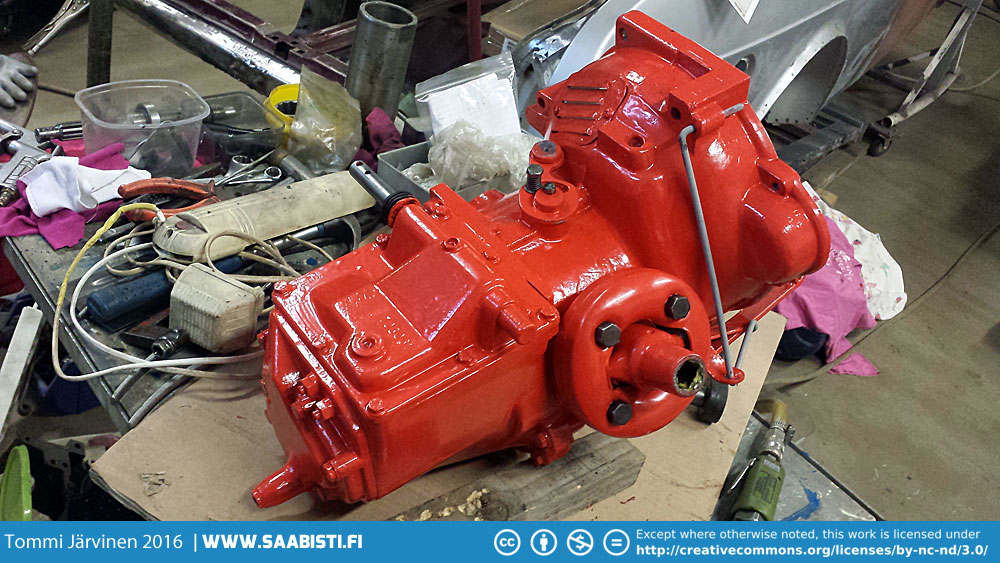
Here's a 2-stroke Saab gearbox, any help?
No.aeropilot said:
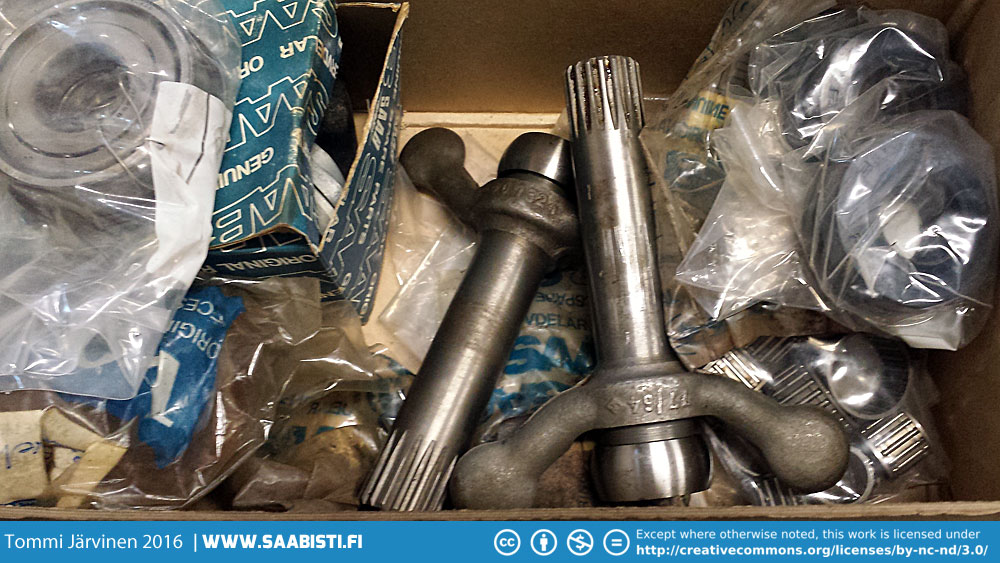
And inner drive shafts
Getting better. Did it have some sort of CV joint, or simple UV joints at the wheels? Front wheel drive was always a problem, look a Citroen's early efforts of slanting wheels. CV joints, on the Mini, sorted it all. SAAB never had them - I believe. What disadvantage did the SAAB have in their front wheel drive?Edited by RayTay on Friday 7th December 11:46
RayTay said:
SAABs in the 1950/60s were excellent rally cars winning many races. The coil springs all around helped but front wheel drive was the key. The Mini is supposed to have perfected front wheel drive in introducing the constant velocity joints. So what did SAAB use in their front drive arrangement? Anyone know?
I am intrigued by your assertion that "front wheel drive was the key." Is that the case? There are lots of things that make a rally car effective. There are plenty of successful rear drivers. Escorts weren't too shabby.
Even if FWD is the key, CV joints aren't that crucial (IMHO) for a rally car. If they replace UJ, I would have thought it was more about NVH.
Edited by OverSteery on Friday 7th December 12:41

aeropilot said:
This is the setup of the later V4 engine 96?
So UJ inboard and something hidden in a boot outboard!Another things with the 2 strokes was a freewheel, so on engine braking - a friend navigated in a 2 stroke on an alpine rally a few years ago and said going uphill was fine but going downhill was terrifying - drum brakes, freewheel and Alpine descents don't go well together!
OverSteery said:
RayTay said:
SAABs in the 1950/60s were excellent rally cars winning many races. The coil springs all around helped but front wheel drive was the key. The Mini is supposed to have perfected front wheel drive in introducing the constant velocity joints. So what did SAAB use in their front drive arrangement? Anyone know?
I am intrigued by your assertion that "front wheel drive was the key." Is that the case? There are lots of things that make a rally car effective. There are plenty of successful rear drivers. Escorts weren't to shabby.
I am not entering into rear v front drive. Front drive cars were a cludge, look at the Citroen's arrangement. On the wheels the Mini had CV joints which took FWD up a level. Yet with FWD arrangement prior to the Mini the SAAB was excellent on ice, snow, winding roads, etc. What did they have at the wheels? Simple UJs? What? Why was this car so good at handling using FWD with a supposed lesser setup?
RayTay said:
I am not entering into rear v front drive. Front drive cars were a cludge, look at the Citroen's arrangement. On the wheels the Mini had CV joints which took FWD up a level. Yet with FWD arrangement prior to the Mini the SAAB was excellent on ice, snow, winding roads, etc. What did they have at the wheels? Simple UJs? What? Why was this car so good at handling using FWD with a supposed lesser setup?
I'm not talking about front or rear wheel drive as such, but where the engine is located relative to the driven wheels. What I'm saying is that incremental advantage can be bought in suspension and technologies but it could easily be the case that the significant portion of the Saab's advantage was down to weight, and weight distribution.
I have spent much of this year around historic formula juniors from the mid to late 50s into the 60s. There is an eclectic mix of designs especially in the suspension design- but the cars in this series can be neatly divided into two distinct categories: Cars made before the rear engine revolution, and cars made after. For all of the variation in suspension, brakes, transmissions, engines etc, the location of the engine / weight distribution is the biggest performance differentiator.
RayTay said:
I am not entering into rear v front drive. Front drive cars were a cludge, look at the Citroen's arrangement. On the wheels the Mini had CV joints which took FWD up a level. Yet with FWD arrangement prior to the Mini the SAAB was excellent on ice, snow, winding roads, etc. What did they have at the wheels? Simple UJs? What? Why was this car so good at handling using FWD with a supposed lesser setup?
Part in bold: I don't know the answer, but the photos pretty clearly show inboard UJs. Therefore, to maintain a broadly constant velocity of the wheels, they would also need UJs, offset at 90deg. The shaft wont spin at constant speed, but the wheels will. With an inboard UJ, I cant see any other way.Gassing Station | Classic Cars and Yesterday's Heroes | Top of Page | What's New | My Stuff