
Discussion


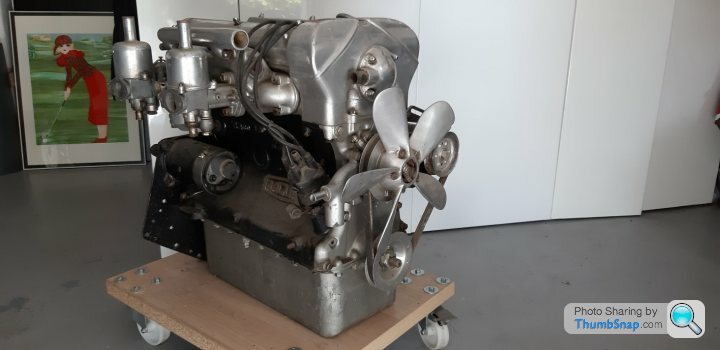

There were two versions in the early stages. One was 1750cc but was quickly dropped. The second was this 2 litre version. I am not sure of the measurements internally, but 2 litres isn't 2/3rds of 3.4 litres so I guess not. I believe mine dates from 1943, but I need to do more research. As regards usage, it hasn't turned in anger for probably 30 years, so it'll get all polished up and sit in the lounge on a stand. It is a curiosity, but part of Jaguar's heritage so important in its way. One interesting fact though is that the cylinder head was based on the 328 BMW.

Yes, 2 litres is not 2/3rds of 3.4, but at the time of the 2 litre engine, isn't it the case that the (projected) 3.4 wasn't 3.4 either, but 3.0 or 3.2, depending on who you believe?
Seriously, it's a fabulous find. Assuming the internals make it at all maintainable, I'd be very tempted to put it into some sort of streamlined MG.
On that last point, perhaps that's what MG really needed in the late 1950s and later, a really beautiful twin OHC 2 litre. If only ...
Seriously, it's a fabulous find. Assuming the internals make it at all maintainable, I'd be very tempted to put it into some sort of streamlined MG.
On that last point, perhaps that's what MG really needed in the late 1950s and later, a really beautiful twin OHC 2 litre. If only ...
Here is the Jaguar Heritage version of events:-
https://www.jaguarheritage.com/jaguar-history/jagu...
Also, you can find this too, which explains the first six cylinder and later the final 3442cc design:-
"A six-cylinder version of the XK engine was also developed, initially with a bore and stroke of 83 x 98 mm for a capacity of 3,181 cc. This was run for the first time on 15 September 1947 giving a power output of 142 bhp at 5,000 rpm. The six-cylinder layout proved better and smoother than the four cylinder and development work concentrated on this version. The 3.2 litre six-cylinder engine offered no increase in power over the 3.5 litre pushrod engine that was already in use by Jaguar. The stroke was lengthened to 106 mm to give a swept volume of 3,442 cc and power increased to 160 bhp at 5,000 rpm. Jaguar now had a smooth-running, six-cylinder, double overhead camshaft (DOHC) engine and this was put into production."
https://www.jaguarheritage.com/jaguar-history/jagu...
Also, you can find this too, which explains the first six cylinder and later the final 3442cc design:-
"A six-cylinder version of the XK engine was also developed, initially with a bore and stroke of 83 x 98 mm for a capacity of 3,181 cc. This was run for the first time on 15 September 1947 giving a power output of 142 bhp at 5,000 rpm. The six-cylinder layout proved better and smoother than the four cylinder and development work concentrated on this version. The 3.2 litre six-cylinder engine offered no increase in power over the 3.5 litre pushrod engine that was already in use by Jaguar. The stroke was lengthened to 106 mm to give a swept volume of 3,442 cc and power increased to 160 bhp at 5,000 rpm. Jaguar now had a smooth-running, six-cylinder, double overhead camshaft (DOHC) engine and this was put into production."
Edited by lowdrag on Thursday 4th June 14:37


LotusOmega375D said:
Wow great find! Can you imagine Jaguar putting a 2 litre 4 pot in one of their sports cars nowadays?
Oh, hang on a minute...
I agree wholeheartedly. I am now confused as to whether to put it in an X-type, an XF, or an MG. I thought of midget racing it in view of my height too.Oh, hang on a minute...
Gassing Station | Classic Cars and Yesterday's Heroes | Top of Page | What's New | My Stuff