
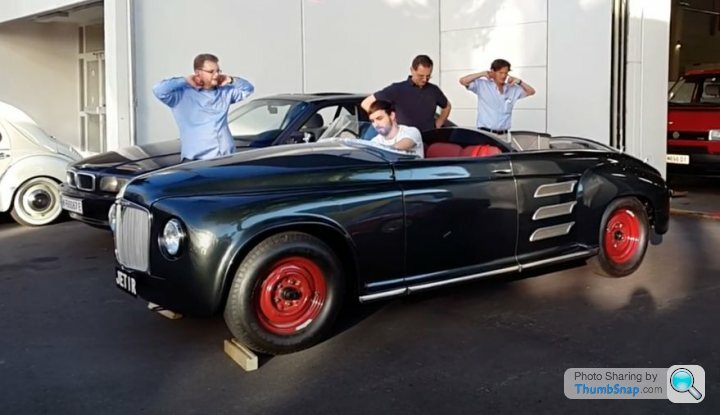
Amazing working replica of the Rover JET 1 turbine car
Discussion



anonymous said:
[redacted]
Indeed, although that was the smaller single shaft version.The bigger twin shaft version this guy has used was used as the APU in the Nimrod and the HS748 (which was operated by the RAAF so I presume this is where the reference in the article regarding Australian military jet comes from, although its a bit of a stretch to regard a HS748 as a military jet
 )
)
tapkaJohnD said:
I don't undestand how a turbine revving at a laarge fraction of 100,000rpm, can drive road wheels!
a VERY tiny drive cog and VERY large driven??
The turbine revs were about 30,000 max. and it was geared down by a 7.55:1 reduction gear and thence to the diff. There was no need for a conventional multi-speed gearbox as the gas turbine produced plenty of torque at low revs.a VERY tiny drive cog and VERY large driven??
I guess it must be. No need for a gearbox so just reduction gears feeding reduction gears.
Rover really were something back then. Jet engine prototype, even a le mans racer with a jet engine, P6 with engine bay big enough for the planned jet engine... cars for Prime Ministers, Queen, Queen Mum, ...a company offering a 3.5 litre V8 in a saloon car when most had 4 cylinders and 2 litres, (or 6 if they were rally posh), and the basis of the Repco V8 which won 2 F1 world championships...and in the other wide of the factory Land Rover and then Range Rover...
I cant think of any car manufacturer wich a back cataogue so varied, bold and imaginative
We all know what happened. Its just such a shame they let it happen
Rover really were something back then. Jet engine prototype, even a le mans racer with a jet engine, P6 with engine bay big enough for the planned jet engine... cars for Prime Ministers, Queen, Queen Mum, ...a company offering a 3.5 litre V8 in a saloon car when most had 4 cylinders and 2 litres, (or 6 if they were rally posh), and the basis of the Repco V8 which won 2 F1 world championships...and in the other wide of the factory Land Rover and then Range Rover...
I cant think of any car manufacturer wich a back cataogue so varied, bold and imaginative
We all know what happened. Its just such a shame they let it happen
mph said:
...the gas turbine produced plenty of torque at low revs.
Well, sort of.Acceleration (and even worse, throttle lag) was always one of their weak points. The original version of Jet 1 (as replicated above) took 14 seconds 0-60, though in fairness that wasn't embarrassingly slow by the standards of the time.
Even the Rover BRM that ran at Le Mans could only manage 0-60 in 11.3 seconds, though.
Interesting period road test of the latter HERE

The original version of JET 1 was detuned to around 100hp, it was later allowed to develop 230hp.
This was the version that was officially timed at over 150mph, not bad for an old "Aunty" Rover.
As a previous poster has mentioned, Rover produced some unique vehicles and had some interesting developments in the pipeline - a mid-engined sports car for one. The prototype still exists.
This was the version that was officially timed at over 150mph, not bad for an old "Aunty" Rover.
As a previous poster has mentioned, Rover produced some unique vehicles and had some interesting developments in the pipeline - a mid-engined sports car for one. The prototype still exists.
mph said:
Rover produced some unique vehicles and had some interesting developments in the pipeline - a mid-engined sports car for one. The prototype still exists.
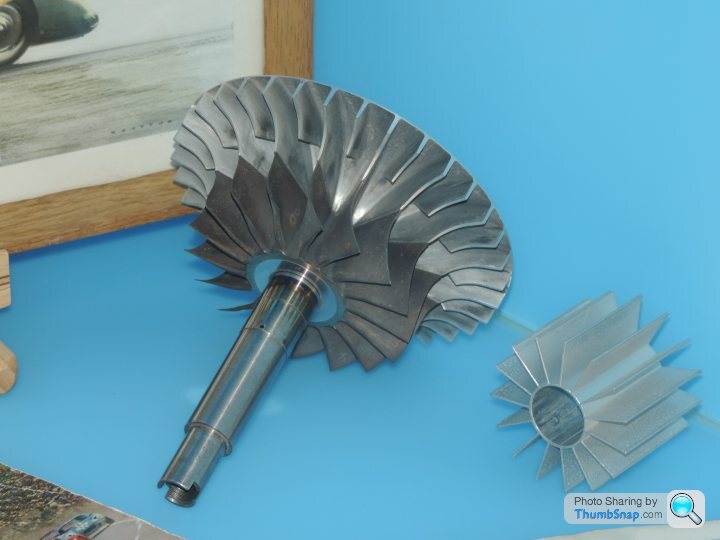
...and can be seen directly alongside the Rover BRM and an example of the gas turbine engine at Gaydon (which is where I took the photo of the compressor, above). Well worth a visit, when it shortly reopens after Covid.williamp said:
I guess it must be. No need for a gearbox so just reduction gears feeding reduction gears.
JET 1 used a twin-shaft system, where there was a power turbine in the exhaust tract of the proper 'jet engine' section. Exhaust gases flowed over the exhaust turbine (driving the compressor) and then over the power turbine, which was mechanically geared to the rest of the transmission. But there was no physical connection between the two turbines. That allowed the gas-producing section to turn at whatever RPM it needed depending on throttle position, while the power turbine (or, more accurately, the air gap between it and the exhaust turbine) served as a fluid flywheel so torque could still be applied to the transmission even if the transmission was stationary. williamp said:
Rover really were something back then. Jet engine prototype, even a le mans racer with a jet engine, P6 with engine bay big enough for the planned jet engine... cars for Prime Ministers, Queen, Queen Mum, ...a company offering a 3.5 litre V8 in a saloon car when most had 4 cylinders and 2 litres, (or 6 if they were rally posh), and the basis of the Repco V8 which won 2 F1 world championships...and in the other wide of the factory Land Rover and then Range Rover...
I cant think of any car manufacturer wich a back cataogue so varied, bold and imaginative
We all know what happened. Its just such a shame they let it happen
It really is a shame to consider Rover's model plan for the 1970s and consider what might have been - they had the new Range Rover, they had the P9 mid-engined sports car (which existed in prototype P6BS form), they had the replacement for the P5 which was the P8, which was also prototyped and was effectively an enlarged and modernised P6. The P6 itself was intended for replacement with a new generation reflecting the updates made in the P8. And there was Project One-Eleven which would produce an all-new Land Rover based on Range Rover drivetrain and suspension technology - effectively a Defender (but slightly larger) around a decade ahead of reality. Rover were also looking at four- and five-cylinder turbodiesels for the 4x4s. They'd played around with a P6 with hydropneumatic active anti-roll suspension. And the gas turbine work was continuing too, although I can see that being halted post-Energy Crisis. I cant think of any car manufacturer wich a back cataogue so varied, bold and imaginative
We all know what happened. Its just such a shame they let it happen
So you'd have:
1) Highly advanced executive saloon (I4, V8, poss turbine)
2) Highly advanced luxury saloon (I6, V8, poss. turbine)
3) Mid-engined three-seater sports car (V8)
4) Utility 4x4 (I4, I4D, I5D, I6, V8)
5) SUV 4x4 (V8, poss. I5D and I6)
That's quite a compelling line-up. It's a shame that even before the BL crisis properly hit the build quality had declined massively due to labour problems at Solihull and issues in the supply chain. And I suspect that in a post-Energy Crisis world, and with the rise of the Japanese 4x4s, Rover simply wouldn't have the financial or production clout to stay on top of things. It was too small a firm to really survive in the age of giant trans-national giants.
Didn't BRM build one as well? or was it Rover.I do remember reader a quote rom Graham Hill about driving it ( or similar) He said the engine lag was that slow, as he as approaching a corner and commenced braking, he already had his accelerator hard to the floor, so when he hit the apex and exiting power was coming on
silverfoxcc said:
Didn't BRM build one as well? or was it Rover.I do remember reader a quote rom Graham Hill about driving it ( or similar) He said the engine lag was that slow, as he as approaching a corner and commenced braking, he already had his accelerator hard to the floor, so when he hit the apex and exiting power was coming on
BRM built cars for Le Mans with Rover gas turbine (NOT jet engine, please) power. They were driven by BRM's current GP drivers, Graham Hill and Ritchie Ginther in 1963 and Graham Hill/Jackie Stewart in '64 and '65silverfoxcc said:
Didn't BRM build one as well? or was it Rover.
It was usually referred to as the Rover-BRM.See my post above, which includes a link to a period road test of it.
RESSE said:
Spotted this a couple of years ago:


The thing I love about JET 1 is the juxtaposition of the very staid, dumpy 'aunty' Rover body styling with the aeroscreen and the aviation-style bank of instrumentation on the dashboard. Very British, very 1950's... it needs a silver painted Gloster Meteor in the background!Gassing Station | Classic Cars and Yesterday's Heroes | Top of Page | What's New | My Stuff