
Vintage car wisdom
Discussion


Purely as a little bit of fun I noted the following advise contained within my ‘Drivers Handbook’
A list of don’ts, please don’t amongst others were :
Be cruel to the starter if the engine will not fire.
Make a fast run with the radiator muff down.
Also in the descriptive list of the cars attributes :
Single dry plate clutch type which proves very sweet in action.
Care of the coachwork :
remove any grease or tar splashes with petrol.
don’t use the same sponge and cleaning cloths used for the chassis and springs or any other greasy parts as are used for the coachwork.
I’m sure some of you must also have some hidden gems ripe for ‘re- publication’
Good indications of just how things have changed over the past 80 years or so!
A list of don’ts, please don’t amongst others were :
Be cruel to the starter if the engine will not fire.
Make a fast run with the radiator muff down.
Also in the descriptive list of the cars attributes :
Single dry plate clutch type which proves very sweet in action.
Care of the coachwork :
remove any grease or tar splashes with petrol.
don’t use the same sponge and cleaning cloths used for the chassis and springs or any other greasy parts as are used for the coachwork.
I’m sure some of you must also have some hidden gems ripe for ‘re- publication’
Good indications of just how things have changed over the past 80 years or so!
I'm an archaeologist, and also do stuff like recording historic buildings. One thing often overlooked that I think needs a study made of is the private motor garage. When cars were first introduced you simply had to have a garage, cars were put away every night and had to have the coolant drained if it was freezing, as antifreeze wasn't developed until the 1920s. They also used to jack the car up to take the weight off the axles and prevent damage to the tyres.
warch said:
I'm an archaeologist, and also do stuff like recording historic buildings. One thing often overlooked that I think needs a study made of is the private motor garage. When cars were first introduced you simply had to have a garage, cars were put away every night and had to have the coolant drained if it was freezing, as antifreeze wasn't developed until the 1920s. They also used to jack the car up to take the weight off the axles and prevent damage to the tyres.
Indeed. Motor houses should be recognised and protected.Regarding Lighting - "For ordinary starlight or moonlight nights two good paraffin lamps are all that is necessary for a car that travels at less than thirty miles an hour "
Regarding Horns - "my only advice is that you should have a connection from the exhaust pipe led into a small reservoir and thence into the horn, so that on turning a tap a prolonged hoot will be emitted. And I hope you will be heard and seen of the police"
On other accessories - " a good carriage clock is a necessity, while a gradometer, for measuring gradients over which car is travelling is a rather interesting accessory to a touring car. " .... "there are "speedometers " now made which I believe are very accurate and trustworthy in recording in miles per hour the rate at which the car is travelling ; but I doubt whether they give much pleasure to the average owner of a car "
Excerpts taken from The " Complete Motorist" published 1904.
Regarding Horns - "my only advice is that you should have a connection from the exhaust pipe led into a small reservoir and thence into the horn, so that on turning a tap a prolonged hoot will be emitted. And I hope you will be heard and seen of the police"
On other accessories - " a good carriage clock is a necessity, while a gradometer, for measuring gradients over which car is travelling is a rather interesting accessory to a touring car. " .... "there are "speedometers " now made which I believe are very accurate and trustworthy in recording in miles per hour the rate at which the car is travelling ; but I doubt whether they give much pleasure to the average owner of a car "
Excerpts taken from The " Complete Motorist" published 1904.
warch said:
I'm an archaeologist, and also do stuff like recording historic buildings. One thing often overlooked that I think needs a study made of is the private motor garage. When cars were first introduced you simply had to have a garage, cars were put away every night and had to have the coolant drained if it was freezing, as antifreeze wasn't developed until the 1920s. They also used to jack the car up to take the weight off the axles and prevent damage to the tyres.
Can I recommend the 2012 book "Carscapes" by Kathryn A. Morrison and John Minnis? It deals with all architecture for the motor vehicle so chapter headings for Part 1 (The Life Cycle of the Car) areMaking Cars
Selling Cars
Keeping the Car at Home
Maintaining the Car
Filling Up
Parking 1896-1939
Parking since 1945
Scrapping the Car
Part 2 is "Driving around" - interesting but not for this thread.
warch said:
I'm an archaeologist, and also do stuff like recording historic buildings. One thing often overlooked that I think needs a study made of is the private motor garage. When cars were first introduced you simply had to have a garage, cars were put away every night and had to have the coolant drained if it was freezing, as antifreeze wasn't developed until the 1920s. They also used to jack the car up to take the weight off the axles and prevent damage to the tyres.
I have what I believe is a "motor house". The property was built in 1901,by a local developer for himself and his family. It has massive wooden side-sliding doors, to shelter two vehicles side-by-side. I think it's original to the house as it is built in the same, very hard 'engineering' bricks and has the same stone window frames and slate roof. When we moved in forty years ago, there was the remains of a small coke boiler that fed a loop of eight inch pipe around two sides of the room, ppresumably to prevent frost damage, as above. The pit, on one side, is framed in the same stone as the windows, lined with the same brick and is a full five feet deep!I'm researching the history of this house and its previous owners, and their fascinating stories. (Rags to riches, "scandalous love nest", pioneering doctor!) If you want a 'motor house' to investigate, you welcome to visit mine!
JOhn
warch said:
I'm an archaeologist, and also do stuff like recording historic buildings. One thing often overlooked that I think needs a study made of is the private motor garage. When cars were first introduced you simply had to have a garage, cars were put away every night and had to have the coolant drained if it was freezing, as antifreeze wasn't developed until the 1920s. They also used to jack the car up to take the weight off the axles and prevent damage to the tyres.
You might like this book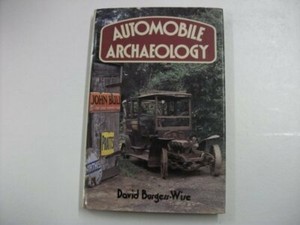
Written in 1980, when some of the early pioneers were still around, and cars were still being found kn farms, etc
warch said:
... had to have the coolant drained if it was freezing, as antifreeze wasn't developed until the 1920s
Into the 60s my grandad had a paraffin heater, round, the size of a quality street tin, to go under the sump at night in winter, I guess more to keep single grade oil thin enough, but would also prevent the block freezing.I have a copy of the Book of the Ford Van, 1921 edition. Before setting off you should amongst other things such as checking the weight and distribution of the load, two chapters are devoted to this, so it must have been pretty marginal 'Lift the driver's cushion, unscrew the stopper from the tank and look down into the tank. If you can see petrol at all, you may be pretty sure that there is enough to start on, although there is no harm in emptying in another can (using a funnel) if the tank will take it'
Checking that the handbrake ( a long black lever that comes up through the floor to the right of the driver's seat) is on, it is time to switch on the ignition and attack the starting handle. 'Brute force is not needed, just remember to pull and not push and you will avoid a sprained or broken wrist' However don't panic 'A slip of a woman can start a Ford engine quite easily when she knows how'
This may seem quaint, but a century ago a Model T will probably have replaced a horse and cart so the new owner would need the basics explained in some detail. However the mechanics were so simple that just about any job could be covered in a couple pages, so you can see why vans completely took over in such a short time.
Checking that the handbrake ( a long black lever that comes up through the floor to the right of the driver's seat) is on, it is time to switch on the ignition and attack the starting handle. 'Brute force is not needed, just remember to pull and not push and you will avoid a sprained or broken wrist' However don't panic 'A slip of a woman can start a Ford engine quite easily when she knows how'
This may seem quaint, but a century ago a Model T will probably have replaced a horse and cart so the new owner would need the basics explained in some detail. However the mechanics were so simple that just about any job could be covered in a couple pages, so you can see why vans completely took over in such a short time.
john2443 said:
Into the 60s my grandad had a paraffin heater, round, the size of a quality street tin, to go under the sump at night in winter, I guess more to keep single grade oil thin enough, but would also prevent the block freezing.
My father used one in the fifties. Until one day a petrol pipe leaked.There were two types, one for "under the sump" (not good for leaky pipes) and the other more of a lantern shape with a hook.
The damage wasn't terminal but the paraffin heater was immediately cast into outer darkness.
BryanC said:
Thumb OVER the starting handle alongside fingers before cranking.
My 60s Land Rover has a starting handle which I usually use to start it from cold. They do have different personalities (if you can call it that), mine almost never kicks back on the handle, my brother's Land Rover has a vicious kick (same model, same engine). Absolutely right about the thumb, it would bloody hurt if it kicked back with your thumb wrapped around it.
Talking of Austin 7s, some sage advice taken from my '38 Austin Big 7 owners manual....
On driving - 'Sometimes it may happen that when the clutch is let in, there is no apparent drive from the engine. That is because there has been no proper engagement of the gears. Therefore, push out the clutch again, and it will almost certainly be found that the lever can then be moved so as to give the proper gear engagement without using any force.'
On correct lubrication - 'We cannot emphasise the folly of using so-called "cheap" lubricants.'
On driving - 'Sometimes it may happen that when the clutch is let in, there is no apparent drive from the engine. That is because there has been no proper engagement of the gears. Therefore, push out the clutch again, and it will almost certainly be found that the lever can then be moved so as to give the proper gear engagement without using any force.'
On correct lubrication - 'We cannot emphasise the folly of using so-called "cheap" lubricants.'
Edited by larrylamb11 on Sunday 8th November 20:10
Gassing Station | Classic Cars and Yesterday's Heroes | Top of Page | What's New | My Stuff