
Lots of questions abut airplanes and airports
Discussion


Been saving these up for ages. I know there are a lot of Airplane enthusiasts on here. So I finally got around to asking all those trivial questions that run through my head whilst on a plane.
1. What do they do with planes at night? Taxiing through the airport on late flights you see short haul commercial jets that appear to have finished for the day sitting on the apron with the lights on and the doors open but no people or service vehicles seem to be around. I guess security isn’t an issue as the airport is secure anyway but surely they don’t leave them open to the elements like that? Do they power them down completely or leave them on a generator or external power supply?
2. What are those little red and white chequered huts you see round the airport? Emergency equipment stores?
3. Sometimes at take off I’m on a plane and it pulls onto the runway and powers up the engines only to sit there for some time, presumable waiting for ATC clearance, before releasing the brakes and shooting off up the runway. Does this put additional stress on the airframe? I imagine powering up the engines and keeping the brakes on with a jet to be akin to releasing the clutch on a car whilst in gear and leaving the handbrake on?
4. How easy is it for pilots to find their way around airports? I try to follow what’s going on looking out the window of airports I fly regularly and can’t make head or tail of it. I was able to listen in to ATC on one flight I was on and could hear the controller calling out reference codes to our flight that I assume correspond to the yellow boards you see along the taxiways. Do pilots ever take a wrong turn at large airports they’ve not been to before or do all pilots have to “learn” the airport before they’re allowed to land there (e.g. the first few times with a colleague that already knows the airport)? I’m not talking pulling onto the runway by accident here! I’d hope someone would spot that long before it happened but, just getting on the wrong gate or parking slot.
Sorry if it’s a bit trivial but I’ve just done 14 flights in 3 weeks and have been saving all these up. There’s more, but I can’t remember them just now
1) no idea
2) no idea
3) Probably doing a power check. You certainly have to do these in light aircraft although normally on the taxi way (unless ATC are having a quiet day in which case you can do them on the runway). Doesn't damage anything and is a good way of testing the brakes.
4) Jeppesen (or simalar e.g. Pooleys etc.). Basically crib sheets with all the information you need about the airfield including runways, taxiways, radio frequencies, height above sea level etc.
I stand to be corrected as I'm only 5 hours in to my PPL
I've recently got into Microsoft Flight Simulator and you certainly do realise that there is more to flying than just puttin' on the power and blattering down the runway. I've found maany an answer by using various flight sim groups and luckily last week somebody posted this link:
www.ais.org.uk
You have to register (free of course) to get to the information but once your there you can find layouts of airports with all the various runways and taxiways listed as well as tower and ground frequencies. I guess pilots use these maps just like we would use a street atlas. There's also various other stuff there which is really interesting if you're into flying.

Here goes,
1. At night if an aircraft is not being used it can be left in varios stages of power depending on when it's going out next. It could have the APU (small jet engine in the tail) running to provide electric power or it could be connected to a ground power source or if it was not being used for a while it could be completely shut down.
2.Huts could be many things from meteorological stations to parts of aerodrome navigation equipment or power generators.
3.You may be waiting to Take off for many reasons.
If no extra engine noise is heard it could be waiting for a landing aircraft to vacate the runway or if a preceding aircraft has just taken off it maybe for wake turbulence (times depend on aircraft types).
If a higher power setting is heard it maybe that it is very cold and engines have to be checked at an intermediate power setting before take off thrust is set.
4.To navigate around airports charts like this are used,
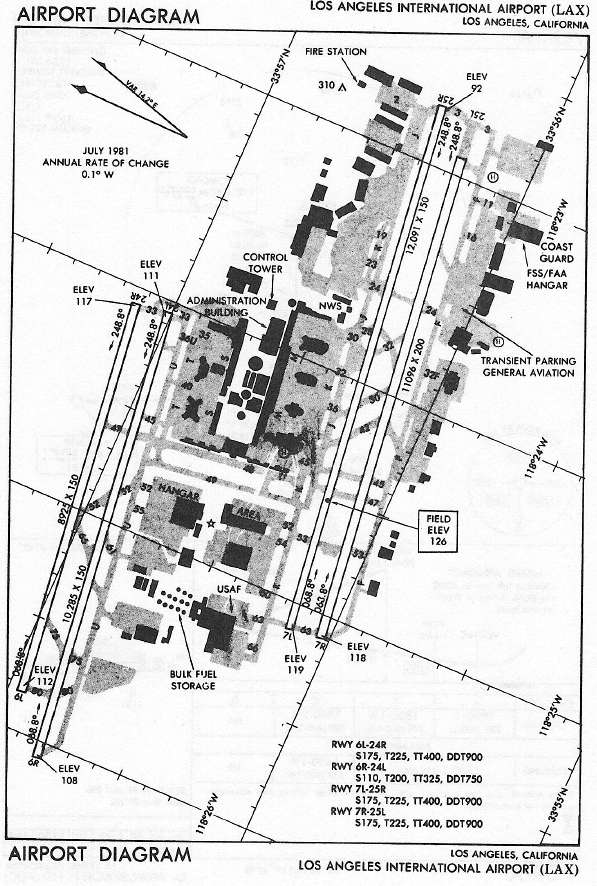
Some airports are difficult to navigate around.
Yes pilots do take wrong turns now and then.No special training is required for most airports unless it has unusual characteristics like a difficult approach but not usually for taxiways.
Accidents have happened because of aircraft entering runways when aircraft are landing or taking off.


1. At night if an aircraft is not being used it can be left in varios stages of power depending on when it's going out next. It could have the APU (small jet engine in the tail) running to provide electric power or it could be connected to a ground power source or if it was not being used for a while it could be completely shut down.
2.Huts could be many things from meteorological stations to parts of aerodrome navigation equipment or power generators.
3.You may be waiting to Take off for many reasons.
If no extra engine noise is heard it could be waiting for a landing aircraft to vacate the runway or if a preceding aircraft has just taken off it maybe for wake turbulence (times depend on aircraft types).
If a higher power setting is heard it maybe that it is very cold and engines have to be checked at an intermediate power setting before take off thrust is set.
4.To navigate around airports charts like this are used,
Some airports are difficult to navigate around.
Yes pilots do take wrong turns now and then.No special training is required for most airports unless it has unusual characteristics like a difficult approach but not usually for taxiways.
Accidents have happened because of aircraft entering runways when aircraft are landing or taking off.
Modern airliners are made to work for a living. Very few are left sitting around at airports for too long, even at night. When a plane isn't flying, it isn't generating revenue.
When they do have to be parked for a couple of hours, they are put on a stand, often one not connected to a departure gate but left "powered up" so that air conditioning and pumps etc can be operated by personnel working on board (cleaners, maintenance staff etc).
Most airliners have a small turbine called the Auxilliary Power Unit (APU) which provides power on the ground. Alternatively, they can be plugged into a mobile power generator.
When the captain gets permission from the Ground Controller to "Push Back" from the departure gate, that is the moment when they switch over from the APU to main engine power. Passengers will notice this as the cabin lights will flicker slightly during the switchover.
At this point the engines will only be at idle setting developing insufficient thrust to move the plane. Therefore, there is no great strain on the brakes. As soon as the tug is disconnected and Ground Control has given permission to start taxying, the pilot will advance the throttles, increasing the power and allowing the plane to begin moving under its own power. Taxi speed is usually limited to 60 mph or less to prevent the brake discs overheating.
Eric Mc said:
Most airliners have a small turbine called the Auxilliary Power Unit (APU) which provides power on the ground. Alternatively, they can be plugged into a mobile power generator.
stovey said:
It could have the APU (small jet engine in the tail) running to provide electric power or it could be connected to a ground power source or if it was not being used for a while it could be completely shut down.
thank you guys - i have always wondered what on earth is at the back of airliners looking like an exhaust with heat coming out.
i can now tick that trivia box.
t1grm said:
you see short haul commercial jets that appear to have finished for the day sitting on the apron with the lights on and the doors open

I'm sure someone is around?
You will probably notice when boarding aircraft that there are many sticky labels that have been stuck across the door and doorframe. These security seals show that no-one has entered while the aircraft was unattended.
t1grm said:
4. Do pilots ever take a wrong turn at large airports they’ve not been to before.......... just getting on the wrong gate or parking slot.
 everything from wrong gates to wrong airports has been known!
Interesting one is parking at the gate. Many different systems exist to guide the pilot to the correct stopping point. I did a jump-seat ride into Tokyo NRT (pre 9-11.....) and it was the PF's first visit there and he had never seen the Japanese system before. They worked it out as they taxied the last few metres

Eric Mc said:
Modern airliners are made to work for a living. Very few are left sitting around at airports for too long, even at night. When a plane isn't flying, it isn't generating revenue.
When they do have to be parked for a couple of hours, they are put on a stand, often one not connected to a departure gate but left "powered up" so that air conditioning and pumps etc can be operated by personnel working on board (cleaners, maintenance staff etc).
Most airliners have a small turbine called the Auxilliary Power Unit (APU) which provides power on the ground. Alternatively, they can be plugged into a mobile power generator.
When the captain gets permission from the Ground Controller to "Push Back" from the departure gate, that is the moment when they switch over from the APU to main engine power. Passengers will notice this as the cabin lights will flicker slightly during the switchover.
At this point the engines will only be at idle setting developing insufficient thrust to move the plane. Therefore, there is no great strain on the brakes. As soon as the tug is disconnected and Ground Control has given permission to start taxying, the pilot will advance the throttles, increasing the power and allowing the plane to begin moving under its own power. Taxi speed is usually limited to 60 mph or less to prevent the brake discs overheating.
Thanks for the info Eric. You just reminded me of and answered another question. What kind of brakes do they have?
Regarding lay-up times I know they’re expensive bits of kit to have sitting doing nothing but for example the Alitalia Barcelona to Rome service (3 times a day) finishes with the last flight getting into Barcelona at 23:05 and then restarts in the morning with the 06:30 back to Rome being the first flight out. That’s a 7.5 hour lay up assuming it’s the same plane working the route everyday (which I think it is – MD80 BTW). I assume there’s some cleaning, replenishing stocks and routine maintenance that can’t take more than a couple of hours in the evening and then they lock the thing down for the night? I guess they’d need about 1 to 1.5 hours in the morning to get the thing ready again?

>> Edited by t1grm on Tuesday 14th February 12:46
Alitalia is not the most efficient airline in the world .
Of course, there will be times when an aircraft is parked overnight or for longer than desirable spells for scheduling or technical reasons.
I've always noticed that a South African Airways Boeing 747 seems to spend a fair chunk of the day parked over at the BA Maintenance site before being towed to the terminal in the late afternoon prior to its return to SA. I've never really known why they do this but I've observed this over the last 20 years.
. Of course, there will be times when an aircraft is parked overnight or for longer than desirable spells for scheduling or technical reasons.
I've always noticed that a South African Airways Boeing 747 seems to spend a fair chunk of the day parked over at the BA Maintenance site before being towed to the terminal in the late afternoon prior to its return to SA. I've never really known why they do this but I've observed this over the last 20 years.

t1grm said:
4. How easy is it for pilots to find their way around airports? I try to follow what’s going on looking out the window of airports I fly regularly and can’t make head or tail of it. I was able to listen in to ATC on one flight I was on and could hear the controller calling out reference codes to our flight that I assume correspond to the yellow boards you see along the taxiways. Do pilots ever take a wrong turn at large airports they’ve not been to before or do all pilots have to “learn” the airport before they’re allowed to land there (e.g. the first few times with a colleague that already knows the airport)? I’m not talking pulling onto the runway by accident here! I’d hope someone would spot that long before it happened but, just getting on the wrong gate or parking slot.
IIRC the was a Singapore Airlines 747 a couple of years ago that tried to take off down a runway closed for repairs and littered with JCB's etc
Gassing Station | The Pie & Piston Archive | Top of Page | What's New | My Stuff