
Space Collision
Discussion


http://spaceflightnow.com/news/n0902/11iridium/
That'll keep somebody very busy for a few days.
Ere' new boy. Go and count the pieces of wreckage from that satelite crash.
That'll keep somebody very busy for a few days.
Ere' new boy. Go and count the pieces of wreckage from that satelite crash.

Parrot of Doom said:
This is how it starts. Next the internet will go down, followed quickly by television and radio.
I for one, welcome our new Ant overlords.
The Ant OverLords having been dealt with by a couple of cans of Raid, we now have to deal with the tricky question of what to do with our newly-outed fifth-columnist, Parrot of Doom.I for one, welcome our new Ant overlords.
Debagging seems too mild a penalty - particularly as parrots don't wear trousers.
On the other hand, transportation to Monty Python Sketch Island seems a tad harsh. Only a tad, mind you.
While the jokes are funny, this kind of thing is probably the thing that scares me most; much more dangerous and likely than terrorism and nuclear war.
The big problem here is that s t begets st. The debris from this collision could well be the cause of the next satellite loss, the debris from which... and so on and so on. It’s not that much of a leap before huge orbital paths become unusable. Think; no GPS, no SATCOM, no Spysats, no Tricia Helfer in BSG in Hi-Def on Sky One.
On the 'no air traffic control' in space, that’s not entirely true. Among other nations the US has a large RADAR system monitoring everything upto GEO, which is where most of the satellites we use every day are to be found (except for GPS, which is lower). This system can and does provide notifications to satellite operators when they spot two objects on a collision course, allowing them to take evasive action. That being said, it can't track every object, as this incident demonstrates.
And here endeth the lesson of doom.
The big problem here is that s
t begets st. The debris from this collision could well be the cause of the next satellite loss, the debris from which... and so on and so on. It’s not that much of a leap before huge orbital paths become unusable. Think; no GPS, no SATCOM, no Spysats, no Tricia Helfer in BSG in Hi-Def on Sky One. On the 'no air traffic control' in space, that’s not entirely true. Among other nations the US has a large RADAR system monitoring everything upto GEO, which is where most of the satellites we use every day are to be found (except for GPS, which is lower). This system can and does provide notifications to satellite operators when they spot two objects on a collision course, allowing them to take evasive action. That being said, it can't track every object, as this incident demonstrates.
And here endeth the lesson of doom.
Edited by bobthemonkey on Thursday 12th February 02:11
This gets more interesting. Both the sats were actually logged and tracked by NORAD, and it predicted a separation of ~800m, which is enough for people to take an avoidance manoeuvre; something which didn't happen.
The question now is why no action was taken? There are a couple of options.
1) The software got it wrong and actually predicted a larger separation based on the available data at the time. 800m came about after the fact.
2) The software got it right, but nobody got the message.
3) Someone got the message, but didn't do anything. Either because
a) The Russian bird is dead and unresponsive (this is plausible) or
b) Iridium decided to risk it (this is also plausible, they have skirted bankruptcy once and the satellites are getting old with very little fuel left onboard).
This is avoiding the more tinfoil-hat suggestions that will no doubt be circling the internet in the next couple of days, fuelled by the fact the impact occurred over Northern Russia.
ETA: A Correction.
While both satellites were tracked, the calculations weren't done for the two colliding (this is called many-on-many). Instead they are only tracked for the risk of them colliding with certain high value targets (space station etc, this is called many on one).
The question now is why no action was taken? There are a couple of options.
1) The software got it wrong and actually predicted a larger separation based on the available data at the time. 800m came about after the fact.
2) The software got it right, but nobody got the message.
3) Someone got the message, but didn't do anything. Either because
a) The Russian bird is dead and unresponsive (this is plausible) or
b) Iridium decided to risk it (this is also plausible, they have skirted bankruptcy once and the satellites are getting old with very little fuel left onboard).
This is avoiding the more tinfoil-hat suggestions that will no doubt be circling the internet in the next couple of days, fuelled by the fact the impact occurred over Northern Russia.
ETA: A Correction.
While both satellites were tracked, the calculations weren't done for the two colliding (this is called many-on-many). Instead they are only tracked for the risk of them colliding with certain high value targets (space station etc, this is called many on one).
Edited by bobthemonkey on Thursday 12th February 22:28
The Russian "satellite" was actually a dead discarded upper stage so would not have been under any control and incapable of being controlled.
The Space Shuttle HAS ben hit by space debris. A fleck of paint impacted one of the cockpit windscreen panels about 20 years ago. The astronauts heard the impact and noticed a small mark on the outside of the glass. After landing, the panel was removed and the impact spot analysed. Microscopic particles of paint were found in the littl;e crater caused by the impact which enabled NASA to discover the nature of the impact object.
The Space Shuttle HAS ben hit by space debris. A fleck of paint impacted one of the cockpit windscreen panels about 20 years ago. The astronauts heard the impact and noticed a small mark on the outside of the glass. After landing, the panel was removed and the impact spot analysed. Microscopic particles of paint were found in the littl;e crater caused by the impact which enabled NASA to discover the nature of the impact object.
Seems there is quite alot of stuff floating around up there , this just shows the stuff they can track .
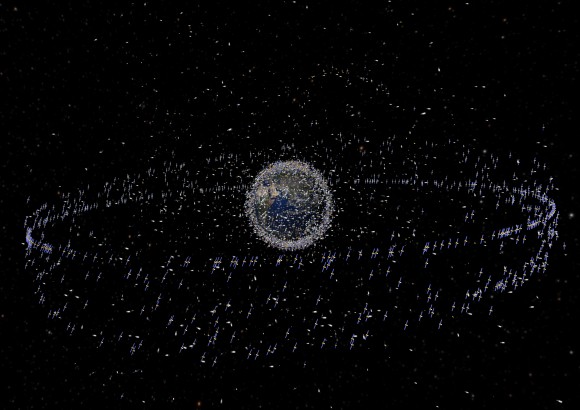

More stuff here - Link
Other site said:
Officials from the space shuttle program have said the shuttle regularly takes hits from space debris, and over 80 windows had to be replaced over the years.
I wonder if they've got glass cover on thier insurance More stuff here - Link
AJS- said:
Anyone know the probability of that happening?
There's about 25 million cars in our little island.There's only 18 thousand big lumps up there in the vastness above us. Earths surface area is 4.pi.r^2
which gives 4.3.141.(5000^2)
~300 million sq meters
So even if the satellites where on the earths surface they'd have on average 16000 sq meters which is quite a lot of room.
Now consider they're spread over about 150km to 600km above the earth and they've each got a volume of 8 thousand million cubic meters each.
I can therefore conclude that the probability of two objects hitting each other is fairly low.
There may be 18,000 BIG lumps - but at the speeds that the impacts occur, even small limps could destroy a satellite, spacecraft or astronaut on a spacewalk. Imagine being impacted by a nut or bolt, or lost glove (or tool bag) with a combined closing speed of 35,000 mph?
There are HUNDREDS of thousands of smaller objects orbiting the earth. Most of it is debris from old satellites and spent upper stages of rockets as well as items lost by EVA crews spread over 50 years of earth orbit missions.
There are HUNDREDS of thousands of smaller objects orbiting the earth. Most of it is debris from old satellites and spent upper stages of rockets as well as items lost by EVA crews spread over 50 years of earth orbit missions.
Eric Mc said:
The Russian "satellite" was actually a dead discarded upper stage so would not have been under any control and incapable of being controlled.
The Space Shuttle HAS ben hit by space debris. A fleck of paint impacted one of the cockpit windscreen panels about 20 years ago. The astronauts heard the impact and noticed a small mark on the outside of the glass. After landing, the panel was removed and the impact spot analysed. Microscopic particles of paint were found in the littl;e crater caused by the impact which enabled NASA to discover the nature of the impact object.
Eric, the reports seem to suggest that the Russian sat was a comsat, rather than an upper stage. Admittidly it doesn't change the fact that could well have been dead and usresponsive. The Space Shuttle HAS ben hit by space debris. A fleck of paint impacted one of the cockpit windscreen panels about 20 years ago. The astronauts heard the impact and noticed a small mark on the outside of the glass. After landing, the panel was removed and the impact spot analysed. Microscopic particles of paint were found in the littl;e crater caused by the impact which enabled NASA to discover the nature of the impact object.
Not only has the shuttle been hit, a spacewalker has been hit, in the hand, causing a slow leak and bleeding. Very little was made of it at the time, and only one account of it exists as far as I am aware.
bobthemonkey said:
While the jokes are funny, this kind of thing is probably the thing that scares me most; much more dangerous and likely than terrorism and nuclear war.
The big problem here is that st begets st. The debris from this collision could well be the cause of the next satellite loss, the debris from which... and so on and so on. It’s not that much of a leap before huge orbital paths become unusable. Think; no GPS, no SATCOM, no Spysats, no Tricia Helfer in BSG in Hi-Def on Sky One.
On the 'no air traffic control' in space, that’s not entirely true. Among other nations the US has a large RADAR system monitoring everything upto GEO, which is where most of the satellites we use every day are to be found (except for GPS, which is lower). This system can and does provide notifications to satellite operators when they spot two objects on a collision course, allowing them to take evasive action. That being said, it can't track every object, as this incident demonstrates.
And here endeth the lesson of doom.
As you come across as a worrier regarding this issue. Some of those Sats are equipped with a plute battery - plute is very toxic. Imagine if one of those batteries let's go in high atmosphere. Sleep well The big problem here is that s
t begets st. The debris from this collision could well be the cause of the next satellite loss, the debris from which... and so on and so on. It’s not that much of a leap before huge orbital paths become unusable. Think; no GPS, no SATCOM, no Spysats, no Tricia Helfer in BSG in Hi-Def on Sky One. On the 'no air traffic control' in space, that’s not entirely true. Among other nations the US has a large RADAR system monitoring everything upto GEO, which is where most of the satellites we use every day are to be found (except for GPS, which is lower). This system can and does provide notifications to satellite operators when they spot two objects on a collision course, allowing them to take evasive action. That being said, it can't track every object, as this incident demonstrates.
And here endeth the lesson of doom.
Edited by bobthemonkey on Thursday 12th February 02:11

Gassing Station | The Pie & Piston Archive | Top of Page | What's New | My Stuff