
A stab at a LEM
Discussion


I've had a bit of time on my hands lately and thought a scale model might be a good idea. Like most I guess, I dabbled in Airfix 1:77 planes as a youngster, along with glue marked formica kitchen tops, spilled humbrol paint tins on the lino and involuntary early nights with no supper. But that's about as far as it goes.
The Apollo program has always been close to my heart and I've great memories of watching Neil make that Step, with my old man giving a running commentary.
A bit of googling led me pretty quickly to the Revell 1:48 kit and off I started.
First off, the 'Instructions' were a bit of a surprise, with no written words and what seemed liked fairly ambiguous diagrams. As a boy I used to get a kick out of learning technical terms like fuselage and ailerons, but it looks like no kicks were to be had here, just a bunch of not very informative icons.The model also contained a number of parts that weren't used and looked a little random. A couple of the sprues were also doubled up so there was a bit of head scratching involved before the top was taken off the glue.
The LEM always struck me as a thing of textures, and the image of it manoeuvring away from the command module looking like a spider with it's best glitter on was a strong one. With that in mind the idea was to avoid the paintbrush and pots of acrylic that came with the kit.
I also wanted to make the kit as accurate as possible, but I think I failed on this. It didn't take much effort to find out where the kit wasn't correct, but to put things right would have meant cutting it up and re modelling it. Right outside my non existent skill set. I think it's more of an approximation...
Anyway, here's a few pics:
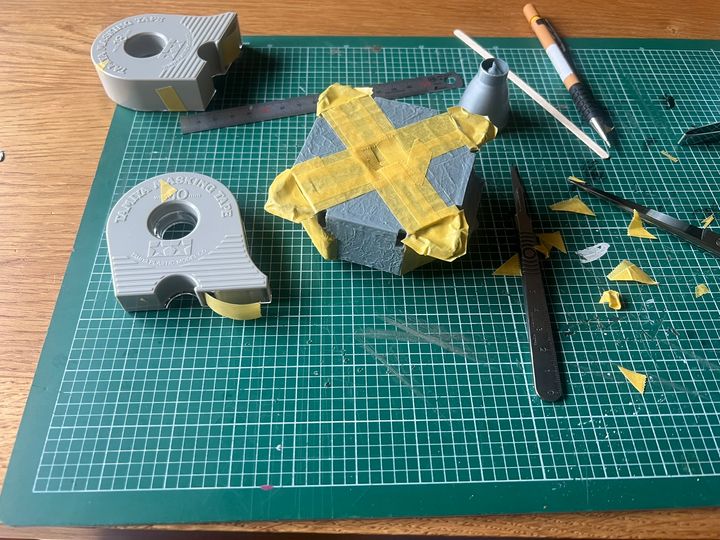
Masking up the descent stage prior to spraying up with matt black. The kit had these panels with a textured/crinkled surface which wasn't right, but how the hell do you fix that?
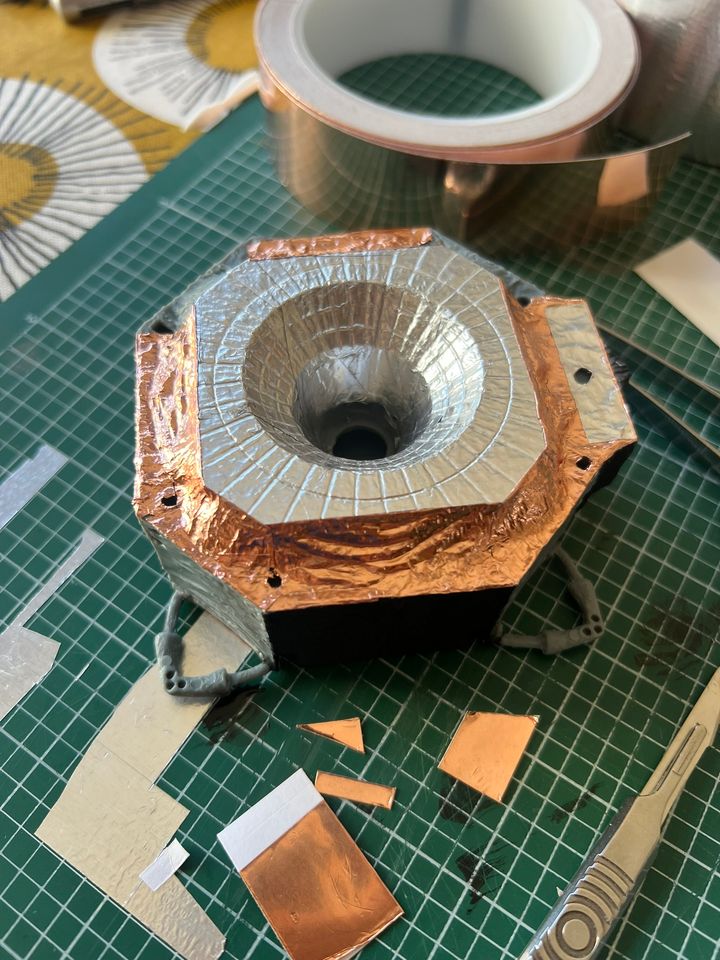
Once the black paint was on I then used sticky backed foil, as a homage to Val Singleton, for the metallic parts. The silver was the sort of aluminium tape used to secure duct insulation and the bronze tinted gold was some slug repellent tape from the garden shed...
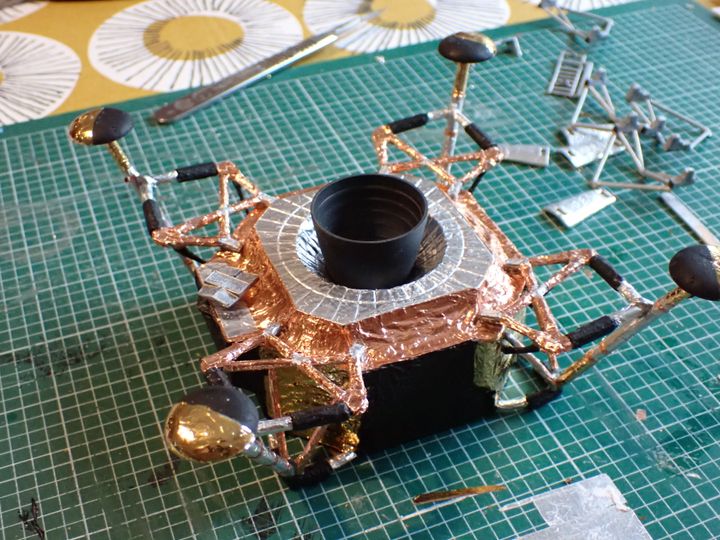
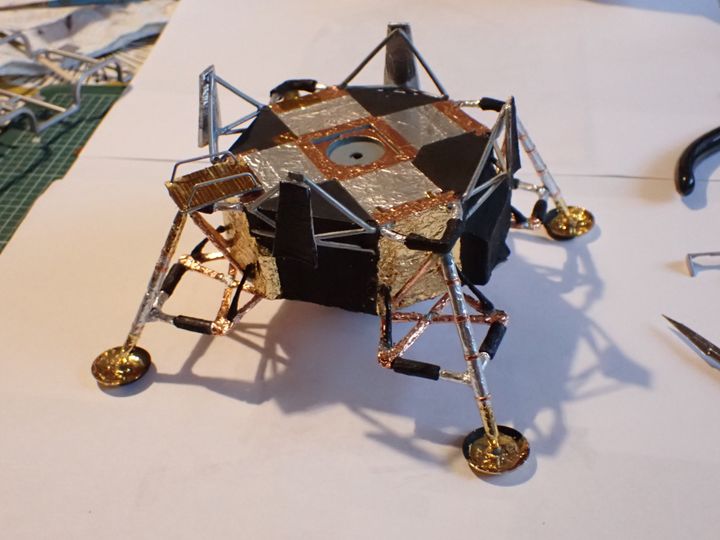
This is the descent stage almost finished. For the gold foil panels I used some gold leaf. It's still in my eyebrows, clothing and nostrils. Strange stuff.
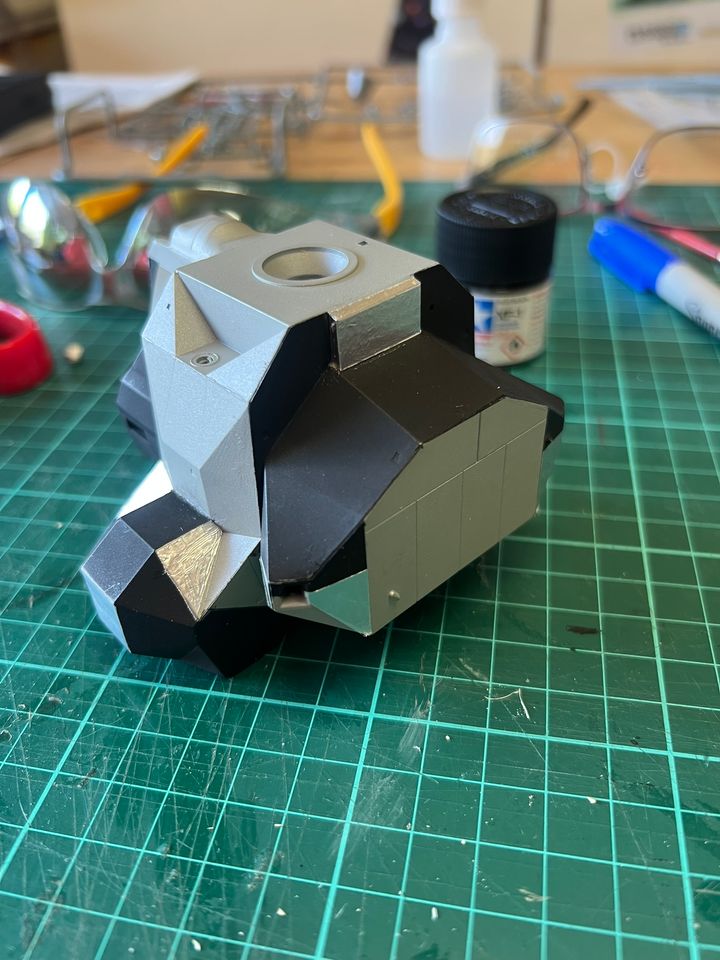
The ascent stage went along similar lines. The main part of the hull is a metallic aluminium paint mixed about 50-50 with a flat green, it took a bit of experimenting but I'd like to think I got the colour pretty close, or maybe not.
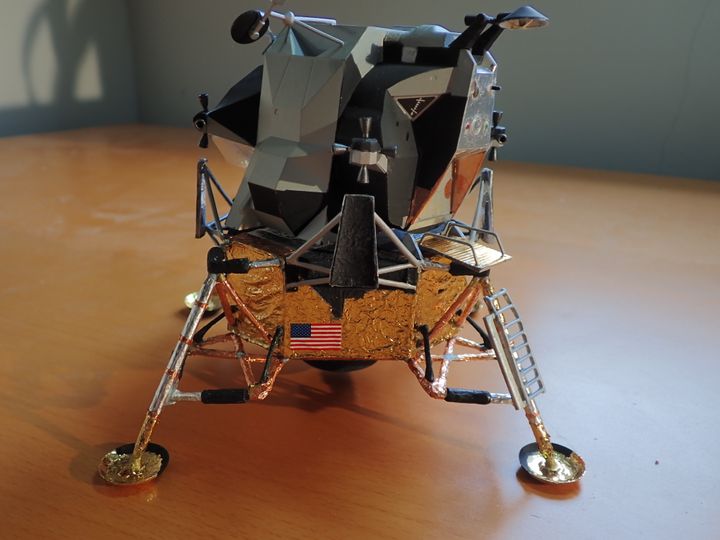
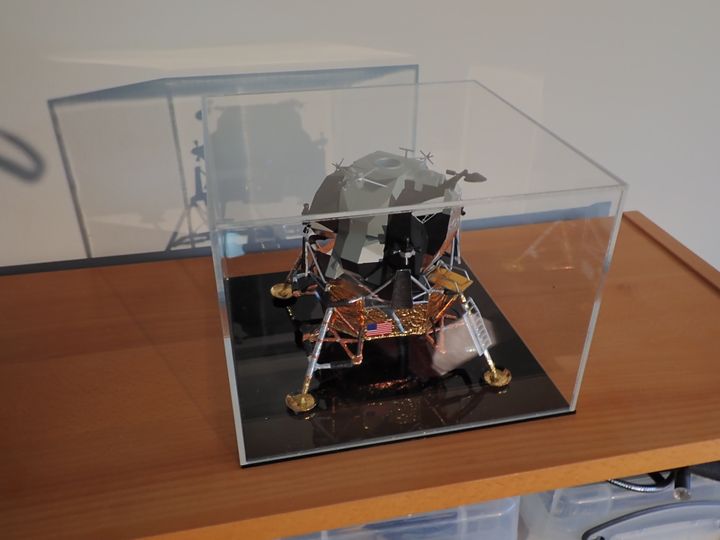
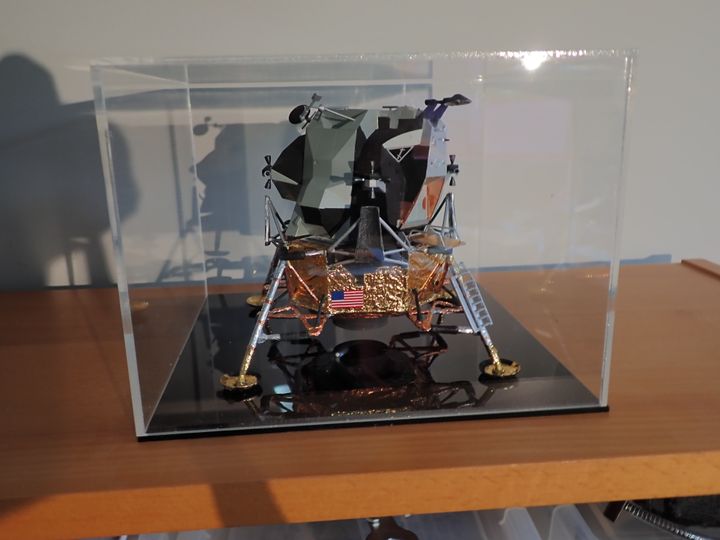
Here's a couple of shots of the finished article, and I've stuck it in a perspex box.
I'm not sure yet if I enjoyed building it or not. It was incredibly fiddly for a start, maybe not for the fingers and eyes of a 10 year old, but I did have to do a lot of squinting and groaning. I think I'll put the scale modelling career on hold for the time being, but leave the finished model on the bookshelf for now.
The Apollo program has always been close to my heart and I've great memories of watching Neil make that Step, with my old man giving a running commentary.
A bit of googling led me pretty quickly to the Revell 1:48 kit and off I started.
First off, the 'Instructions' were a bit of a surprise, with no written words and what seemed liked fairly ambiguous diagrams. As a boy I used to get a kick out of learning technical terms like fuselage and ailerons, but it looks like no kicks were to be had here, just a bunch of not very informative icons.The model also contained a number of parts that weren't used and looked a little random. A couple of the sprues were also doubled up so there was a bit of head scratching involved before the top was taken off the glue.
The LEM always struck me as a thing of textures, and the image of it manoeuvring away from the command module looking like a spider with it's best glitter on was a strong one. With that in mind the idea was to avoid the paintbrush and pots of acrylic that came with the kit.
I also wanted to make the kit as accurate as possible, but I think I failed on this. It didn't take much effort to find out where the kit wasn't correct, but to put things right would have meant cutting it up and re modelling it. Right outside my non existent skill set. I think it's more of an approximation...
Anyway, here's a few pics:
Masking up the descent stage prior to spraying up with matt black. The kit had these panels with a textured/crinkled surface which wasn't right, but how the hell do you fix that?
Once the black paint was on I then used sticky backed foil, as a homage to Val Singleton, for the metallic parts. The silver was the sort of aluminium tape used to secure duct insulation and the bronze tinted gold was some slug repellent tape from the garden shed...
This is the descent stage almost finished. For the gold foil panels I used some gold leaf. It's still in my eyebrows, clothing and nostrils. Strange stuff.
The ascent stage went along similar lines. The main part of the hull is a metallic aluminium paint mixed about 50-50 with a flat green, it took a bit of experimenting but I'd like to think I got the colour pretty close, or maybe not.
Here's a couple of shots of the finished article, and I've stuck it in a perspex box.
I'm not sure yet if I enjoyed building it or not. It was incredibly fiddly for a start, maybe not for the fingers and eyes of a 10 year old, but I did have to do a lot of squinting and groaning. I think I'll put the scale modelling career on hold for the time being, but leave the finished model on the bookshelf for now.
Really well done.
Almost all the Apollo kits that were issued "in period" were inaccurate in various areas. This was mainly down to the fact that the kits were being issued even before the real artefacts had actually been flown and they were often based on artists impressions, mock ups or earth based training versions of the vehicles.
I have this model in my unbuilt stash. I bought it was back in 1984 when Revell issued some of their older models in a series called "The History Makers" -
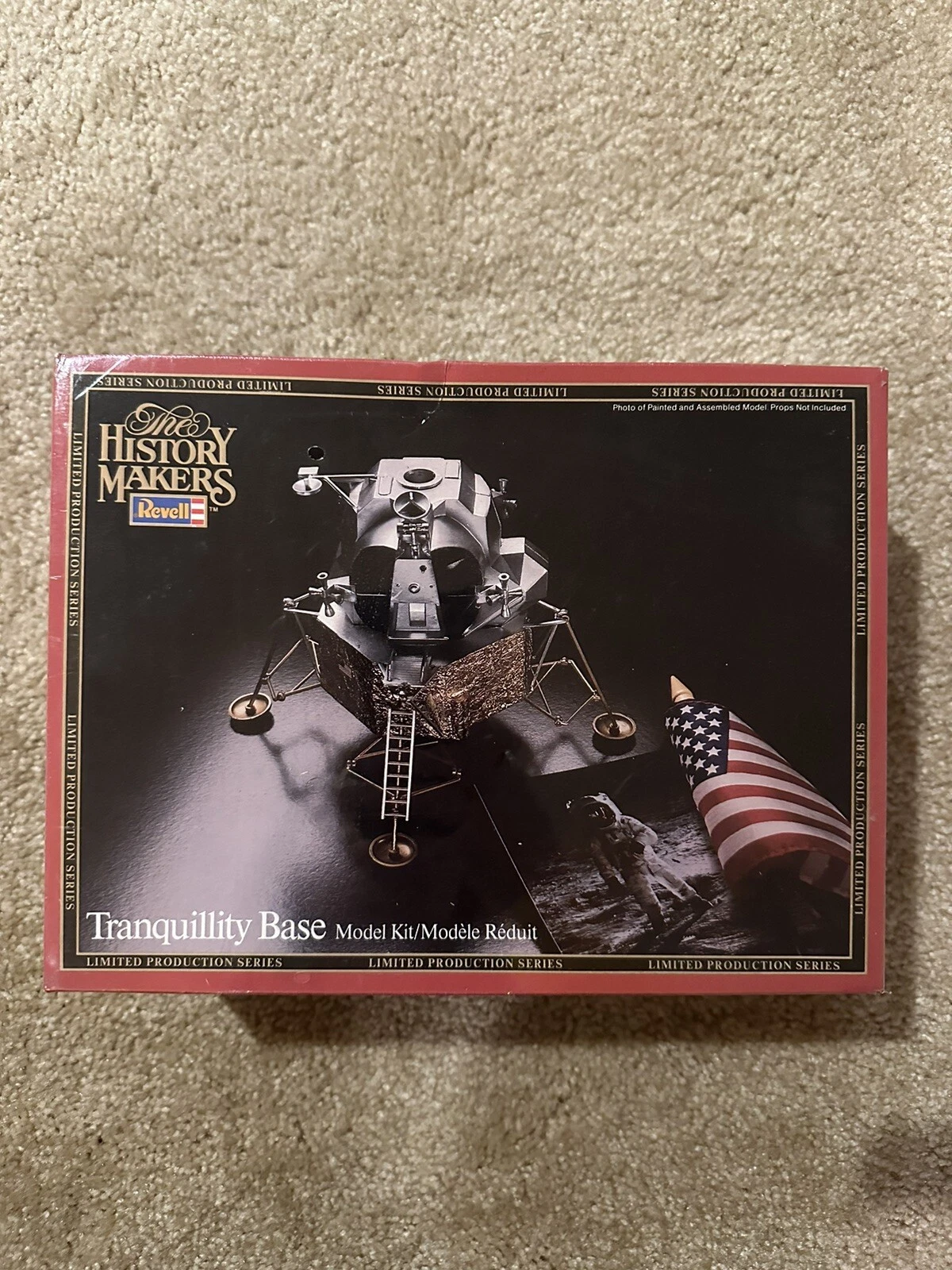
The kit was originally released in 1967, two years before Apollo 11 and before any LMs had even been tested in space.

Regarding the issue of dealing with "fiddly bits" in later life, one of these really helps -

I've only ever built the 1/72 Airfix LM - which is also inaccurate in various areas.
Almost all the Apollo kits that were issued "in period" were inaccurate in various areas. This was mainly down to the fact that the kits were being issued even before the real artefacts had actually been flown and they were often based on artists impressions, mock ups or earth based training versions of the vehicles.
I have this model in my unbuilt stash. I bought it was back in 1984 when Revell issued some of their older models in a series called "The History Makers" -
The kit was originally released in 1967, two years before Apollo 11 and before any LMs had even been tested in space.
Regarding the issue of dealing with "fiddly bits" in later life, one of these really helps -
I've only ever built the 1/72 Airfix LM - which is also inaccurate in various areas.
Edited by Eric Mc on Monday 9th November 17:19
That's a cracking job, especially with the foil/gold leaf. I've used both on wargaming models, and know how bloody annoying it is to use!
On the texture - it's surprisingly easy to remove. If it's quite 'harsh' I'll often use a hobby knife to scrape the highest points off, then raid Mrs Sway's nail bag for various soft sanding files. For a glass like finish (if desired), I may have stolen her fancy glass file, which is absolutely lovely to use...
On the texture - it's surprisingly easy to remove. If it's quite 'harsh' I'll often use a hobby knife to scrape the highest points off, then raid Mrs Sway's nail bag for various soft sanding files. For a glass like finish (if desired), I may have stolen her fancy glass file, which is absolutely lovely to use...
Reminds me of a story a mate told me; many years ago, before the Wall came down, the only way to get models from behind the Iron Curtain was to ask somebody who lived in the relevant country to buy one and send it to you. But because you couldn't send money, you'd find out what they wanted in the way of kits from our nasty capitalist countries and send them that.
One day his penfriend in, I believe, Ukraine asked him for an Airfix LEM kit, which he was pleased to provide. But he also wanted some bars of Cadbury's Bourneville, which puzzled my mate for a while. Until he remembered that they were wrapped *in those days) in GOLD foil! Perfect for a LEM.
One day his penfriend in, I believe, Ukraine asked him for an Airfix LEM kit, which he was pleased to provide. But he also wanted some bars of Cadbury's Bourneville, which puzzled my mate for a while. Until he remembered that they were wrapped *in those days) in GOLD foil! Perfect for a LEM.
Gassing Station | Scale Models | Top of Page | What's New | My Stuff