
Idiot question alert...
Discussion


If I cycle the same route at two different speeds do I burn the same amount of calories?
Taking away the fact that higher speeds means greater air resistance to overcome, does moving the same weight over the same distance in a slower time expend the same energy.
I failed my A-level physics. Hence the question.
Taking away the fact that higher speeds means greater air resistance to overcome, does moving the same weight over the same distance in a slower time expend the same energy.
I failed my A-level physics. Hence the question.
No, Just think about it like a car:
50 mile motorway journey , same car, first time you do it @ 80-110mph , lets say 25mpg
On way home you do it cruising @ 60mph and get 45mpg
Same with riding in principle in theory, obvs there are a million and one additional factors, such as wind speed and weight on rucksack etc...
50 mile motorway journey , same car, first time you do it @ 80-110mph , lets say 25mpg
On way home you do it cruising @ 60mph and get 45mpg
Same with riding in principle in theory, obvs there are a million and one additional factors, such as wind speed and weight on rucksack etc...
 k out of it, you'll burn more calories than pootling the same distance, even accounting for the fact that the former will see you cover the distance quicker.
Given that we are ignoring air resistance (and probably a few other factors too), the answer is yes - same total number of calories.
It's a question of power and energy. Faster rider uses twice the power and gets there in half for the time = same energy. Calories are a unit of energy.
It's a question of power and energy. Faster rider uses twice the power and gets there in half for the time = same energy. Calories are a unit of energy.
This article seems to imply faster speeds require a disproportionate amount of power?
http://mccraw.co.uk/wind-resistance-cycling-speed/
But ignoring wind resistance I would have though this formula applied
kinetic energy= 0.5 *mass* velocity squared
So to double your speed require 4 times as much energy?
http://mccraw.co.uk/wind-resistance-cycling-speed/
But ignoring wind resistance I would have though this formula applied
kinetic energy= 0.5 *mass* velocity squared
So to double your speed require 4 times as much energy?
Edited by jfrf on Saturday 25th July 21:57
jfrf said:
This article seems to imply faster speeds require a disproportionate amount of power?
http://mccraw.co.uk/wind-resistance-cycling-speed/
But ignoring wind resistance I would have though this formula applied
kinetic energy= 0.5 *mass* velocity squared
So to double your speed require 4 times as much energy?
Yes, that's true for the period of acceleration when getting up to the higher speed. If you're riding around a course at a constant speed in a vacuum, you won't have either acceleration nor air resistance to contend with (pretty much only the rolling resistance). In the real world you'd have all of those, and there will be a massive difference in energy expended at the higher speed. http://mccraw.co.uk/wind-resistance-cycling-speed/
But ignoring wind resistance I would have though this formula applied
kinetic energy= 0.5 *mass* velocity squared
So to double your speed require 4 times as much energy?
Edited by jfrf on Saturday 25th July 21:57
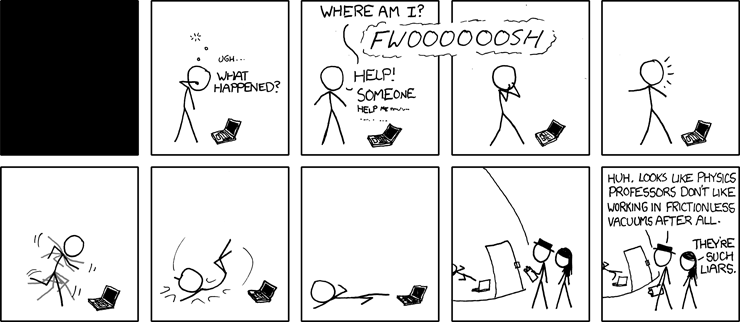
This thread reminded me of this:

Magic919 said:
jfrf said:
So to double your speed require 4 times as much energy?
It certainly requires more power, but you get there in less time. Energy is power over time, so no increase in total energy required.Dr Jekyll said:
At first approximation, 4 times the power for half as long, so twice the energy.
Isnt it 4 times the energy? its called kinetic energy not kinetic power.So to double your speed needs (a disproportional) 4 times as much kinetic energy.
The time saved with the speed increase being irreleavnt as it takes no energy to maintain a constant speed in a vacuum
Anyhow I am not claiming to be correct here but just interested in the theorectial answer
There are two strands of discussion here and it is muddying the waters. OP said to ignore wind resistance and there are replies including it.
The effects of the wind resistance roughly suggest you need four times the power to double your speed. This is power and only becomes energy once you factor in how long the power is produced (time).
The effects of the wind resistance roughly suggest you need four times the power to double your speed. This is power and only becomes energy once you factor in how long the power is produced (time).
personally i have found the power/energy debate adding complications
Sticking to energy and calories rather than power
kinetic energy =0.5*mass * velocity squared
I am no expert on the subject but this to me this it suggests to double the speed means quadrupling the energy and calories required.
Time saved due to a quicker journery is not relevant
This ignores any wind resistance as per the original question.
Sticking to energy and calories rather than power
kinetic energy =0.5*mass * velocity squared
I am no expert on the subject but this to me this it suggests to double the speed means quadrupling the energy and calories required.
Time saved due to a quicker journery is not relevant
This ignores any wind resistance as per the original question.
I took the ignore wind resistance to mean assuming there is no wind on both days not to mean he's cycling in space. In the real world where we all live going the same distance twice as fast uses roughly twice as many calories, going twice as fast for the same amount of time would use 4 times as many calories. In a vacum it'd use hardly any calories as once you're up to your chosen speed it'd take very few watts to overcome the mechanical (bearing) and frictional (tyre vs road) losses, but we don't live there so stop dreaming, cars would also do thousands of mpg and a daewoo matiz with the right gearing could hit the double or even triple ton.
jfrf said:
personally i have found the power/energy debate adding complications
Sticking to energy and calories rather than power
kinetic energy =0.5*mass * velocity squared
I am no expert on the subject but this to me this it suggests to double the speed means quadrupling the energy and calories required.
Time saved due to a quicker journery is not relevant
This ignores any wind resistance as per the original question.
The kinetic energy equation is the amount of energy stored by a moving body. It takes that amount of energy to accelerate to the velocity, and the same amount to decelerate back down from that speed. If we're ignoring friction, air resistance etc, the amount of energy required to maintain that velocity is zero. (Newton's first law, as used by New Horizons to get all the way to Pluto without burning its engines the whole time.) Sticking to energy and calories rather than power
kinetic energy =0.5*mass * velocity squared
I am no expert on the subject but this to me this it suggests to double the speed means quadrupling the energy and calories required.
Time saved due to a quicker journery is not relevant
This ignores any wind resistance as per the original question.
So, doubling the speed quadruples the energy required to accelerate (and decelerate), but without wind resistance there's no difference in the energy needed to maintain that speed.
Gassing Station | Pedal Powered | Top of Page | What's New | My Stuff