
still Turbocharger efficiency
Discussion


Ok, what makes a turbo more efficient?
The Norwegian chaps seem to be getting big numbers from very large turbos, is this due to a lack of back pressure and "Work" the engine needs to do to drive the turbo to produce such boost?
Would say a T72 be more efficient than a T4 due to its size, or am I missing something obvious and basic?
Also, what kind of efficiencies are modern turbos running these days?
Dave!
The Norwegian chaps seem to be getting big numbers from very large turbos, is this due to a lack of back pressure and "Work" the engine needs to do to drive the turbo to produce such boost?
Would say a T72 be more efficient than a T4 due to its size, or am I missing something obvious and basic?
Also, what kind of efficiencies are modern turbos running these days?
Dave!
efficiency has little to do with size, its more about design
also larger turbos won't spool up until higher rpm than a small turbo, so depends what engine you would be using it on, the use of the engine, how hard you want to hit it etc etc
sure there are people on here who know more than me for specific detail, but basically bigger isn't necessarily better - a well matched turbo is much more worthwhile
also larger turbos won't spool up until higher rpm than a small turbo, so depends what engine you would be using it on, the use of the engine, how hard you want to hit it etc etc
sure there are people on here who know more than me for specific detail, but basically bigger isn't necessarily better - a well matched turbo is much more worthwhile
The turbine is spun by the flow of exhaust gas. The pressure differential is what makes the efficiency with regard to spooling.
This is why the Scandanavians are getting big numbers- low pressure in the exhaust. They've discovered that using truck turbos isn't creating the laggy monsters you'd assume. It's a point of view that is only recently being accepted in the UK.
I'm personally expecting to be fully spooled on my 2.3l 4 pot engine by 3500rpm (from accounts of others with the same engine spec) and to go on to make 5-600hp. All this from a Holset turbo from a Bus that you often see new on Ebay for £150. Bolt two of those on a healthy V8 and you've got lots of power.
Also, the parasitic losses from driving the compressor are nowhere near as bad as with a roots type blower. The trade of, or course, is the instant grunt of the blower. However, the anti-lag systems used in rallying can provide the instant grunt required at the expense of turbine wheel life.
Here's some very interesting reading for you regarding exhaust desing on turbocharged engines. I know it's not 100% relevant when applied to drag racing, but it puts tuning theory across quite well:
Jay Kavanaugh, a turbosystems engineer at Garret, responding to a thread on www.impreza.net regarding exhaust design and exhaust theory:
[i]“This thread was brought to my attention by a friend of mine in hopes of shedding some light on the issue of exhaust size selection for turbocharged vehicles. Most of the facts have been covered already. FWIW I’m an turbocharger development engineer for Garrett Engine Boosting Systems.
N/A cars: As most of you know, the design of turbo exhaust systems runs counter to exhaust design for n/a vehicles. N/A cars utilize exhaust velocity (not backpressure) in the collector to aid in scavenging other cylinders during the blowdown process. It just so happens that to get the appropriate velocity, you have to squeeze down the diameter of the discharge of the collector (aka the exhaust), which also induces backpressure. The backpressure is an undesirable byproduct of the desire to have a certain degree of exhaust velocity. Go too big, and you lose velocity and its associated beneficial scavenging effect. Too small and the backpressure skyrockets, more than offsetting any gain made by scavenging. There is a happy medium here.
For turbo cars, you throw all that out the window. You want the exhaust velocity to be high upstream of the turbine (i.e. in the header). You’ll notice that primaries of turbo headers are smaller diameter than those of an n/a car of two-thirds the horsepower. The idea is to get the exhaust velocity up quickly, to get the turbo spooling as early as possible. Here, getting the boost up early is a much more effective way to torque than playing with tuned primary lengths and scavenging. The scavenging effects are small compared to what you’d get if you just got boost sooner instead. You have a turbo; you want boost. Just don’t go so small on the header’s primary diameter that you choke off the high end.
Downstream of the turbine (aka the turboback exhaust), you want the least backpressure possible. No ifs, ands, or buts. Stick a Hoover on the tailpipe if you can. The general rule of “larger is better” (to the point of diminishing returns) of turboback exhausts is valid. Here, the idea is to minimize the pressure downstream of the turbine in order to make the most effective use of the pressure that is being generated upstream of the turbine. Remember, a turbine operates via a pressure ratio. For a given turbine inlet pressure, you will get the highest pressure ratio across the turbine when you have the lowest possible discharge pressure. This means the turbine is able to do the most amount of work possible (i.e. drive the compressor and make boost) with the available inlet pressure.
Again, less pressure downstream of the turbine is goodness. This approach minimizes the time-to-boost (maximizes boost response) and will improve engine VE throughout the rev range.
As for 2.5″ vs. 3.0″, the “best” turboback exhaust depends on the amount of flow, or horsepower. At 250 hp, 2.5″ is fine. Going to 3″ at this power level won’t get you much, if anything, other than a louder exhaust note. 300 hp and you’re definitely suboptimal with 2.5″. For 400-450 hp, even 3″ is on the small side.”
“As for the geometry of the exhaust at the turbine discharge, the most optimal configuration would be a gradual increase in diameter from the turbine’s exducer to the desired exhaust diameter– via a straight conical diffuser of 7-12° included angle (to minimize flow separation and skin friction losses) mounted right at the turbine discharge. Many turbochargers found in diesels have this diffuser section cast right into the turbine housing. A hyperbolic increase in diameter (like a trumpet snorkus) is theoretically ideal but I’ve never seen one in use (and doubt it would be measurably superior to a straight diffuser). The wastegate flow would be via a completely divorced (separated from the main turbine discharge flow) dumptube. Due the realities of packaging, cost, and emissions compliance this config is rarely possible on street cars. You will, however, see this type of layout on dedicated race vehicles.
A large “bellmouth” config which combines the turbine discharge and wastegate flow (without a divider between the two) is certainly better than the compromised stock routing, but not as effective as the above. If an integrated exhaust (non-divorced wastegate flow) is required, keep the wastegate flow separate from the main turbine discharge flow for ~12-18″ before reintroducing it. This will minimize the impact on turbine efficiency– the introduction of the wastegate flow disrupts the flow field of the main turbine discharge flow.
Necking the exhaust down to a suboptimal diameter is never a good idea, but if it is necessary, doing it further downstream is better than doing it close to the turbine discharge since it will minimize the exhaust’s contribution to backpressure. Better yet: don’t neck down the exhaust at all.
Also, the temperature of the exhaust coming out of a cat is higher than the inlet temperature, due to the exothermic oxidation of unburned hydrocarbons in the cat. So the total heat loss (and density increase) of the gases as it travels down the exhaust is not as prominent as it seems.
Another thing to keep in mind is that cylinder scavenging takes place where the flows from separate cylinders merge (i.e. in the collector). There is no such thing as cylinder scavenging downstream of the turbine, and hence, no reason to desire high exhaust velocity here. You will only introduce unwanted backpressure.
Other things you can do (in addition to choosing an appropriate diameter) to minimize exhaust backpressure in a turboback exhaust are: avoid crush-bent tubes (use mandrel bends); avoid tight-radius turns (keep it as straight as possible); avoid step changes in diameter; avoid “cheated” radii (cuts that are non-perpendicular); use a high flow cat; use a straight-thru perforated core muffler… etc.”
“Comparing the two bellmouth designs, I’ve never seen either one so I can only speculate. But based on your description, and assuming neither of them have a divider wall/tongue between the turbine discharge and wg dump, I’d venture that you’d be hard pressed to measure a difference between the two. The more gradual taper intuitively appears more desirable, but it’s likely that it’s beyond the point of diminishing returns. Either one sounds like it will improve the wastegate’s discharge coefficient over the stock config, which will constitute the single biggest difference. This will allow more control over boost creep. Neither is as optimal as the divorced wastegate flow arrangement, however.
There’s more to it, though– if a larger bellmouth is excessively large right at the turbine discharge (a large step diameter increase), there will be an unrecoverable dump loss that will contribute to backpressure. This is why a gradual increase in diameter, like the conical diffuser mentioned earlier, is desirable at the turbine discharge.
As for primary lengths on turbo headers, it is advantageous to use equal-length primaries to time the arrival of the pulses at the turbine equally and to keep cylinder reversion balanced across all cylinders. This will improve boost response and the engine’s VE. Equal-length is often difficult to achieve due to tight packaging, fabrication difficulty, and the desire to have runners of the shortest possible length.”
“Here’s a worked example (simplified) of how larger exhausts help turbo cars:
Say you have a turbo operating at a turbine pressure ratio (aka expansion ratio) of 1.8:1. You have a small turboback exhaust that contributes, say, 10 psig backpressure at the turbine discharge at redline. The total backpressure seen by the engine (upstream of the turbine) in this case is:
(14.5 +10)*1.8 = 44.1 psia = 29.6 psig total backpressure
So here, the turbine contributed 19.6 psig of backpressure to the total.
Now you slap on a proper low-backpressure, big turboback exhaust. Same turbo, same boost, etc. You measure 3 psig backpressure at the turbine discharge. In this case the engine sees just 17 psig total backpressure! And the turbine’s contribution to the total backpressure is reduced to 14 psig (note: this is 5.6 psig lower than its contribution in the “small turboback” case).
So in the end, the engine saw a reduction in backpressure of 12.6 psig when you swapped turbobacks in this example. This reduction in backpressure is where all the engine’s VE gains come from.
This is why larger exhausts make such big gains on nearly all stock turbo cars– the turbine compounds the downstream backpressure via its expansion ratio. This is also why bigger turbos make more power at a given boost level– they improve engine VE by operating at lower turbine expansion ratios for a given boost level.
As you can see, the backpressure penalty of running a too-small exhaust (like 2.5″ for 350 hp) will vary depending on the match. At a given power level, a smaller turbo will generally be operating at a higher turbine pressure ratio and so will actually make the engine more sensitive to the backpressure downstream of the turbine than a larger turbine/turbo would. As for output temperatures, I’m not sure I understand the question. Are you referring to compressor outlet temperatures?
The advantage to the bellmouth setup from the wg’s perspective is that it allows a less torturous path for the bypassed gases to escape. This makes it more effective in bypassing gases for a given pressure differential and wg valve position. Think of it as improving the VE of the wastegate. If you have a very compromised wg discharge routing, under some conditions the wg may not be able bypass enough flow to control boost, even when wide open. So the gases go through the turbine instead of the wg, and boost creeps up.
The downside to a bellmouth is that the wg flow still dumps right into the turbine discharge. A divider wall would be beneficial here. And, as mentioned earlier, if you go too big on the bellmouth and the turbine discharge flow sees a rapid area change (regardless of whether the wg flow is being introduced there or not), you will incur a backpressure penalty right at the site of the step. This is why you want gradual area changes in your exhaust.”[/i]
This is why the Scandanavians are getting big numbers- low pressure in the exhaust. They've discovered that using truck turbos isn't creating the laggy monsters you'd assume. It's a point of view that is only recently being accepted in the UK.
I'm personally expecting to be fully spooled on my 2.3l 4 pot engine by 3500rpm (from accounts of others with the same engine spec) and to go on to make 5-600hp. All this from a Holset turbo from a Bus that you often see new on Ebay for £150. Bolt two of those on a healthy V8 and you've got lots of power.
Also, the parasitic losses from driving the compressor are nowhere near as bad as with a roots type blower. The trade of, or course, is the instant grunt of the blower. However, the anti-lag systems used in rallying can provide the instant grunt required at the expense of turbine wheel life.
Here's some very interesting reading for you regarding exhaust desing on turbocharged engines. I know it's not 100% relevant when applied to drag racing, but it puts tuning theory across quite well:
Jay Kavanaugh, a turbosystems engineer at Garret, responding to a thread on www.impreza.net regarding exhaust design and exhaust theory:
[i]“This thread was brought to my attention by a friend of mine in hopes of shedding some light on the issue of exhaust size selection for turbocharged vehicles. Most of the facts have been covered already. FWIW I’m an turbocharger development engineer for Garrett Engine Boosting Systems.
N/A cars: As most of you know, the design of turbo exhaust systems runs counter to exhaust design for n/a vehicles. N/A cars utilize exhaust velocity (not backpressure) in the collector to aid in scavenging other cylinders during the blowdown process. It just so happens that to get the appropriate velocity, you have to squeeze down the diameter of the discharge of the collector (aka the exhaust), which also induces backpressure. The backpressure is an undesirable byproduct of the desire to have a certain degree of exhaust velocity. Go too big, and you lose velocity and its associated beneficial scavenging effect. Too small and the backpressure skyrockets, more than offsetting any gain made by scavenging. There is a happy medium here.
For turbo cars, you throw all that out the window. You want the exhaust velocity to be high upstream of the turbine (i.e. in the header). You’ll notice that primaries of turbo headers are smaller diameter than those of an n/a car of two-thirds the horsepower. The idea is to get the exhaust velocity up quickly, to get the turbo spooling as early as possible. Here, getting the boost up early is a much more effective way to torque than playing with tuned primary lengths and scavenging. The scavenging effects are small compared to what you’d get if you just got boost sooner instead. You have a turbo; you want boost. Just don’t go so small on the header’s primary diameter that you choke off the high end.
Downstream of the turbine (aka the turboback exhaust), you want the least backpressure possible. No ifs, ands, or buts. Stick a Hoover on the tailpipe if you can. The general rule of “larger is better” (to the point of diminishing returns) of turboback exhausts is valid. Here, the idea is to minimize the pressure downstream of the turbine in order to make the most effective use of the pressure that is being generated upstream of the turbine. Remember, a turbine operates via a pressure ratio. For a given turbine inlet pressure, you will get the highest pressure ratio across the turbine when you have the lowest possible discharge pressure. This means the turbine is able to do the most amount of work possible (i.e. drive the compressor and make boost) with the available inlet pressure.
Again, less pressure downstream of the turbine is goodness. This approach minimizes the time-to-boost (maximizes boost response) and will improve engine VE throughout the rev range.
As for 2.5″ vs. 3.0″, the “best” turboback exhaust depends on the amount of flow, or horsepower. At 250 hp, 2.5″ is fine. Going to 3″ at this power level won’t get you much, if anything, other than a louder exhaust note. 300 hp and you’re definitely suboptimal with 2.5″. For 400-450 hp, even 3″ is on the small side.”
“As for the geometry of the exhaust at the turbine discharge, the most optimal configuration would be a gradual increase in diameter from the turbine’s exducer to the desired exhaust diameter– via a straight conical diffuser of 7-12° included angle (to minimize flow separation and skin friction losses) mounted right at the turbine discharge. Many turbochargers found in diesels have this diffuser section cast right into the turbine housing. A hyperbolic increase in diameter (like a trumpet snorkus) is theoretically ideal but I’ve never seen one in use (and doubt it would be measurably superior to a straight diffuser). The wastegate flow would be via a completely divorced (separated from the main turbine discharge flow) dumptube. Due the realities of packaging, cost, and emissions compliance this config is rarely possible on street cars. You will, however, see this type of layout on dedicated race vehicles.
A large “bellmouth” config which combines the turbine discharge and wastegate flow (without a divider between the two) is certainly better than the compromised stock routing, but not as effective as the above. If an integrated exhaust (non-divorced wastegate flow) is required, keep the wastegate flow separate from the main turbine discharge flow for ~12-18″ before reintroducing it. This will minimize the impact on turbine efficiency– the introduction of the wastegate flow disrupts the flow field of the main turbine discharge flow.
Necking the exhaust down to a suboptimal diameter is never a good idea, but if it is necessary, doing it further downstream is better than doing it close to the turbine discharge since it will minimize the exhaust’s contribution to backpressure. Better yet: don’t neck down the exhaust at all.
Also, the temperature of the exhaust coming out of a cat is higher than the inlet temperature, due to the exothermic oxidation of unburned hydrocarbons in the cat. So the total heat loss (and density increase) of the gases as it travels down the exhaust is not as prominent as it seems.
Another thing to keep in mind is that cylinder scavenging takes place where the flows from separate cylinders merge (i.e. in the collector). There is no such thing as cylinder scavenging downstream of the turbine, and hence, no reason to desire high exhaust velocity here. You will only introduce unwanted backpressure.
Other things you can do (in addition to choosing an appropriate diameter) to minimize exhaust backpressure in a turboback exhaust are: avoid crush-bent tubes (use mandrel bends); avoid tight-radius turns (keep it as straight as possible); avoid step changes in diameter; avoid “cheated” radii (cuts that are non-perpendicular); use a high flow cat; use a straight-thru perforated core muffler… etc.”
“Comparing the two bellmouth designs, I’ve never seen either one so I can only speculate. But based on your description, and assuming neither of them have a divider wall/tongue between the turbine discharge and wg dump, I’d venture that you’d be hard pressed to measure a difference between the two. The more gradual taper intuitively appears more desirable, but it’s likely that it’s beyond the point of diminishing returns. Either one sounds like it will improve the wastegate’s discharge coefficient over the stock config, which will constitute the single biggest difference. This will allow more control over boost creep. Neither is as optimal as the divorced wastegate flow arrangement, however.
There’s more to it, though– if a larger bellmouth is excessively large right at the turbine discharge (a large step diameter increase), there will be an unrecoverable dump loss that will contribute to backpressure. This is why a gradual increase in diameter, like the conical diffuser mentioned earlier, is desirable at the turbine discharge.
As for primary lengths on turbo headers, it is advantageous to use equal-length primaries to time the arrival of the pulses at the turbine equally and to keep cylinder reversion balanced across all cylinders. This will improve boost response and the engine’s VE. Equal-length is often difficult to achieve due to tight packaging, fabrication difficulty, and the desire to have runners of the shortest possible length.”
“Here’s a worked example (simplified) of how larger exhausts help turbo cars:
Say you have a turbo operating at a turbine pressure ratio (aka expansion ratio) of 1.8:1. You have a small turboback exhaust that contributes, say, 10 psig backpressure at the turbine discharge at redline. The total backpressure seen by the engine (upstream of the turbine) in this case is:
(14.5 +10)*1.8 = 44.1 psia = 29.6 psig total backpressure
So here, the turbine contributed 19.6 psig of backpressure to the total.
Now you slap on a proper low-backpressure, big turboback exhaust. Same turbo, same boost, etc. You measure 3 psig backpressure at the turbine discharge. In this case the engine sees just 17 psig total backpressure! And the turbine’s contribution to the total backpressure is reduced to 14 psig (note: this is 5.6 psig lower than its contribution in the “small turboback” case).
So in the end, the engine saw a reduction in backpressure of 12.6 psig when you swapped turbobacks in this example. This reduction in backpressure is where all the engine’s VE gains come from.
This is why larger exhausts make such big gains on nearly all stock turbo cars– the turbine compounds the downstream backpressure via its expansion ratio. This is also why bigger turbos make more power at a given boost level– they improve engine VE by operating at lower turbine expansion ratios for a given boost level.
As you can see, the backpressure penalty of running a too-small exhaust (like 2.5″ for 350 hp) will vary depending on the match. At a given power level, a smaller turbo will generally be operating at a higher turbine pressure ratio and so will actually make the engine more sensitive to the backpressure downstream of the turbine than a larger turbine/turbo would. As for output temperatures, I’m not sure I understand the question. Are you referring to compressor outlet temperatures?
The advantage to the bellmouth setup from the wg’s perspective is that it allows a less torturous path for the bypassed gases to escape. This makes it more effective in bypassing gases for a given pressure differential and wg valve position. Think of it as improving the VE of the wastegate. If you have a very compromised wg discharge routing, under some conditions the wg may not be able bypass enough flow to control boost, even when wide open. So the gases go through the turbine instead of the wg, and boost creeps up.
The downside to a bellmouth is that the wg flow still dumps right into the turbine discharge. A divider wall would be beneficial here. And, as mentioned earlier, if you go too big on the bellmouth and the turbine discharge flow sees a rapid area change (regardless of whether the wg flow is being introduced there or not), you will incur a backpressure penalty right at the site of the step. This is why you want gradual area changes in your exhaust.”[/i]
That's excellent BBQ, just what I was hoping to hear, much appreciated!
I was wondering why they made such big numbers, I will be using them on a 5.6 Litre 16V V8, the cost difference between a truck turbo and other units was huge. It's put my mind at rest.
It will be a road car mainly but i'm still expecting to see 900hp on short runs, it's my target and even with no boost a MK1 Escort wont need that much power to punt around with traffic.
Dave!
I was wondering why they made such big numbers, I will be using them on a 5.6 Litre 16V V8, the cost difference between a truck turbo and other units was huge. It's put my mind at rest.
It will be a road car mainly but i'm still expecting to see 900hp on short runs, it's my target and even with no boost a MK1 Escort wont need that much power to punt around with traffic.
Dave!
Howitzer said:
That's excellent BBQ, just what I was hoping to hear, much appreciated!
I was wondering why they made such big numbers, I will be using them on a 5.6 Litre 16V V8, the cost difference between a truck turbo and other units was huge. It's put my mind at rest.
It will be a road car mainly but i'm still expecting to see 900hp on short runs, it's my target and even with no boost a MK1 Escort wont need that much power to punt around with traffic.
Dave!
2x HX35's will do just fine for that power target. If you get them with internal wastegates you'll need to block them off and use externals- you'll suffer boost surge otherwise, as diesel wastegates are tiny. If you want to stick with internal gates look for HY35's, which have a larger wastegate hole. You won't be forced to use BOV's either as they have anti-surge ports in the compressor housings (I still would though).I was wondering why they made such big numbers, I will be using them on a 5.6 Litre 16V V8, the cost difference between a truck turbo and other units was huge. It's put my mind at rest.
It will be a road car mainly but i'm still expecting to see 900hp on short runs, it's my target and even with no boost a MK1 Escort wont need that much power to punt around with traffic.
Dave!
One thing to note: Holset will NOT help you with one of their turbo's fitted outside of the OEM stuff, and they will tell you that their turbos will melt if fitted to a petrol engined vehicle. This is clearly b
 ks, proven by Red Victor, Hunchback Racing and many thousands of petrolheads across the globe running them on Volvos, Saabs, Mustangs, Merkurs and others. Holset will even tell you that their compressor maps are confidential, fer christs sake!
Silent1 said:
Aren't some volvos running truck turbos now for some quick 1/4 mile times?
Yes, it's the Scandanavian way of doing it. The quickest I can think of is the Hunchback, which although a Lenco equipped, carbon fibre bodied pure race car, is putting out 1040hp from a 2l 4 cylinder Volvo engine and single Holset- even retaining a full cooling system on a fairly stock block.There's plenty of street legal 4 pot 9 and 10 second stuff in Sweden too.
kestral said:
Can anyone tell me why turbos develope boost under load? I.E If going along on a LEVEL road at a given RPM and throttle opening when an INCLINE is encounterd boost is developed without opening the throttle?
Boost isn't developed with out opening the throttle relative to engine speed. A turbocharger spins due to the volume of exhaust gases coming out of the exhaust ports, basically. The resultant volume of air will, under the right conditions, exceed the requirements of the engine under N/A conditions and then boost wil be developed.Given the incline scenario, the throttle could remain the same but the RPM wold initally drop, the throttle opening is then proportionally larger in relation to the air requirements of the engine at it's lower rpm and so boost develops. Also, it's very difficult to NOT open the throttle when going up an incline!
Does that make any sense to you?
I saw this program on the Ultima forum and it was what prompted me to ask the question in the first place about turbo efficiency.
When i've used the set up I changed these settings....
Bore/ Stroke = 96.5/ 94.8mm
Manifold Boost = 28psi
Intercooler Eff = 85%
RPM = 6000
VE = 75%
Now this gives me the power I want from the engine disregarding what I need to do to the heads and compression etc. I chose the engine due to its strength (M117 Merc V8) and 6 bolt mains. What worries me is the turbocharger outlet temp, which to me sees very very high, now i'm used to doing work on large diesel applications, some work on large gas engines and despite 3 bar of boost on some have never seen turbo temps (Compressor side) this high? I'll be running 2 chargecoolers possibly (These http://www.advancedvehicletuning.co.uk/ ) or maybe one, depends on how much room I have to spare once I fit my fibreglass front sat in the garage.
Am I missing something obvious here? I know there is a massive amount of variables i'm missing out on but if something is amiss with the fundamentals then maybe I need to think of a different method to get the power?
Dave!
When i've used the set up I changed these settings....
Bore/ Stroke = 96.5/ 94.8mm
Manifold Boost = 28psi
Intercooler Eff = 85%
RPM = 6000
VE = 75%
Now this gives me the power I want from the engine disregarding what I need to do to the heads and compression etc. I chose the engine due to its strength (M117 Merc V8) and 6 bolt mains. What worries me is the turbocharger outlet temp, which to me sees very very high, now i'm used to doing work on large diesel applications, some work on large gas engines and despite 3 bar of boost on some have never seen turbo temps (Compressor side) this high? I'll be running 2 chargecoolers possibly (These http://www.advancedvehicletuning.co.uk/ ) or maybe one, depends on how much room I have to spare once I fit my fibreglass front sat in the garage.
Am I missing something obvious here? I know there is a massive amount of variables i'm missing out on but if something is amiss with the fundamentals then maybe I need to think of a different method to get the power?
Dave!
Edited by Howitzer on Sunday 13th January 19:34
I saw this program on the Ultima forum and it was what prompted me to ask the question in the first place about turbo efficiency.
When i've used the set up I changed these settings....
Bore/ Stroke = 96.5/ 94.8mm
Manifold Boost = 28psi
Intercooler Eff = 85%
RPM = 6000
VE = 75%
Now this gives me the power I want from the engine disregarding what I need to do to the heads and compression etc. I chose the engine due to its strength (M117 Merc V8) and 6 bolt mains. What worries me is the turbocharger outlet temp, which to me sees very very high, now i'm used to doing work on large diesel applications, some work on large gas engines and despite 3 bar of boost on some have never seen turbo temps (Compressor side) this high? I'll be running 2 chargecoolers possibly (These http://www.advancedvehicletuning.co.uk/ ) or maybe one, depends on how much room I have to spare once I fit my fibreglass front sat in the garage.
Am I missing something obvious here? I know there is a massive amount of variables i'm missing out on but if something is amiss with the fundamentals then maybe I need to think of a different method to get the power?
Dave!
When i've used the set up I changed these settings....
Bore/ Stroke = 96.5/ 94.8mm
Manifold Boost = 28psi
Intercooler Eff = 85%
RPM = 6000
VE = 75%
Now this gives me the power I want from the engine disregarding what I need to do to the heads and compression etc. I chose the engine due to its strength (M117 Merc V8) and 6 bolt mains. What worries me is the turbocharger outlet temp, which to me sees very very high, now i'm used to doing work on large diesel applications, some work on large gas engines and despite 3 bar of boost on some have never seen turbo temps (Compressor side) this high? I'll be running 2 chargecoolers possibly (These http://www.advancedvehicletuning.co.uk/ ) or maybe one, depends on how much room I have to spare once I fit my fibreglass front sat in the garage.
Am I missing something obvious here? I know there is a massive amount of variables i'm missing out on but if something is amiss with the fundamentals then maybe I need to think of a different method to get the power?
Dave!
Edited by Howitzer on Sunday 13th January 19:36
Unless you're using alcohol as fuel then you really need to intercool it. The generic Ebay intercoolers are bloody brilliant and dirt cheap. As a rule of thumb regarding sizing.............the biggest you can fit in there is probably big enough!
I'll be using my 24"x18"x3" core ebay intercooler on my volvo without a worry about intake temperatures. The power difference after intercooling is pretty impressive. Cooler air is more dense and so can carry more fuel. More fuel/air ='s bigger bang ='s more power.
I'll be using my 24"x18"x3" core ebay intercooler on my volvo without a worry about intake temperatures. The power difference after intercooling is pretty impressive. Cooler air is more dense and so can carry more fuel. More fuel/air ='s bigger bang ='s more power.
I would personally make room for an air/air intercooler just behind the grille. This is from a totally personal point of view, but unless you're going to have an independent cooling system for the chargecooler (which will take up a fair bit of room too) that can cool down close to ambient, then you're spending a lot of money, time and effort on something that isn't going to work as well as an air/air unit.
From a drag racing point of view then the ice/air idea is pretty good, and for the 7 second turbo cars out there cooling the air via a traditional intercooler is always going to present a problem, but a for a street/strip car I'd always go air/air. If you're worried about static heat build up just wire in an electric fan to draw air over the intercooler whilst waiting in the fire up road, or use a CO2 spray.
Just my £0.02, but I've been studying turbo stuff quite a lot over the last couple of years.
From a drag racing point of view then the ice/air idea is pretty good, and for the 7 second turbo cars out there cooling the air via a traditional intercooler is always going to present a problem, but a for a street/strip car I'd always go air/air. If you're worried about static heat build up just wire in an electric fan to draw air over the intercooler whilst waiting in the fire up road, or use a CO2 spray.
Just my £0.02, but I've been studying turbo stuff quite a lot over the last couple of years.
Mainly due to cost i'd preferably have an Air/Air cooler but I really think due to the lack of space that it would be far too small. With the Chargecooler I can have a rad in the front wings or even behind each front wheel, not the safest place but i'll at least get good airflow to them.
This is where the engine sits in the chassis, very close to the firewall which has been moved back and as low as I can get it safely....
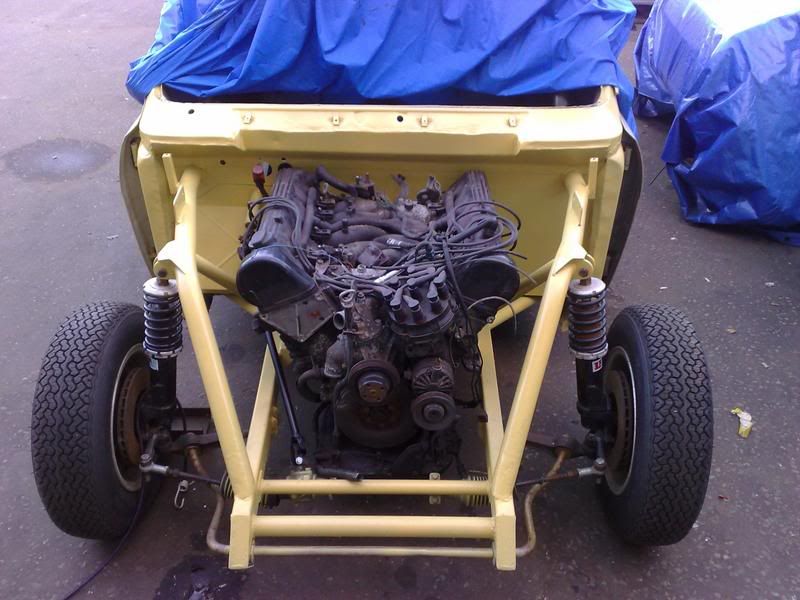
Now I still need to fit the turbos into this space, there isn't much room down the sides when you take into account the manifolds and they may end up slightly poking out of the bonnet yet, will try some configurations when I get the turbos.
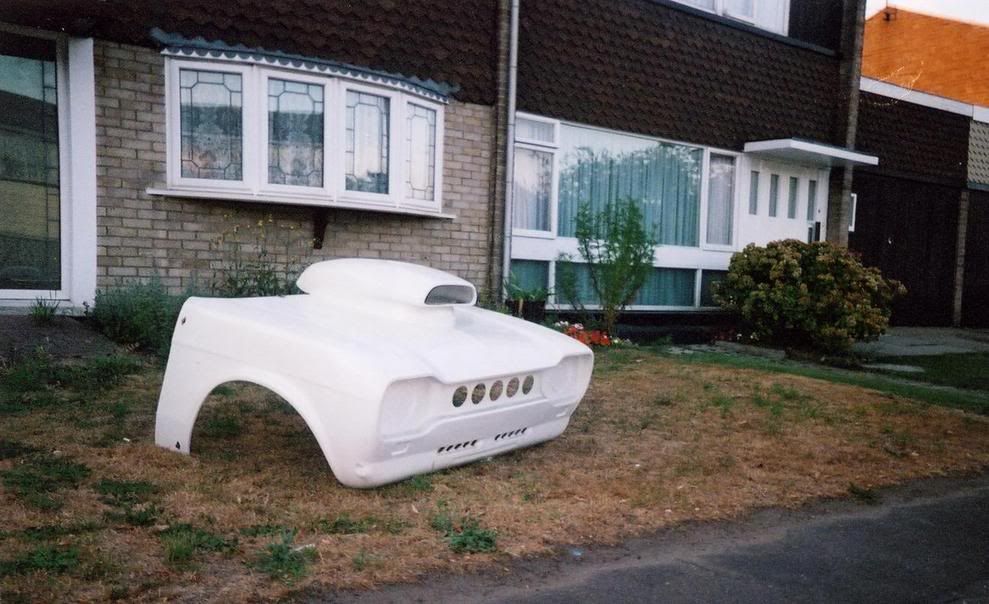
The scoop is going as that was for when I had the old Rover V8 going in, which gave me far more room to work with. The circular cutouts are being opened up for the full width of the grill and a standard grill mounted inside this, the space for direct airflow though is tiny, it's like the car wasn't designed for it or something haha
I saw this set up......
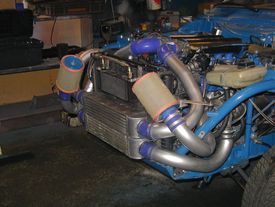
Which is very neat but how does any air actually flow through it, there doesn't seem to be anywhere for it to go?
Dave!
This is where the engine sits in the chassis, very close to the firewall which has been moved back and as low as I can get it safely....
Now I still need to fit the turbos into this space, there isn't much room down the sides when you take into account the manifolds and they may end up slightly poking out of the bonnet yet, will try some configurations when I get the turbos.
The scoop is going as that was for when I had the old Rover V8 going in, which gave me far more room to work with. The circular cutouts are being opened up for the full width of the grill and a standard grill mounted inside this, the space for direct airflow though is tiny, it's like the car wasn't designed for it or something haha
I saw this set up......
Which is very neat but how does any air actually flow through it, there doesn't seem to be anywhere for it to go?
Dave!
Gassing Station | Drag Racing | Top of Page | What's New | My Stuff