
Worn tyres on a track day?
Discussion


My tyres (Michelin PS1s) are on the legal limit and I'm wondering if that would be a good thing on a track day or a bad thing? I'm tempted to give them one last fling on a track day before replacing them (they would definitely be illegal afterwards), but am I better replacing them first and using the new ones once they're past the first 500 miles or so? My thinking was they'd be gripping better now given they're well worn (provided it's a dry day of course).
If its a dry day then worn tyres are generally accepted to be a good idea ime, as most road tyres with lots of tread will overheat quite quickly, so having little movement in the remaining tread is a good thing. Obviously, if they're practically bald its a different story as you run the risk of wearing them out and incurring complications that don't bear thinking about 
With some tyres the grip drops off as you wear through the last bit of tread, so it's a bad idea to use these on track when they're badly worn. You also need to be concerned about how quickly the tyres will wear on the track and whether they could wear so far they become dangerous before you notice. Losing 1mm of tread in a session is no big deal if you have new tyres with 6mm of tread, but quite a big deal if you only had 0.5mm to start with. There is also the risk that if the tyres do wear quicker than you expected and run out of rubber, are you going to have to cut the track day short?
If you decide to replace them first, make sure they're fully cured before the track day. Brand new tyres are very soft and can wear very quickly (and still not grip well either) until they've been through a couple of heat cycles. This won't happen in normal driving (especially this time of year) so if you are going to heat cycle them you're going to have to go out of your way to do it.
If you decide to replace them first, make sure they're fully cured before the track day. Brand new tyres are very soft and can wear very quickly (and still not grip well either) until they've been through a couple of heat cycles. This won't happen in normal driving (especially this time of year) so if you are going to heat cycle them you're going to have to go out of your way to do it.
I remeber reading a magazine article answering this question - the old idea of bald tyres being 'almost like slicks' and therefore ideal for trackdays...
They compared worn tyres, and set of new versions of the same tyres to 'R' tyres (I think they where R888's, but not sure).
The answer was a resounding no - the worn tyres perfored worst in all the tests they did - they overheated quickly, where very unpredictable and didn't have a lot of ultimate grip.
May be due to road tyre construction, 'track' tyres seems to work quite well right down to the 'canvas'
They compared worn tyres, and set of new versions of the same tyres to 'R' tyres (I think they where R888's, but not sure).
The answer was a resounding no - the worn tyres perfored worst in all the tests they did - they overheated quickly, where very unpredictable and didn't have a lot of ultimate grip.
May be due to road tyre construction, 'track' tyres seems to work quite well right down to the 'canvas'
We discussed this on the winter tyres thread in motoring news forum.
Basically the more worn your tyres are the worse they will perform,they do not magically turn themselves into slicks!
The more tread a tyre has the quicker it will go off in hot conditions but it's more than balanced out by having superior grip.& I do mean hot conditions!
Road tyres are a completely different thing to slicks & perform in a much different manner, remember even r888's for all they're known as semi slicks are just a road tyre & that goes for all the other makes of track day tyres as well. They do give increased performance compared to a standard road tyre but performance works in the same way-grip reduces as tread depth decreases.
It's amazing how many people spend a small fortune on their cars yet remain totally in the dark regarding tyres,it's only those four contact patches that keep you on the black stuff guys-look after em!
Basically the more worn your tyres are the worse they will perform,they do not magically turn themselves into slicks!
The more tread a tyre has the quicker it will go off in hot conditions but it's more than balanced out by having superior grip.& I do mean hot conditions!
Road tyres are a completely different thing to slicks & perform in a much different manner, remember even r888's for all they're known as semi slicks are just a road tyre & that goes for all the other makes of track day tyres as well. They do give increased performance compared to a standard road tyre but performance works in the same way-grip reduces as tread depth decreases.
It's amazing how many people spend a small fortune on their cars yet remain totally in the dark regarding tyres,it's only those four contact patches that keep you on the black stuff guys-look after em!
I'm not convinced for example, that a new set of PS2's with 8mm tread depth would perform in the dry as well as a 4mm set.. over a 6-8 lap run, I'm fairly confident that the 8mm ones will overheat because the tread blocks squirm around and as a result go off quicker and not yield the same grip levels as the 4mm ones, there must be a pretty good reason why some race teams shave the tread off new tyres to get a 3-4mm tread depth..? granted fresh moulded rubber that hasn't been sun baked and dried out will give up more grip than ones that have been around for 2-3 years.. so the lap time advantage in this event is coming from the newness of the rubber and not because of the increase in tread depth..
Personally I have run 3-4mm road tread in the dry, and binned them after the day. running new ones, on a stock camber up is a pretty expensive business..! as they are generally destroyed on the shoulders after 1 day, so it can be cost prohibive...
I only run Mich Cup tyres in the dry now, these come with 5mm tread and not 8mm for this very reason, to stop the blocks moving around and the rubber overheating.. as the result is greater temperature stability..
Personally I have run 3-4mm road tread in the dry, and binned them after the day. running new ones, on a stock camber up is a pretty expensive business..! as they are generally destroyed on the shoulders after 1 day, so it can be cost prohibive...
I only run Mich Cup tyres in the dry now, these come with 5mm tread and not 8mm for this very reason, to stop the blocks moving around and the rubber overheating.. as the result is greater temperature stability..
Edited by RatBoy M3CSL on Tuesday 27th October 18:34
I've run all sorts on my car and can generally agree with the comments above, but have found that track day tyres (I've only run A0-32Rs) behave much the same as slicks - ie they retain their grip more or less until the casing shows through. Perhaps these are better than R888s in that respect?
I thought:
Slicks = high grip, progressive, last ages, stable down to the casing
Semi slicks (A0-32Rs at least) = nearly as good grip as slicks, wear quicker, stable down to casing
Good road tyres nearly new = good
Good road tyres half worn = better than new
Good road tyres down to 1 or 2mm = no good, grip goes off quite quickly
Cheap road tyres = no good, especially in wet
The tyres that I thought were no good are generally worst for A) dry straight line braking, B) wet grip.
Any comments...?
I thought:
Slicks = high grip, progressive, last ages, stable down to the casing
Semi slicks (A0-32Rs at least) = nearly as good grip as slicks, wear quicker, stable down to casing
Good road tyres nearly new = good
Good road tyres half worn = better than new
Good road tyres down to 1 or 2mm = no good, grip goes off quite quickly
Cheap road tyres = no good, especially in wet
The tyres that I thought were no good are generally worst for A) dry straight line braking, B) wet grip.
Any comments...?
take a set of wheels for the drive home.
do a few warm up laps in the worn tyres, see how they perform but not on the limit. then check them for wear.
if they are still ok, do another outing, maybe up the ante if you are feeling confident.
check them again for wear. feel all round for any signs of blistering especially on the inside rim area. check the tread across the tyre on different areas of the circumference.
if they are still fine enjoy another 'outing' and check them again after.
when they are beginning to show signs of complete knackered-ness, are ruined or are being too slippy/unpredictable call it a day and drive home on the 'drive home' wheels. strip old tyres off ready for new set.
as long as you are conscientious and check them you should be fine. ultimately they have done the job for a while already but you have to be pedantic about how hard you push them and for how long. if you regulate it you should be able to see how much longer you have left on them. i did this on some rather fast wearing intermediates (I ran them in the dry!!! so they wore really quick) and I could gauge how many 6 lap outings I had left. worked a treat.
job done.
do a few warm up laps in the worn tyres, see how they perform but not on the limit. then check them for wear.
if they are still ok, do another outing, maybe up the ante if you are feeling confident.
check them again for wear. feel all round for any signs of blistering especially on the inside rim area. check the tread across the tyre on different areas of the circumference.
if they are still fine enjoy another 'outing' and check them again after.
when they are beginning to show signs of complete knackered-ness, are ruined or are being too slippy/unpredictable call it a day and drive home on the 'drive home' wheels. strip old tyres off ready for new set.
as long as you are conscientious and check them you should be fine. ultimately they have done the job for a while already but you have to be pedantic about how hard you push them and for how long. if you regulate it you should be able to see how much longer you have left on them. i did this on some rather fast wearing intermediates (I ran them in the dry!!! so they wore really quick) and I could gauge how many 6 lap outings I had left. worked a treat.
job done.
paulmnz said:
I remeber reading a magazine article answering this question - the old idea of bald tyres being 'almost like slicks' and therefore ideal for trackdays...
They compared worn tyres, and set of new versions of the same tyres to 'R' tyres (I think they where R888's, but not sure).
The answer was a resounding no - the worn tyres perfored worst in all the tests they did - they overheated quickly, where very unpredictable and didn't have a lot of ultimate grip.
May be due to road tyre construction, 'track' tyres seems to work quite well right down to the 'canvas'
Mmmm, down to the canvas They compared worn tyres, and set of new versions of the same tyres to 'R' tyres (I think they where R888's, but not sure).
The answer was a resounding no - the worn tyres perfored worst in all the tests they did - they overheated quickly, where very unpredictable and didn't have a lot of ultimate grip.
May be due to road tyre construction, 'track' tyres seems to work quite well right down to the 'canvas'
 !
!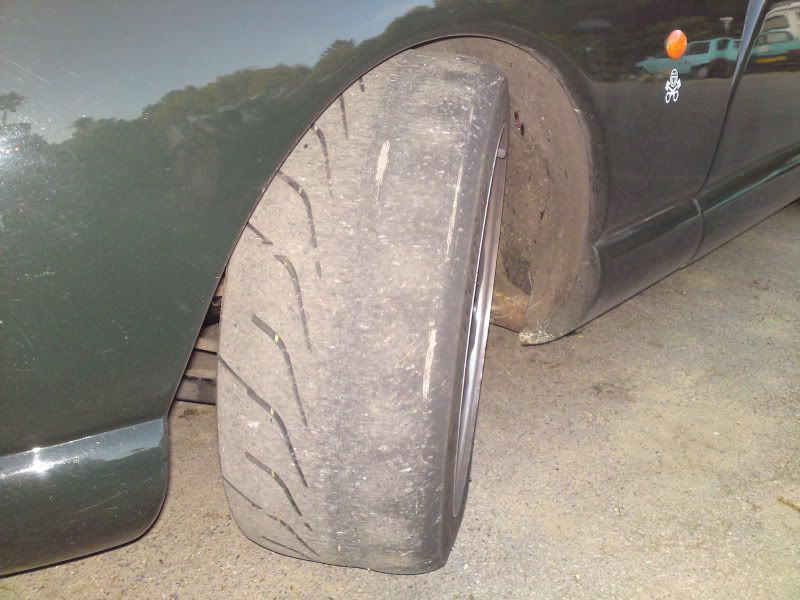
I didn't notice any lack of grip at all, (triple 8's), in fact the handling was predictable to the end, a great day!
Gassing Station | Track Days | Top of Page | What's New | My Stuff