
Adult autism diagnosis - any use?
Discussion


TLDR: does a diagnosis of ASD, in your 40s, actually have any benefit? Specifically, when it comes to the workplace and finding a way to get the best out of you whilst not feeling like your brain is going through a mincer?
The long version:
I am in my 40s. I have, since childhood, had what would be termed "autistic tendencies" and participate in what I now know to be called "masking". Nothing too debilitating, if I am on the spectrum then I'm high functioning. As two of my nephews are profoundly autistic I have some appreciation that the struggles I face are orders of magnitude less than those of people who are far down the other end of the spectrum.
It's never been something I've felt much need to investigate until the last two years. My daughter exhibits similar traits, and I see her struggling with some of the same matters of "understanding people" and "the world isn't as it should be" that I have always struggled with. My mind turns to how I can prepare her for a world that is frankly disorganised and stupid, and what tools I can equip her with to reduce stress and anxiety along the way.
However... Recently my brain's workings have been causing me real problems at work. I need focus time. I cannot flick from task to task. Recently my job has evolved (without me being part of the decision) into one where I am expected to flick between tasks ad hoc, on the whims of four different bosses, each with their own sense of priorities. The result is that instead of having focused time to work on each problem (somewhat sequentially) I am expected to switch in and out of tasks with abandon.
My brain clearly cannot cope with that and all I end up doing is spiralling and achieving next to nothing. The response from management is to pile on more pressure, thinking that will somehow push the work out of me. When all I need is time to focus and finish task A before I think about task B. If I dip in and out of tasks then nothing happens.
I wonder if seeking out some assessment of neurological differences might help. A piece of paper to point to that means my employer will take note that they need to let me focus, or we need to spread the work across more people instead of me trying to spin plates. Or, they'll need to explain that adjustments can't be made and I need to look for a new appointment. Which would be a shame because I quite liked the job and the people before.
For some context, my job is in STEM, the job involves problem solving, mathematical modelling, sometimes coming up with new solutions to problems.
I should say the issue is not one of mental capability; a physical analogue would be starting off by asking Geoff Capes to lift a 50lb barbell, but then ask him to suddenly put that one down and lift this other one over here. No, not that one, this one. Why are you lifting that one Geoff? I already told you I wanted THAT barbell lifted by the end of the week and you're lifting that other guy's barbells. Come on Geoff, can't you lift a 50lb barbell?! Geoff Capes could lift that barbell with one finger, but he couldn't switch between several different barbells like that.
Now... when I was 5, following some observations by my school about some behaviours, I was assessed for something. I remember having to play with toys and talk to some adults while my mum had to sit off to the side. My parents spoke of it a few times, but never said anything of any conclusions drawn and I never thought to ask. Unfortunately my mum died a few years ago and my dad has a swiss cheese brain, so I'll never know.
The long version:
I am in my 40s. I have, since childhood, had what would be termed "autistic tendencies" and participate in what I now know to be called "masking". Nothing too debilitating, if I am on the spectrum then I'm high functioning. As two of my nephews are profoundly autistic I have some appreciation that the struggles I face are orders of magnitude less than those of people who are far down the other end of the spectrum.
It's never been something I've felt much need to investigate until the last two years. My daughter exhibits similar traits, and I see her struggling with some of the same matters of "understanding people" and "the world isn't as it should be" that I have always struggled with. My mind turns to how I can prepare her for a world that is frankly disorganised and stupid, and what tools I can equip her with to reduce stress and anxiety along the way.
However... Recently my brain's workings have been causing me real problems at work. I need focus time. I cannot flick from task to task. Recently my job has evolved (without me being part of the decision) into one where I am expected to flick between tasks ad hoc, on the whims of four different bosses, each with their own sense of priorities. The result is that instead of having focused time to work on each problem (somewhat sequentially) I am expected to switch in and out of tasks with abandon.
My brain clearly cannot cope with that and all I end up doing is spiralling and achieving next to nothing. The response from management is to pile on more pressure, thinking that will somehow push the work out of me. When all I need is time to focus and finish task A before I think about task B. If I dip in and out of tasks then nothing happens.
I wonder if seeking out some assessment of neurological differences might help. A piece of paper to point to that means my employer will take note that they need to let me focus, or we need to spread the work across more people instead of me trying to spin plates. Or, they'll need to explain that adjustments can't be made and I need to look for a new appointment. Which would be a shame because I quite liked the job and the people before.
For some context, my job is in STEM, the job involves problem solving, mathematical modelling, sometimes coming up with new solutions to problems.
I should say the issue is not one of mental capability; a physical analogue would be starting off by asking Geoff Capes to lift a 50lb barbell, but then ask him to suddenly put that one down and lift this other one over here. No, not that one, this one. Why are you lifting that one Geoff? I already told you I wanted THAT barbell lifted by the end of the week and you're lifting that other guy's barbells. Come on Geoff, can't you lift a 50lb barbell?! Geoff Capes could lift that barbell with one finger, but he couldn't switch between several different barbells like that.
Now... when I was 5, following some observations by my school about some behaviours, I was assessed for something. I remember having to play with toys and talk to some adults while my mum had to sit off to the side. My parents spoke of it a few times, but never said anything of any conclusions drawn and I never thought to ask. Unfortunately my mum died a few years ago and my dad has a swiss cheese brain, so I'll never know.
Wow, you've described me, and my daughter.
I've always known I'm different, at a young age there were noises I just couldn't stand.
And jobs, just one at a time, but my observation skills are another level (many car dealers describing my eye)
I've wondered whether a diag would be needed?
I haven't bothered as I function 95% ok
But I do wear my hidden disability lanyard when on cruise boats, and on public transport (explains me having to wear earphone sometimes)
So I'll follow your thread with much interest.
First thing I'd do with work is tell them they're loading too much work on you, and can I please just complete one task at a time?
I've always known I'm different, at a young age there were noises I just couldn't stand.
And jobs, just one at a time, but my observation skills are another level (many car dealers describing my eye)
I've wondered whether a diag would be needed?
I haven't bothered as I function 95% ok
But I do wear my hidden disability lanyard when on cruise boats, and on public transport (explains me having to wear earphone sometimes)
So I'll follow your thread with much interest.
First thing I'd do with work is tell them they're loading too much work on you, and can I please just complete one task at a time?
Noises, yes! We have a "work on campus" initiative at the moment, so I end up in an open plan office wearing noise cancelling headphones for most of the day.
Open plan offices are a bugbear... It's a big room full of scientists and engineers, professions that do attract more than their fair share of the 'tism, with some accountants sprinkled in (generally within shouting distance of the spectrum). So we have people who cannot control the modulation of their voice and often have idiosyncratic behaviour and movements, sharing the same space as people who are distracted more easily than a dog in a room full of squirrels. Then we want them to concentrate. What knobhead thought open plan was a good idea?
COVID was a godsend so far as that was concerned. I can work in a silent office, tucked away at the back of the house, by myself. I lose focus? I can go away and come back later.
Open plan offices are a bugbear... It's a big room full of scientists and engineers, professions that do attract more than their fair share of the 'tism, with some accountants sprinkled in (generally within shouting distance of the spectrum). So we have people who cannot control the modulation of their voice and often have idiosyncratic behaviour and movements, sharing the same space as people who are distracted more easily than a dog in a room full of squirrels. Then we want them to concentrate. What knobhead thought open plan was a good idea?
COVID was a godsend so far as that was concerned. I can work in a silent office, tucked away at the back of the house, by myself. I lose focus? I can go away and come back later.
OP- i could have written that post word for word.
I’ve thought for a while now that I was probably somewhat autistic- when my son was younger a few people said he does things in a bit of an autistic way way. I thought oh I do that too- as does my dad. So it probably runs in the family.
2 years ago I got promoted to run the design team I was in, resulting in me having to jump between tasks constantly, deal with conflicting priorities and manage people. Previously I had big long solo design projects I could just immerse myself in.
As a result my mental state had become really low, wasn’t coping at work, my wife was at her wits end as I was just becoming burnt out. Finally gave in and had some therapy sessions which have been really useful- finally realised that it’s not that I’m useless it’s just my brain isn’t wired in the right way to do that job.
I have since handed in my notice so I can go back to the design job I loved. Bit of a gamble financially but I’m so much happier and can’t wait for the next step in my career.
I’m glad to have had the opportunity to lead the team- it was always the “end goal”- but now I’ve done it I know it’s not where my strengths lie. For me, happiness and job satisfaction outweighs the extra salary.
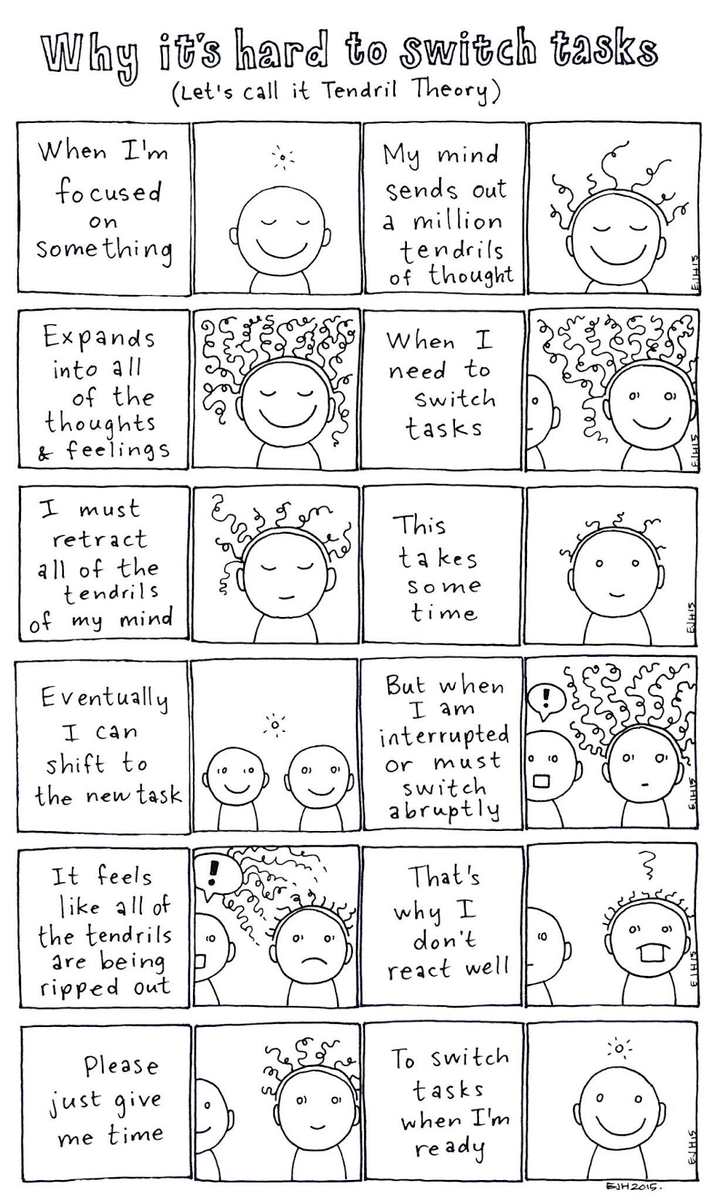
Bit cheesy but I like this cartoon:
I’ve thought for a while now that I was probably somewhat autistic- when my son was younger a few people said he does things in a bit of an autistic way way. I thought oh I do that too- as does my dad. So it probably runs in the family.
2 years ago I got promoted to run the design team I was in, resulting in me having to jump between tasks constantly, deal with conflicting priorities and manage people. Previously I had big long solo design projects I could just immerse myself in.
As a result my mental state had become really low, wasn’t coping at work, my wife was at her wits end as I was just becoming burnt out. Finally gave in and had some therapy sessions which have been really useful- finally realised that it’s not that I’m useless it’s just my brain isn’t wired in the right way to do that job.
I have since handed in my notice so I can go back to the design job I loved. Bit of a gamble financially but I’m so much happier and can’t wait for the next step in my career.
I’m glad to have had the opportunity to lead the team- it was always the “end goal”- but now I’ve done it I know it’s not where my strengths lie. For me, happiness and job satisfaction outweighs the extra salary.
Bit cheesy but I like this cartoon:
donkmeister said:
However... Recently my brain's workings have been causing me real problems at work. I need focus time. I cannot flick from task to task. Recently my job has evolved (without me being part of the decision) into one where I am expected to flick between tasks ad hoc, on the whims of four different bosses, each with their own sense of priorities. The result is that instead of having focused time to work on each problem (somewhat sequentially) I am expected to switch in and out of tasks with abandon.
My brain clearly cannot cope with that and all I end up doing is spiralling and achieving next to nothing. The response from management is to pile on more pressure, thinking that will somehow push the work out of me. When all I need is time to focus and finish task A before I think about task B. If I dip in and out of tasks then nothing happens.
[...]
For some context, my job is in STEM, the job involves problem solving, mathematical modelling, sometimes coming up with new solutions to problems.
I have no expertise regarding ASD (other than managing people who are on the spectrum) but it seems to be that, whether or not you are on the spectrum, the core problem here is that you're being forced to context-switch too frequently, and that is negatively impacting your productivity (and, presumably, causing you stress). My brain clearly cannot cope with that and all I end up doing is spiralling and achieving next to nothing. The response from management is to pile on more pressure, thinking that will somehow push the work out of me. When all I need is time to focus and finish task A before I think about task B. If I dip in and out of tasks then nothing happens.
[...]
For some context, my job is in STEM, the job involves problem solving, mathematical modelling, sometimes coming up with new solutions to problems.
In an ideal world, you would have a one person setting your priorities (instead of four different people constantly trying to get you to prioritise whatever they want you to do) - i.e. a single manager who would field work requests from the four different bosses, decide how they should be prioritised, and act as a buffer to protect you from their pressure.
If that sounds like a good solution, the key question is: How do you get there?
Edited by MadCaptainJack on Friday 2nd October 18:19
Is this a situation where, as some YouTubers would say, 'you need to learn to say No'?
i.e. in the absence of a single manager above you upon whom you can rely to support your preferred (and indeed most productive) working practices, you effectively need to become that manager yourself and set down how you are working and how others' work requests will be dealt with within that framework / operational practices.
'I can do that, but it will need several hours of focused time and I don't have a suitable block of time/capacity until Wednesday PM.'
'This cannot be done in the timescale you request unless all other work is paused, and doing so would have unacceptable knock-on impacts on person X and Y and project Z.'
'I can reprioritise the other work you have requested so that I can get this urgent task done, but it will cause delays of X days to that other project.'
All easier typed on the internet than said and done in the real world, of course...
It seems anecdotally to be the case that those most valued / most highly paid, are those that are good at their job, know they are good at their job, and who set the 'terms of engagement' with others who are paying for their services.
Or at least that is my perception of the PBPH Directors
i.e. in the absence of a single manager above you upon whom you can rely to support your preferred (and indeed most productive) working practices, you effectively need to become that manager yourself and set down how you are working and how others' work requests will be dealt with within that framework / operational practices.
'I can do that, but it will need several hours of focused time and I don't have a suitable block of time/capacity until Wednesday PM.'
'This cannot be done in the timescale you request unless all other work is paused, and doing so would have unacceptable knock-on impacts on person X and Y and project Z.'
'I can reprioritise the other work you have requested so that I can get this urgent task done, but it will cause delays of X days to that other project.'
All easier typed on the internet than said and done in the real world, of course...
It seems anecdotally to be the case that those most valued / most highly paid, are those that are good at their job, know they are good at their job, and who set the 'terms of engagement' with others who are paying for their services.
Or at least that is my perception of the PBPH Directors
Edited by RSTurboPaul on Friday 2nd October 18:42
Gassing Station | Jobs & Employment Matters | Top of Page | What's New | My Stuff