
Vintage Breitling Navitimer Back From Overhaul
Discussion


I'm sure I mentioned somewhere in another thread I was waiting for my 1969 vintage Breitling to come back from Breitling UK following a full overhaul, well it's back, it wasn't cheap (£1,169) but they did a fantastic job on it!


Remember, this is what it was like.....................

Stef
Remember, this is what it was like.....................
Stef


 Saying that, it looks stunning!
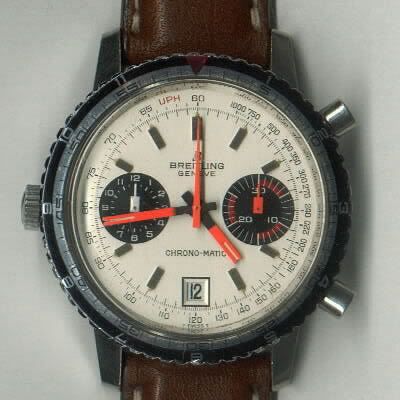

The early ones were all lefties as they used the Calibre 11 movement. Some digging and googling revealed the following info though the link I have to the information is now dead. Luckily I copied it into a Word doc and kept it.
The Race
The 1960s saw the race towards the development of the world’s first automatic chronograph movement, with two groups of watchmakers in competition to achieve this milestone. The groups of Movado/Zenith (further referred to as M/Z) and Heuer/Breitling/Hamilton/Dubois Depraz (further referred to as H/B/H/DD) achieved their aims independently and exhibited their new developments at the Basel Fair in 1969. Both claimed to be the first to introduce the automatic chronograph movement, however, the Caliber 11 movement of H/B/H/DD had beaten the M/Z group by over a month.
Heuer/Breitling/Hamilton/Dubois Depraz
The main competition of M/Z came from the amalgamation of the chronograph specialists Breitling and Heuer-Leonidas with Hamiliton-Bruen and Dubois Depraz, who started the development of their project in 1965. When the delegation of the four houses met together for the first time in 1965, they were so obsessed with keeping things quiet that they gave their project a confidential code name: 99. During this meeting, the role each house would play was distributed in utter secrecy. Bruen would be in charge of the special automatic mechanism (adapted from Bruen’s "Intramatic" caliber: Planetary rotor of heavy winding in both directions via gliding pinion); Dubois-Depraz would be responsible for the chronographic module (chronograph unit 8510 with coulisse-lever switching, equipped with a 12-hour and a 30-minute counter) as well as the oscillating pinion invented by Edouard Heuer. Breitling and Heuer would develop the other components and oversee the design of the watch dial and case.
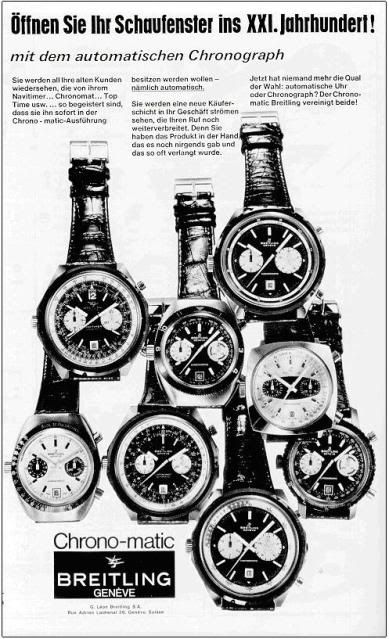
By 1968, the group had carried out the first conclusive tests and developed experimental prototypes. The winding-mechanism and the caliber 11 chronograph, the ‘chrono-matic’ measuring 13 ¾ lines (31 mm in diameter) and 7.7 mm in height, worked marvellously well, even under extreme conditions, with an accuracy close to the norms required of a chronometer. The world’s first automatic chronograph (developed at a total cost of 500,000 Swiss francs) was officially unveiled on March 3rd 1969, over a month before the Basel fair where the ‘El Primero’ was introduced. Named ‘Chrono-matic’, the movement was used in several models by the developers. Heuer used the movement in the ‘Monaco’, ‘Carrera’ and ‘Autavia’ models, Breitling in the ‘Chrono-matic’ models and Hamilton/Bruen in several models.
The Caliber 11
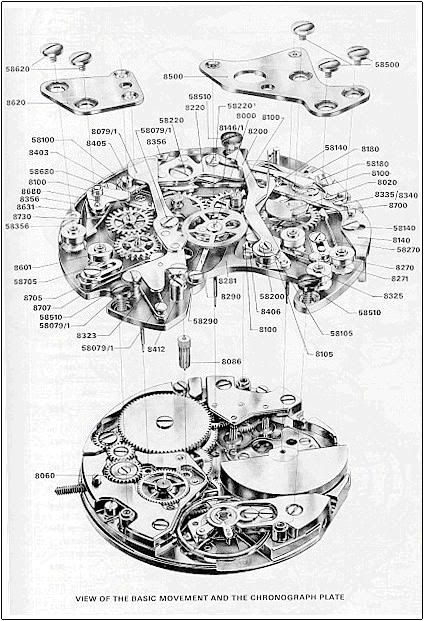
Beating at 19,800 bps, ‘Chrono-matic’ consists of a basis movement unit and a chrono-section unit. These two units are attached with screws, one on top of the other. The design required that the winding stem with the crown had to be removed to the position of the 9. Although a surprising innovation, it seems that all the firms agreed that this would be the best. Since this watch does not often need to be wound up by hand, it follows that the chronograph buttons would be better located on the right side of the case.
A suitable winding mechanism is required for this automatic chronograph. The heavy microrotor that winds the mainspring is housed in the basic movement and has a pointed dead angle of only 11 degrees, which means that even relatively inactive wearers can always depend on the watch being wound up. In addition, a special regulator setting was developed for the watch, with eccentric setting and moveable spiral block, which allow precise regulation and the smallest error in the timing. These developments are also patented.
Later versions of the Caliber 11:
The difference between the caliber 11 and 12 lies with the beats. The Caliber 12, which is an updated version, beats faster at 21,600 bps. The later versions from Heuer and Breitling are the caliber 14 and 15, some with 3 registers instead of 2.
The Race
The 1960s saw the race towards the development of the world’s first automatic chronograph movement, with two groups of watchmakers in competition to achieve this milestone. The groups of Movado/Zenith (further referred to as M/Z) and Heuer/Breitling/Hamilton/Dubois Depraz (further referred to as H/B/H/DD) achieved their aims independently and exhibited their new developments at the Basel Fair in 1969. Both claimed to be the first to introduce the automatic chronograph movement, however, the Caliber 11 movement of H/B/H/DD had beaten the M/Z group by over a month.
Heuer/Breitling/Hamilton/Dubois Depraz
The main competition of M/Z came from the amalgamation of the chronograph specialists Breitling and Heuer-Leonidas with Hamiliton-Bruen and Dubois Depraz, who started the development of their project in 1965. When the delegation of the four houses met together for the first time in 1965, they were so obsessed with keeping things quiet that they gave their project a confidential code name: 99. During this meeting, the role each house would play was distributed in utter secrecy. Bruen would be in charge of the special automatic mechanism (adapted from Bruen’s "Intramatic" caliber: Planetary rotor of heavy winding in both directions via gliding pinion); Dubois-Depraz would be responsible for the chronographic module (chronograph unit 8510 with coulisse-lever switching, equipped with a 12-hour and a 30-minute counter) as well as the oscillating pinion invented by Edouard Heuer. Breitling and Heuer would develop the other components and oversee the design of the watch dial and case.
By 1968, the group had carried out the first conclusive tests and developed experimental prototypes. The winding-mechanism and the caliber 11 chronograph, the ‘chrono-matic’ measuring 13 ¾ lines (31 mm in diameter) and 7.7 mm in height, worked marvellously well, even under extreme conditions, with an accuracy close to the norms required of a chronometer. The world’s first automatic chronograph (developed at a total cost of 500,000 Swiss francs) was officially unveiled on March 3rd 1969, over a month before the Basel fair where the ‘El Primero’ was introduced. Named ‘Chrono-matic’, the movement was used in several models by the developers. Heuer used the movement in the ‘Monaco’, ‘Carrera’ and ‘Autavia’ models, Breitling in the ‘Chrono-matic’ models and Hamilton/Bruen in several models.
The Caliber 11
Beating at 19,800 bps, ‘Chrono-matic’ consists of a basis movement unit and a chrono-section unit. These two units are attached with screws, one on top of the other. The design required that the winding stem with the crown had to be removed to the position of the 9. Although a surprising innovation, it seems that all the firms agreed that this would be the best. Since this watch does not often need to be wound up by hand, it follows that the chronograph buttons would be better located on the right side of the case.
A suitable winding mechanism is required for this automatic chronograph. The heavy microrotor that winds the mainspring is housed in the basic movement and has a pointed dead angle of only 11 degrees, which means that even relatively inactive wearers can always depend on the watch being wound up. In addition, a special regulator setting was developed for the watch, with eccentric setting and moveable spiral block, which allow precise regulation and the smallest error in the timing. These developments are also patented.
Later versions of the Caliber 11:
The difference between the caliber 11 and 12 lies with the beats. The Caliber 12, which is an updated version, beats faster at 21,600 bps. The later versions from Heuer and Breitling are the caliber 14 and 15, some with 3 registers instead of 2.
Edited by Spice_Weasel on Friday 22 October 16:13


 .......
Gassing Station | Watches | Top of Page | What's New | My Stuff