
US military to launch fastest-ever plane ( 1 hr Lon-Sydney)
Discussion


http://www.guardian.co.uk/world/2011/aug/10/us-mil...
extract:
By the time you finish reading this sentence, the Falcon HTV-2, the fastest plane ever built, could have flown 18 miles. It would get from London to Sydney in less than an hour, while withstanding temperatures of almost 2,000C, hotter than the melting point of steel.
At 3pm BST on Thursday , the US Defence Advance Research Projects Agency will launch the Falcon Hypersonic Technology Vehicle 2 on the back of a rocket from the Vandenberg Air Force Base in California. If all goes to plan, engineers will launch the Falcon HTV-2 to the edge of space, before detaching the plane and guiding it on a hypersonic flight that will reach speeds of 13,000mph (about 20 times the speed of sound) on its return to Earth.
extract:
By the time you finish reading this sentence, the Falcon HTV-2, the fastest plane ever built, could have flown 18 miles. It would get from London to Sydney in less than an hour, while withstanding temperatures of almost 2,000C, hotter than the melting point of steel.
At 3pm BST on Thursday , the US Defence Advance Research Projects Agency will launch the Falcon Hypersonic Technology Vehicle 2 on the back of a rocket from the Vandenberg Air Force Base in California. If all goes to plan, engineers will launch the Falcon HTV-2 to the edge of space, before detaching the plane and guiding it on a hypersonic flight that will reach speeds of 13,000mph (about 20 times the speed of sound) on its return to Earth.
Mr Dave said:
How come US DOD are doing all the practical aerospace development while NASA seems to be pretty much not?
Because they has the budget? Always been a battle between USAF and NASA for budget for things like this, the shuttle was supposed to be a joint venture at one point.Mr Dave said:
How come US DOD are doing all the practical aerospace development while NASA seems to be pretty much not?
Apart from the Apollo era, the DoD has had more money available to spend on space than NASA has had.The USAF has ALWAYS had an agenda to run its own manned programme. At one point it had its own separate projects (Dyna-Soar and the Manned Orbiting Laboratory) but both of these projects were cancelled.
The Space Shuttle would not have been built without military support - and indeed, it would have been a very different (and probably more practical and safe vehicle) if the military had not insisted on various requirements.
What we are seeing is the demise of NASA as the provider of manned spaceflight in the US and its replacement by the USAF and, probably, independent commercial ventures supported by NASA.
stew-S160 said:
Well it crashed, again.
Something about the design has got me wondering. Why have they gone for such a pointed nose? I thought that such a design would cause a lot more instability during flight due to the air wave passing over the vehicle?
http://uk.news.yahoo.com/worlds-fastest-plane-designed-us-military-112431862.htmlSomething about the design has got me wondering. Why have they gone for such a pointed nose? I thought that such a design would cause a lot more instability during flight due to the air wave passing over the vehicle?
Well as they say in technical circles, "Back to the drawing board"


RobDickinson said:
Where is the line drawn between missile and plane?
Originally, the word missile was used when referring to a "ballistic missile" i.e an object whjich flies through the air (or above the air) on a ballistic arc. The object follows a path imparted upon it by the force of its firing (a cannon/gun or a rocket motor) and the effect of the earth's garvitational field. A ballistic missile dows not generate aerodynamic lift.Objects which fly through the air using wings or their body shape to generate lift are not ballistic missiles, they are aircraft.
Obviously, there is some crossover betrween the two concepts. a nominally ballistic missile or its warhead/payload capsule will actually generate aerodynamic flight if the missile or nose cone is shaped in a particular way and it travels through the air fast enough. The Apollo space capsule was a typical ballistic nose-cone shape, but at Mach 30 it could generate aerodynamic lift and this was used to refine its re-entry path through the atmosphere prior to splashdown.
Cruise missiles are really unmamned aircraft and usually only have a very short paeriod of ballistic flight i.e. the initial few seconds of launch from the ground or a ship/submarine. Air launched crusie missiles undertake all their flights as aircraft.
I had to chuckle at this yesterday- almost all the newspapers/news websites where running this story and touting the speed as an indication that it will "carry passengers from London to Sydney in 1hr" proof positive if it where needed that hacks don't read press releases!
The above posting discussing the similarity to a ballistic missile is a far closer analogy to this experiment than a commercial flight.
I know its just the journos trying to put something into terms people will understand but frankly its embarrasing.
That said I am sorry it failed (or is reported to have failed) wonder if thats DOD coverup? As its an incredible challenge, in many ways its trickier than space flight as the atmosphere (even at the altitude of these flights) is a thick thing to punch through at low Mach numbers, what they are trying to do it like flying through jelly :-)
The above posting discussing the similarity to a ballistic missile is a far closer analogy to this experiment than a commercial flight.
I know its just the journos trying to put something into terms people will understand but frankly its embarrasing.
That said I am sorry it failed (or is reported to have failed) wonder if thats DOD coverup? As its an incredible challenge, in many ways its trickier than space flight as the atmosphere (even at the altitude of these flights) is a thick thing to punch through at low Mach numbers, what they are trying to do it like flying through jelly :-)
Geting aircraft to fly aerodynamically at hypersonic speeds is extremely difficult. Just the slightest twitch in an aileron, elevator or rudder will send the aircraft into an uncontrollable high Mach tumble which will result in vehicle break up or even burn up.
The Space Shuttle was a genuine Mach 20+ aerodynamic flyer and Columbia showed what can happen within seconds once structural integrity is lost.
Back in 1968, an X-15 came very close to heat destruction in one of its test flights - and that was travelling at Mach 6.7 - the fastest speed achieved in the X-15 programme. That X-15 never flew again.
The Space Shuttle was a genuine Mach 20+ aerodynamic flyer and Columbia showed what can happen within seconds once structural integrity is lost.
Back in 1968, an X-15 came very close to heat destruction in one of its test flights - and that was travelling at Mach 6.7 - the fastest speed achieved in the X-15 programme. That X-15 never flew again.
scubadude said:
I had to chuckle at this yesterday- almost all the newspapers/news websites where running this story and touting the speed as an indication that it will "carry passengers from London to Sydney in 1hr" proof positive if it where needed that hacks don't read press releases!
London to Sydney in ONE hour fantastic, now can we just reduce the 3 - 4 hour check in, and 2-3 hours the other end clearing immigration/customs.I can't see Ryanair getting one of these though, the tight git won't have time to sell sarnies on the flight
So these are just hypersonic test gliders? Thought that's what the shuttle essentially was too? Why such difficulties with this then? It doesn't appear to have its own engine so what's so different about it compared to what was developed and mastered with the the shuttle program?
No mention of any hypersonic propulsion systems involved like that successfully tested with NASA's X-43A scramjet.
Are these two projects at all related or is that the hush hush part?
No mention of any hypersonic propulsion systems involved like that successfully tested with NASA's X-43A scramjet.
Are these two projects at all related or is that the hush hush part?
I think the big difference is that the Shuttle was a hypersonic aircraft by default i.e. it entered the atmopshere at high Mach numbers because it was decelerating from the necessary orbital velocity of 17,500 mph. All through the descent the Shuttle was slowing so that by the time it had reached overhead its destination, it was just slightly above the speed of sound.
I think this vehicle is designed to maintain high hypersonic speeds for a much longer portion of its flight profile as it still needs to be flying quite quickly when it arives at its destination.
I am sure the flight profiles of the Shuttle and this are very different.
The USAF have shown they can handle Shuttle type scenarios already - with their remote-controlled X-37.
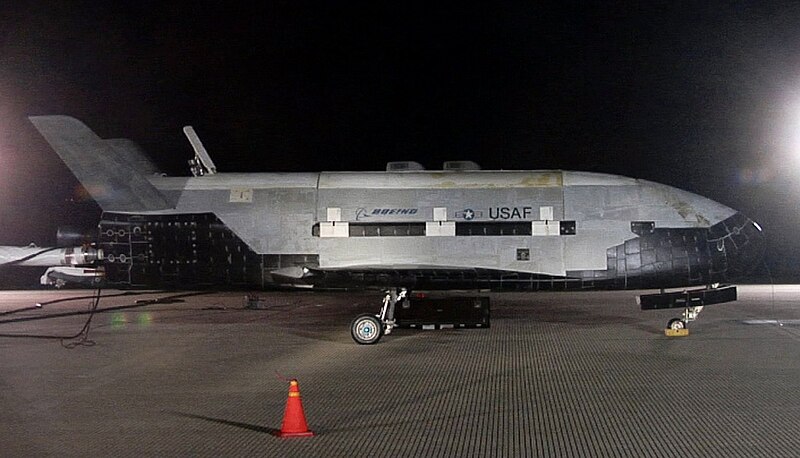
I think this vehicle is designed to maintain high hypersonic speeds for a much longer portion of its flight profile as it still needs to be flying quite quickly when it arives at its destination.
I am sure the flight profiles of the Shuttle and this are very different.
The USAF have shown they can handle Shuttle type scenarios already - with their remote-controlled X-37.
Gassing Station | Boats, Planes & Trains | Top of Page | What's New | My Stuff