
Research and Experimental Aircraft
Discussion


I've always been fascinated by the weird and wonderful - and often downright dangerous - test and one-off prototype aircraft that hve been built over the years.
I thought it might be interesting to see what other PHers might have as their favourite or most impressive research aeroplane. There are many to chose from.
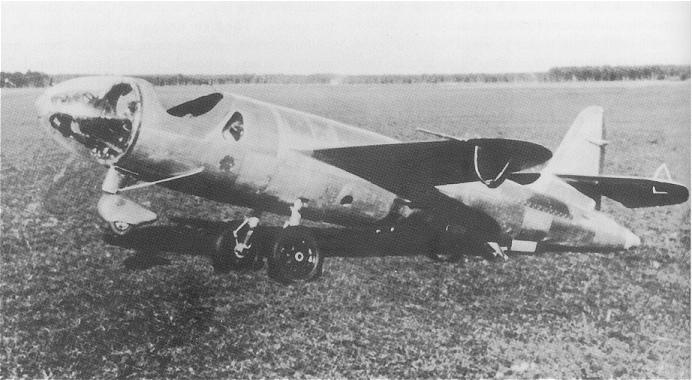
I'll start the ball rolling with the rocket powered Heinkel He176. I've just been reading Erich Warsitz's biography. he was the one and only person who ever flew this contraption and it was a pretty hairy litle beast. This is the only known decent photograph of the machine -
I thought it might be interesting to see what other PHers might have as their favourite or most impressive research aeroplane. There are many to chose from.
I'll start the ball rolling with the rocket powered Heinkel He176. I've just been reading Erich Warsitz's biography. he was the one and only person who ever flew this contraption and it was a pretty hairy litle beast. This is the only known decent photograph of the machine -
It was. The wing span was pretty short too.
It was designed for speeds up to 1,000 kmh - so Heinkel genuinely thought that it would be the first supersonic aircraft. They tested models in a transonic tunnel in 1936/37 and were fully confident that it could exceed the speed of sound. It was designed with very thin wings and a bullet shaped fuselage - much like the later Miles M.52 and the Bell X-1.
The main reason why it may not have succeeded was down to the tailfin which indicates to me that it would have been directionally unstable at high speeds. Its other main problem was the extremely limited endurance of the rocket motor - less than a minute. There simply would not have been enough time to take off from the ground and accelerate to the necessary speed. That is the reason why the X-1 was air dropped.
In an emergency, the nose cone was jettisonable - like the Miles M.52.
As it was, the German High Command ordered a stop to the programme on the basis that it was a diversion of resources from the upcoming conflict and it was too dangerous. It ended up in the Berlin Museum and being destroyed by an Allied bombing raid in 1943.
The nosewheel was a ground handling device only. It was essentially a tail wheel design.
It was designed for speeds up to 1,000 kmh - so Heinkel genuinely thought that it would be the first supersonic aircraft. They tested models in a transonic tunnel in 1936/37 and were fully confident that it could exceed the speed of sound. It was designed with very thin wings and a bullet shaped fuselage - much like the later Miles M.52 and the Bell X-1.
The main reason why it may not have succeeded was down to the tailfin which indicates to me that it would have been directionally unstable at high speeds. Its other main problem was the extremely limited endurance of the rocket motor - less than a minute. There simply would not have been enough time to take off from the ground and accelerate to the necessary speed. That is the reason why the X-1 was air dropped.
In an emergency, the nose cone was jettisonable - like the Miles M.52.
As it was, the German High Command ordered a stop to the programme on the basis that it was a diversion of resources from the upcoming conflict and it was too dangerous. It ended up in the Berlin Museum and being destroyed by an Allied bombing raid in 1943.
The nosewheel was a ground handling device only. It was essentially a tail wheel design.

It's the Fairey Delta 2. Two of these were built and it was the first aircraft to exceed 1,000 mph in level flight. Later one FD2 was converted into the BAC 221 and fitted with a new wing to replicate the proposed shape of Concorde's wing.
Both aircraft are preserved, the FD2 at Cosford and the 221 at Yeovilton.
The main test pilot for the FD2 was Peter Twiss, who sadly died last year.
Here's the Fairey Delta 1, which was a completely different aircraft.

Both aircraft are preserved, the FD2 at Cosford and the 221 at Yeovilton.
The main test pilot for the FD2 was Peter Twiss, who sadly died last year.
Here's the Fairey Delta 1, which was a completely different aircraft.
Edited by Eric Mc on Thursday 26th January 11:09
WestYorkie said:
Didn't the Fairey Delta 2 hold the speed record for a while?
I got a book for Xmas called 'Empire of the clouds' great book and some great pics.
Going to find a pic that's in there.
It did. A few British aircraft held World Air Speed records in that era, including the Supermarine Swift.I got a book for Xmas called 'Empire of the clouds' great book and some great pics.
Going to find a pic that's in there.

That wasn't an Experimental nor a Research aircraft (and it was never actually built) so hardly fits into the theme of the thread 
I'd also like tio discuss some of the non-British protitypes, which were often every bit as weird and eccentric. I think the French were particularly crazy with some of their concepts -

I'd also like tio discuss some of the non-British protitypes, which were often every bit as weird and eccentric. I think the French were particularly crazy with some of their concepts -


Gassing Station | Boats, Planes & Trains | Top of Page | What's New | My Stuff