
Boeing Stearman or DH Tiger Moth?
Discussion


-06.jpg)

Simpo Two said:
Tiger Moth. If it was good enough for BoB pilots it's good enough for me.
Quite a few BoB pilots wouldn't have done their elementary training on Tiger Moths. In the 1930s, the Avro Tutor and the Miles Magister were also used as basic trainers. However, as the war progressed, the Tiger Moth became the dominant trainer in the Commonwealth Training Scheme, with quite a few being built and used in Canada and Australia.However, thousands of RAF pilots were also trained in the USA, under the Arnold Scheme, which meant they were mainly trained on Stearmans.
Eric Mc said:
However, thousands of RAF pilots were also trained in the USA, under the Arnold Scheme, which meant they were mainly trained on Stearmans.
While the Arnold scheme with the USAAC (from June 1941) and the Towers scheme with the USN (from July 1941) carried out basic training on the Stearman / Kaydet PT13 / PT17 (N2S in USN nomenclature), don't forget that there was the American BFTS scheme (set up based upon an agreement between Churchill and Roosevelt) that began in May 1941 with 7 schools primarily using the PT19 Cornell as the basic trainer.Having flown both the PT17 and the Tiger Moth (as well as the PT19), for me the choice would be the Tiggie. While easy to fly, just like it's DeHavilland stable mate and replacement the Chippie, it is easy to fly but difficult to fly well. IMO that makes it the choice for an elementary / basic trainer because it rapidly shows up who has the real handling skills and potential to be a Service pilot.
Edited by Ginetta G15 Girl on Tuesday 20th November 08:15
Ginetta G15 Girl said:
IMO that makes it the choice for an elementary / basic trainer because it rapidly shows up who has the real handling skills and potential to be a Service pilot.
That makes perfect sense.Although Richthofen and Gabreski were faltering students so maybe you can't always tell! Sometimes I wonder whether flying is a progressive linear thing, or whether you just wake up one morning and it all snaps into place.
Ginetta G15 Girl said:
Having flown both the PT17 and the Tiger Moth (as well as the PT19), for me the choice would be the Tiggie. While easy to fly, just like it's DeHavilland stable mate and replacement the Chippie, it is easy to fly but difficult to fly well. IMO that makes it the choice for an elementary / basic trainer because it rapidly shows up who has the real handling skills and potential to be a Service pilot.
Interesting though that the Soviet equivalent of the Chippie, the Yak-52 and original Yak-18 before it, were engineered to a) punish ultimate mis-handling by tearing your arms off and beating you to death with the sticky ends and b) have enough bells, whistles, switches and gizmos to keep your average stick-and-rudder-gifted Boris crapping himself when the bloke in the back starts failing systems deliberately.The point being at what stage does a basic trainer stop being a filter for those who really can't do what the inherently competent in stick and rudder can do, and start selecting those that have the capacity to work like a one-armed paper-hanger when all of the bells and whistles have gone Pete Tong?
Talking to a friend last night who got most of the way through the Hawk course, never had a problem with the handling aspects, but ultimately she was chopped through the reaction to multiple system failure drills that they apparently would spring on you, every time.
Stearman for me, anyway. Radials rock, Gypsy Majors suck.

Only flown the Tiger twice, but as mentioned above it's pretty tricky to keep properly in balance. It'll let you know if you aren't with a blast of airflow to one side of your head! I also seem to pick winter to go in one and end-up freezing my nuts off. Good fun though, but I prefer flying the Chipmunk. It's warmer for a start...
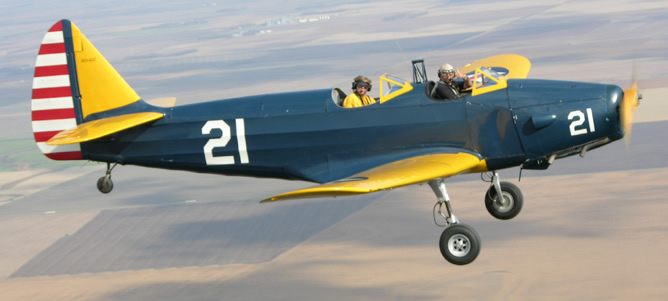
Haven't had a go in a Stearman, but it looks meaty and you can't beat the atmosphere of a radial. I reckon I saw the one pictured above getting airborne as I drove past Popham at the weekend...
Haven't had a go in a Stearman, but it looks meaty and you can't beat the atmosphere of a radial. I reckon I saw the one pictured above getting airborne as I drove past Popham at the weekend...
eharding said:
Interesting though that the Soviet equivalent of the Chippie, the Yak-52 and original Yak-18 before it, were engineered to a) punish ultimate mis-handling by tearing your arms off and beating you to death with the sticky ends and b) have enough bells, whistles, switches and gizmos to keep your average stick-and-rudder-gifted Boris crapping himself when the bloke in the back starts failing systems deliberately.
The point being at what stage does a basic trainer stop being a filter for those who really can't do what the inherently competent in stick and rudder can do, and start selecting those that have the capacity to work like a one-armed paper-hanger when all of the bells and whistles have gone Pete Tong?
Ed, I don't really know anything about the Yaks, having never flown them (hint!), but I would suggest that the -18 was about equivalent to the Percival Provost? I'm also not sure we can equivalate WW2 flying training with the post-War feed in to FJs, especially the early generation jets!The point being at what stage does a basic trainer stop being a filter for those who really can't do what the inherently competent in stick and rudder can do, and start selecting those that have the capacity to work like a one-armed paper-hanger when all of the bells and whistles have gone Pete Tong?
Personally (as an ex-QFI) I would say that something like the Chipmunk was a good idea as an Elementary Trainer / Selection Device in this world of limited budgets and highly competitive Service Flying Training, the idea being that if you have to 'chop' a student, then it makes far more economic sense to chop them early rather than later (remember FSS / EFTS ?).
With respect to Basic Trainers, I see the need for an a/c that can develop a student's potential early on (i.e. relatively easy to fly), but one which can be used to 'load' a student up to check their 'capacity' once they have developed / demonstrated the required Handling Skills. To this end I do not think the Tucano was the ideal choice; the JP 3A / JP 5A route being ideal IMO. I went straight through on the JP 5A (and never flew the 3A as a 'Stude') and trust me, putting a 400 kt capable jet in the hands of an 'ab initio' certainly makes for a steep learning curve! For those that don’t know, the Jet Provost T Mk 5a had a performance similar to a late war Spitfire.
eharding said:
Talking to a friend last night who got most of the way through the Hawk course, never had a problem with the handling aspects, but ultimately she was chopped through the reaction to multiple system failure drills that they apparently would spring on you, every time.
With all due respect to your friend, TBH from an RAF point of view, she didn't have the requisite handling skills if she got chopped, or rather, she didn't have the required capacity to be able to fly the jet while dealing with everything else (and trust me it only gets harder as you go towards OCU and then Sqn). As I am sure you know, you can teach anyone to fly (if you have enough time), but not everyone can be taught to operate. The problem is that the RAF does not have unlimited training time for each student, and it requires operators on the Front Line. By the time you get to AFTS (or at least post CONVEX) you are expected to be able to fly and required to learn to operate.To this end, the Hawk is (possibly) not the best advanced trainer because it is far too easy to fly (as a result 'artificial' problems have to be introduced such as unrealistically high fuel minima, simulated systems failures, etc). While a good lead in to Tornado (in terms of care-free handling), it definitely was not so good for the earlier types such as Jaguar / Harrier / Buccaneer / F4 – witness the failure rates at those OCUs.
IMO the Gnat was probably the better Advanced Trainer.
Hope that helps.
PS: I'd love a trip in your Yak if only to assess it's qualities as a Training a/c!
Edited by Ginetta G15 Girl on Thursday 22 November 06:52
Eric Mc said:
After the Stearman, what did pilots usually move onto for advanced training in teh States.
Eric,By far the most Basic Training Stateside was on the PT 19 Cornell and not the PT 13/17 Kaydet. The latter was primarily used by the USN (as the NTS). IMHO the PT 19 will bite far harder than the Stearman if you get it wrong. Also, like all American training a/c of the era both feel huge relative to the Tiggie, Magister, Tutor.
For most US schools (whether AAC or USN) the progression was then to the Vultee BT 13 Valiant (known as the SNV by the USN) and thence to the T6 Harvard/Texan/SNJ.
The 7 British Flying Training Schools Stateside rapidly binned the BT 13 because (while it filled the gap between the PT13 / 17 / PT 19 and the T6) it was felt it was a gap that did not need to be filled - hence it was superfluous. Ie the gap was surmountable by the students without having to use the BT 13.
Interesting website on the restoration of a Tiger Moth. Hope he gets her flying again!
http://www.n5490.org/Restoration/Restoration.html
http://www.n5490.org/Restoration/Restoration.html
Gassing Station | Boats, Planes & Trains | Top of Page | What's New | My Stuff