
Interesting WW1/2 RAF stories required.
Discussion


Hopefully this will be the most appropriate forum to post this 
I'm undertaking a project at work which requires me looking for interesting stories from WW1 & 2 which I can link in to a tour which we are undertaking via bike.
My absolute dream scenario would be to find a tale of a daring airman who escaped the enemy via bicycle, unfortunately these terms don't translate very well into a google search!
I'm undertaking a project at work which requires me looking for interesting stories from WW1 & 2 which I can link in to a tour which we are undertaking via bike.
My absolute dream scenario would be to find a tale of a daring airman who escaped the enemy via bicycle, unfortunately these terms don't translate very well into a google search!
Great suggestion Ditchvisitor! I assume you're doing something broadly similar yourself 
In all seriousness the Comete line is a fantastic escape to retrace, if I remember correctly it starts in Northern Belgium/France and routes down the West Coast of France, via the Pyrenees to Spain. I was supposed to do it myself a few years ago but my daughter came along instead! I think the way it was planned was that you spent a day cycling, followed by a day in the support minibus organising food, hotels and briefing the cyclists on the relevance of that particular section of the route to the wartime escape.
You'll have a brilliant time, all the best
In all seriousness the Comete line is a fantastic escape to retrace, if I remember correctly it starts in Northern Belgium/France and routes down the West Coast of France, via the Pyrenees to Spain. I was supposed to do it myself a few years ago but my daughter came along instead! I think the way it was planned was that you spent a day cycling, followed by a day in the support minibus organising food, hotels and briefing the cyclists on the relevance of that particular section of the route to the wartime escape.
You'll have a brilliant time, all the best
This book is about Lt. John Godwin RNVR, a very distant relative of mine: www.amazon.co.uk/Godwins-Saga-Kenneth-Macksey/dp/0...
More at www.commandoveterans.org/cdoForum/posts/list/832.p...
Sadly he didn't make it.
NB Just realised you'd have to cycle from Argentina to Britain to Norway to Germany, so maybe not!
NNB 'Moondrop to Gascony' is an excellent book with lots of detail so you could retrace a route: www.amazon.co.uk/Moondrop-Gascony-Anne-Marie-Walte...
More at www.commandoveterans.org/cdoForum/posts/list/832.p...
Sadly he didn't make it.
NB Just realised you'd have to cycle from Argentina to Britain to Norway to Germany, so maybe not!
NNB 'Moondrop to Gascony' is an excellent book with lots of detail so you could retrace a route: www.amazon.co.uk/Moondrop-Gascony-Anne-Marie-Walte...
Edited by Simpo Two on Friday 8th March 20:28
This was written recently by my son:
V8LM's son said:
Albert Gothian Kilsby
Albert Gothian Kilsby (my great grandfather) was in a reserved occupation within the boot and shoe industry but he was not content with this and volunteered to serve his country as a Lancaster bomber pilot during the Second World War. Many people named him as a hero for his heroics in the operation on bombing Le Havre. As well as becoming a hero he also lost is life. This particular operation took place on the 8Th of September 1944.
Operation Le Havre 1944
Operation Le Havre was an operation to bomb strong points near the beleaguered garrison. A last ditch attempt to hold on the vital port by the Germans. The Germans held onto the port for 2-3months after the D-day landings. The allies also had plans on capturing Dieppe and Bruges.
In preparation for the attack LT. H.F McAuley constructed an excellent model of the area so that they could pin point which specific place they needed to attack to push the fall of Le Havre. Also they had gained intelligence photos from spy planes of the ground. Overall they had significant information to launch a strong attack. The German garrison (a group of soldiers) was 5000 strong. The outer defences consisted of inter-supporting pill-boxes (mounted machine guns) and concrete emplacements. The pill-boxes were very well disguised often looked like innocent cottages or villas.
The Kentish regiment, 79TH armoured division were sent into take the German garrison in Le Havre. By this time allied forces had already reached Brussels. The 79TH division were used because of their firepower: they had special weapons that made them more superior to other divisions and therefore more fitting for this operation, the weapons were:
AVRE: (Armoured Vehicle Royal Engineers) this was a special tank that had the capability of firing a large bomb petard. This was used for destroying pillboxes.
FLAIL: this was one of Hobart’s funnies. It was a tank with a large cylinder on the top of it witch had chains attached. As the cylinder oscillated the chains rapidly swung. This was used fro destroying mine fields therefor creating a safe path for other vehicles to follow.
Crocodile: this tank had a flamethrower attached, which created a large liquid squirt that could reach a man 60 yards away.
The assault on Le Havre began at 1745 hours. The assault began with navel vessels engaging fire with the German defences, supporting the RAF. There were two phases to the attack. Firstly, to penetrate the German defences of the city. Secondly to advance into the city and clear out the remaining resistance.
Day 2: the RAF began its programme. Hundreds of heavy bombers flooded the sky over Le Havre, the bombers had weakened the enemy defences in the city, and this allowed the full assault on Le Havre to progress. Before the city of Le Havre laid a minefield that that allies forces had to encounter. On Sunday 10th of September 1830, the flairs started across the minefield, covered by a troop of Churchill tanks. After the flair tanks successfully cleared a pathway across the minefield “D” Coy progressed through the minefield then to be followed by “A” and “B” Coys, they successfully progressed through however “D” Coy came under fire. Despite of this the operation was exactly to plan and all their objectives were complete. As they pushed through Le Havre a mined road South of Montville’s held them up. Hey were granted permission to push on through. This was extraordinary because these Coys became a mounted battalion. Firstly the 49th division broke through the Northeast section first and then the 51St division also broke through. The last strong points of the outer defences surrendered at 1400 hours. On the third day the town the allies reached centre of the city and the German garrison commander was officially forced to surrender at 1145. The port was officially handed over to the allies.
Killed in Action Friday 8th of September
Albert Gothian Kilsby, father of Rita, received a letter from his wife, Mona Kilsby that she had successfully given birth to a boy, Denly Colin Kilsby on the 8th of August and Albert was the father. Albert later replied saying that he did not like the name Denly and asked if the name could be changed to Derrick. She agreed and so my grandfather is called Derrick Colin Kilsby.
Albert Gothian Kislby was the captain (pilot) of a Lancaster Heavy Bomber – KK 579 – A4 – B. On the 8th of September 1944 he set of on a daylight raid at 6:10 a.m. on a raid on an important town and seaport of Le Havre.
His crew were:
Sergeant Backhouse Flight Engineer
Flight Sergeant Hawkins Navigator
Sergeant Wails Air Bomber
Sergeant Feary Wireless Operator/Gunner
Sergeant Ovender (RCAF) Mid-upper Gunner
Sergeant Odell (RCAF) Rear Gunner
The WWII Diary of Lancaster Pilot Bruce Johnson
September 8, 1944 (Friday)
Operation # 26 - Le Havre
Eleven 1,000 pound and four 500 pound bombs
Got up at 2:30 a.m. Finally took off at six. Went to take “S” for Sugar but couldn’t get it going so took KO-A of “A” flight.
It was a shambles over the target – cloud down to 3,000 feet and the master bomber in a flat spin. Finally brought all of ’em back except three which we left in the channel.
There was a chop over the town – which we all saw very well indeed. Saw four chutes. There was a fair amount of light flak there and Dave sent a few rounds at ’em.
Hill had some fun chasing one of these artillery spotting Austers all over and scaring it half to death by pointing his rear turret at it. It was night tactics luckily.- Lancaster diary.net
This diary sates that only few planes carried onto their target including Lancaster MK I HK579 A4-B (albert’s plane)
‘There was a chop over the town’ a chop is a plane shot down. This probably refers to Albert Gothian Kilsby’s plane
‘Saw four chutes’ these were most probably the parachutes of four of the five other crewmembers that bailed out of the plane before it crashed.
Sgt E Backhouse, FE, Sgt K Feary, WOP, Sgt A Walls, BA all became POW (prisoners of war) after they landed behind enemy lines.
F/Sgt G Hawkins, Nav, F/S R Ovender, RG, RCAF, both evd (evaded capture).
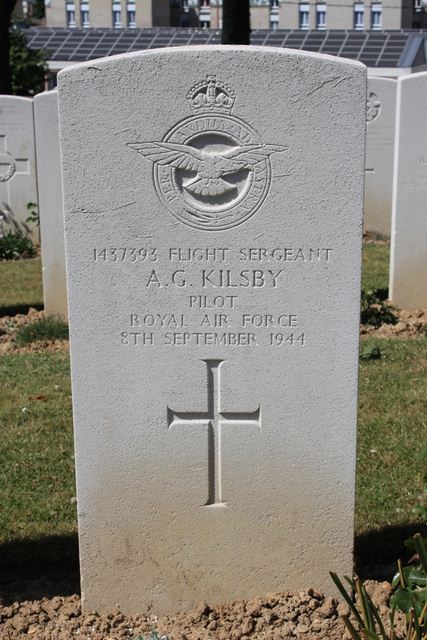
F/S Albert Gothian Kilsby, Pilot, 1437793 RAFVR, P/O Donald Carr ODELL, MUG, 19, J95168 RCAF, both died. Donald Carr was the gunner. He was wounded when the plane was hit by flak and because of the ill design of the Lancaster bomber he could not get out.
Albert Gothian Kilsby allowed all the surviving crew members to escape by keeping the aircraft flying. He went down with the aircraft even though he could have saved himself.
R.I.P
Albert Gothian Kilsby is buried in St. Marie Cemetery Le Havre France Division 677 Row G Grave number 12, next to his companion D.C Odell. R.I.P.
Albert Gothian Kilsby (my great grandfather) was in a reserved occupation within the boot and shoe industry but he was not content with this and volunteered to serve his country as a Lancaster bomber pilot during the Second World War. Many people named him as a hero for his heroics in the operation on bombing Le Havre. As well as becoming a hero he also lost is life. This particular operation took place on the 8Th of September 1944.
Operation Le Havre 1944
Operation Le Havre was an operation to bomb strong points near the beleaguered garrison. A last ditch attempt to hold on the vital port by the Germans. The Germans held onto the port for 2-3months after the D-day landings. The allies also had plans on capturing Dieppe and Bruges.
In preparation for the attack LT. H.F McAuley constructed an excellent model of the area so that they could pin point which specific place they needed to attack to push the fall of Le Havre. Also they had gained intelligence photos from spy planes of the ground. Overall they had significant information to launch a strong attack. The German garrison (a group of soldiers) was 5000 strong. The outer defences consisted of inter-supporting pill-boxes (mounted machine guns) and concrete emplacements. The pill-boxes were very well disguised often looked like innocent cottages or villas.
The Kentish regiment, 79TH armoured division were sent into take the German garrison in Le Havre. By this time allied forces had already reached Brussels. The 79TH division were used because of their firepower: they had special weapons that made them more superior to other divisions and therefore more fitting for this operation, the weapons were:
AVRE: (Armoured Vehicle Royal Engineers) this was a special tank that had the capability of firing a large bomb petard. This was used for destroying pillboxes.
FLAIL: this was one of Hobart’s funnies. It was a tank with a large cylinder on the top of it witch had chains attached. As the cylinder oscillated the chains rapidly swung. This was used fro destroying mine fields therefor creating a safe path for other vehicles to follow.
Crocodile: this tank had a flamethrower attached, which created a large liquid squirt that could reach a man 60 yards away.
The assault on Le Havre began at 1745 hours. The assault began with navel vessels engaging fire with the German defences, supporting the RAF. There were two phases to the attack. Firstly, to penetrate the German defences of the city. Secondly to advance into the city and clear out the remaining resistance.
Day 2: the RAF began its programme. Hundreds of heavy bombers flooded the sky over Le Havre, the bombers had weakened the enemy defences in the city, and this allowed the full assault on Le Havre to progress. Before the city of Le Havre laid a minefield that that allies forces had to encounter. On Sunday 10th of September 1830, the flairs started across the minefield, covered by a troop of Churchill tanks. After the flair tanks successfully cleared a pathway across the minefield “D” Coy progressed through the minefield then to be followed by “A” and “B” Coys, they successfully progressed through however “D” Coy came under fire. Despite of this the operation was exactly to plan and all their objectives were complete. As they pushed through Le Havre a mined road South of Montville’s held them up. Hey were granted permission to push on through. This was extraordinary because these Coys became a mounted battalion. Firstly the 49th division broke through the Northeast section first and then the 51St division also broke through. The last strong points of the outer defences surrendered at 1400 hours. On the third day the town the allies reached centre of the city and the German garrison commander was officially forced to surrender at 1145. The port was officially handed over to the allies.
Killed in Action Friday 8th of September
Albert Gothian Kilsby, father of Rita, received a letter from his wife, Mona Kilsby that she had successfully given birth to a boy, Denly Colin Kilsby on the 8th of August and Albert was the father. Albert later replied saying that he did not like the name Denly and asked if the name could be changed to Derrick. She agreed and so my grandfather is called Derrick Colin Kilsby.
Albert Gothian Kislby was the captain (pilot) of a Lancaster Heavy Bomber – KK 579 – A4 – B. On the 8th of September 1944 he set of on a daylight raid at 6:10 a.m. on a raid on an important town and seaport of Le Havre.
His crew were:
Sergeant Backhouse Flight Engineer
Flight Sergeant Hawkins Navigator
Sergeant Wails Air Bomber
Sergeant Feary Wireless Operator/Gunner
Sergeant Ovender (RCAF) Mid-upper Gunner
Sergeant Odell (RCAF) Rear Gunner
The WWII Diary of Lancaster Pilot Bruce Johnson
September 8, 1944 (Friday)
Operation # 26 - Le Havre
Eleven 1,000 pound and four 500 pound bombs
Got up at 2:30 a.m. Finally took off at six. Went to take “S” for Sugar but couldn’t get it going so took KO-A of “A” flight.
It was a shambles over the target – cloud down to 3,000 feet and the master bomber in a flat spin. Finally brought all of ’em back except three which we left in the channel.
There was a chop over the town – which we all saw very well indeed. Saw four chutes. There was a fair amount of light flak there and Dave sent a few rounds at ’em.
Hill had some fun chasing one of these artillery spotting Austers all over and scaring it half to death by pointing his rear turret at it. It was night tactics luckily.- Lancaster diary.net
This diary sates that only few planes carried onto their target including Lancaster MK I HK579 A4-B (albert’s plane)
‘There was a chop over the town’ a chop is a plane shot down. This probably refers to Albert Gothian Kilsby’s plane
‘Saw four chutes’ these were most probably the parachutes of four of the five other crewmembers that bailed out of the plane before it crashed.
Sgt E Backhouse, FE, Sgt K Feary, WOP, Sgt A Walls, BA all became POW (prisoners of war) after they landed behind enemy lines.
F/Sgt G Hawkins, Nav, F/S R Ovender, RG, RCAF, both evd (evaded capture).
F/S Albert Gothian Kilsby, Pilot, 1437793 RAFVR, P/O Donald Carr ODELL, MUG, 19, J95168 RCAF, both died. Donald Carr was the gunner. He was wounded when the plane was hit by flak and because of the ill design of the Lancaster bomber he could not get out.
Albert Gothian Kilsby allowed all the surviving crew members to escape by keeping the aircraft flying. He went down with the aircraft even though he could have saved himself.
R.I.P
Albert Gothian Kilsby is buried in St. Marie Cemetery Le Havre France Division 677 Row G Grave number 12, next to his companion D.C Odell. R.I.P.
A timely thread resurrection: I received an email yesterday (November 11th) from the nephew of Donald Carr Odell, the tail gunner who was unable to evacuate from the aircraft and died alongside my wife's grandfather. They are buried next to each other in the Ste. Marie Cemetery, Le Havre.
We will remember them.
We will remember them.
Take a look at www.lancaster-lm658.co.uk - the tale (initially) of Gerald Hood but expanded to include the rest of the crew & some other related aircraft.
Shot down Nr Almelo/Hengelo - sheltered by the resistance & then executed by the Gestapo - an incredible tale. All researched by a British Trucker who found a memorial plaque in a Dutch wood when taking a break & a stroll...
Thanks to his work, relatives of the survivors and relatives of the Resistance were able to meet and families finally found out the story of the crew's last moments...
{From http://www.lancaster-lm658.co.uk/the-hood-story/a-...
May 4th 2009 Zenderen Overijssel Nethelands
The annual liberation day ceremony in the De Vloedbeld woodland outside Zenderen, near Almelo is always an important, well attended local event but this year it had a special significance as no less than nine of Gerald Hood’s family, as guests of the Zenderen Liberation Committee joined representatives of the Royal Russell school and over a hundred local people at the ceremony in front of the “Oorlogsmonument” (war memorial). This day was also to be the first meeting between Gerald Hood’s relatives and the descendants of the Van der Wal family who had sheltered him in their home at Nyverdal.
Shot down Nr Almelo/Hengelo - sheltered by the resistance & then executed by the Gestapo - an incredible tale. All researched by a British Trucker who found a memorial plaque in a Dutch wood when taking a break & a stroll...
Thanks to his work, relatives of the survivors and relatives of the Resistance were able to meet and families finally found out the story of the crew's last moments...
{From http://www.lancaster-lm658.co.uk/the-hood-story/a-...
May 4th 2009 Zenderen Overijssel Nethelands
The annual liberation day ceremony in the De Vloedbeld woodland outside Zenderen, near Almelo is always an important, well attended local event but this year it had a special significance as no less than nine of Gerald Hood’s family, as guests of the Zenderen Liberation Committee joined representatives of the Royal Russell school and over a hundred local people at the ceremony in front of the “Oorlogsmonument” (war memorial). This day was also to be the first meeting between Gerald Hood’s relatives and the descendants of the Van der Wal family who had sheltered him in their home at Nyverdal.
Gassing Station | Boats, Planes & Trains | Top of Page | What's New | My Stuff