
Charles de Rouge's Elytroplan
Discussion


Whilst on holiday in france last week, I happened across a display about this chap's invention, quite randomly, at a castle in Les Essarts.
It was called the Elytroplan, an odd device, the key part of which seems to be a very high control surface.
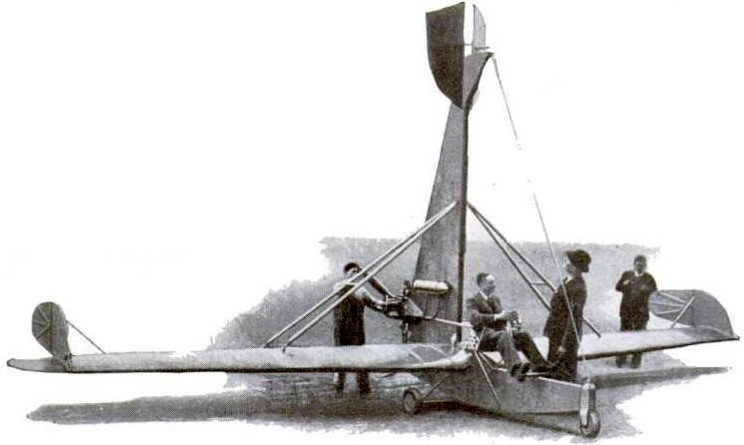 .
.
There seemed to be various versions, some with an extra wing way out above and in front of the nose, some with it in the centre, and some where it seems to be more or less simply a high tail.
Can't find out much about it on the webs, I'm wondering if anyone's come across it and what he was actually trying to achieve by these designs. It looks like he was after making something very stable that could be towed behind ships for spotting, but it seemed to evolve into motorised versions later.
Obviously it didn't catch on, but I'm always intruiged by these early experiments.
It was called the Elytroplan, an odd device, the key part of which seems to be a very high control surface.
.There seemed to be various versions, some with an extra wing way out above and in front of the nose, some with it in the centre, and some where it seems to be more or less simply a high tail.
Can't find out much about it on the webs, I'm wondering if anyone's come across it and what he was actually trying to achieve by these designs. It looks like he was after making something very stable that could be towed behind ships for spotting, but it seemed to evolve into motorised versions later.
Obviously it didn't catch on, but I'm always intruiged by these early experiments.
Simpo Two said:
Interesting flaps at the top. Presume this is pitch control - open flaps, drag increases, nose goes up and vice versa. Not a great solution though as you'd lose more airspeed.
However, bend the back down 90 degrees and he's almost there!
I wonder if they were intended to provide roll control too? Perhaps the aim was to keep the nose up in turns? Pitch stability looks like it would be very sketchy without massive amounts of reflex on the main wing and even then I wouldn't fancy it much....However, bend the back down 90 degrees and he's almost there!
Here's a dodgy google translate of an image I found on google:

So looks like he was trying to prevent crashing by using the high control surfaces to ensure that it always stayed the right way up. I've a scan of a contemporary leaflet which I'll post up later which supports this, as it shows a comparison of the descent of an elytroplan and a normal aircraft.
Presumably other advances in design solved the problems in other ways.
translation said:
C de Rouge is the door of many inventors including some supporters are convinced
they owed their failure of O coboles mounted against them by powerful competitors.
From 20s From Rouge built several prototypes equipped with rudders into two parts
could be opened as a jaw and he called elytra. Por them, cellesci
were expected to bring greater security to the driver, making the "self-righting" aircraft.
All this is an illusion that decieved many manufacturers (not always morginoux) over the total
early aviation.
On skins that also constotô an aircraft Corpsand heavier than air, always ends por fall, have
endeavored, with more happiness, solve the problem of falling so perfecting the Steering
O hear back plane "plumb" before landing, making the rudders and surfaces
bearing more efficient, or ... perfecting the parachute!
they owed their failure of O coboles mounted against them by powerful competitors.
From 20s From Rouge built several prototypes equipped with rudders into two parts
could be opened as a jaw and he called elytra. Por them, cellesci
were expected to bring greater security to the driver, making the "self-righting" aircraft.
All this is an illusion that decieved many manufacturers (not always morginoux) over the total
early aviation.
On skins that also constotô an aircraft Corpsand heavier than air, always ends por fall, have
endeavored, with more happiness, solve the problem of falling so perfecting the Steering
O hear back plane "plumb" before landing, making the rudders and surfaces
bearing more efficient, or ... perfecting the parachute!
So looks like he was trying to prevent crashing by using the high control surfaces to ensure that it always stayed the right way up. I've a scan of a contemporary leaflet which I'll post up later which supports this, as it shows a comparison of the descent of an elytroplan and a normal aircraft.
Presumably other advances in design solved the problems in other ways.

Gassing Station | Boats, Planes & Trains | Top of Page | What's New | My Stuff