
Apollo and all the "stuff" that was left on the Moon.
Discussion


So, I know it was all a big hoax filmed in a studio but.....
Having recently watched an old episode of Top Gear where JM reviews the latest generation of lunar rover, he mentioned the fact that the original lunar rover is still up there on the Moon, and it got me thinking....
All the hardware that got left behind by six lunar landings, does any of it still actually work or do anything? Or would it work if it were switched on again? I mean, is any of it lying there in a sort of stand-by state, pinging out a signal to say it's there for example, just waiting for a return visit, or is it all just cold, dead metal.....slowly sinking in to the Moon....awaiting the Clangers to come along and tidy it up?
Just wondered......
Having recently watched an old episode of Top Gear where JM reviews the latest generation of lunar rover, he mentioned the fact that the original lunar rover is still up there on the Moon, and it got me thinking....
All the hardware that got left behind by six lunar landings, does any of it still actually work or do anything? Or would it work if it were switched on again? I mean, is any of it lying there in a sort of stand-by state, pinging out a signal to say it's there for example, just waiting for a return visit, or is it all just cold, dead metal.....slowly sinking in to the Moon....awaiting the Clangers to come along and tidy it up?
Just wondered......
Most of the equipment that was left on the moon (from the 6 missions that landed successfully) continued to work up until 1977 when it was turned off in order to save money for the Shuttle programme (which was already way over budget).
From Apollo 12 onward the power for the experiments came from a nuclear isotope powered generator so, in theory, might even be still operational today (like the Voyagers) if the experiments hadn't been deliberately switched off.
The only experiments that still function are the laser reflectors - because they were mirrors and were unpowered. Sadly, it looks like at least one of the sites in the US that regularly fires lasers at these mirrors is going to be closed as funding is withdrawn.
As for the Rovers (there are three sitting up there), in theory they might be revivable. In fact, in one of Stephen Baxter's novels ("Moonseed") that is exactly what happens when the US sends a cobbled together emergency mission to the moon using canablised Shuttle based hardware and has the solo astronaut get one of the Rovers fired up again using a set of more modern replacement batteries.
In reality, even though the moon is pretty inert and doesn't feature "weathering" in the earthly sense, I reckon it would take a bit more than a few new batteries to get the Rovers running again. They have been sitting on the surface for 44 years now and will have been through over 500 lunar day/night cycles. The temperatures on the moon vary from plus 200 degrees C to minus 100 degrees C each lunar day and each lunar night - which would play havoc with plastics and rubbers contained within the Rover drive train and electrics.
I wish we had the opportunity to find out
From Apollo 12 onward the power for the experiments came from a nuclear isotope powered generator so, in theory, might even be still operational today (like the Voyagers) if the experiments hadn't been deliberately switched off.
The only experiments that still function are the laser reflectors - because they were mirrors and were unpowered. Sadly, it looks like at least one of the sites in the US that regularly fires lasers at these mirrors is going to be closed as funding is withdrawn.
As for the Rovers (there are three sitting up there), in theory they might be revivable. In fact, in one of Stephen Baxter's novels ("Moonseed") that is exactly what happens when the US sends a cobbled together emergency mission to the moon using canablised Shuttle based hardware and has the solo astronaut get one of the Rovers fired up again using a set of more modern replacement batteries.
In reality, even though the moon is pretty inert and doesn't feature "weathering" in the earthly sense, I reckon it would take a bit more than a few new batteries to get the Rovers running again. They have been sitting on the surface for 44 years now and will have been through over 500 lunar day/night cycles. The temperatures on the moon vary from plus 200 degrees C to minus 100 degrees C each lunar day and each lunar night - which would play havoc with plastics and rubbers contained within the Rover drive train and electrics.
I wish we had the opportunity to find out
 k off moon buggy is visable if they turned the camera round or am i being naive?
An earth orbiting spy satellite works because it is flying low over the earth (altitude between 100 and 200 miles). Turning it around to view the moon at a distance of 250,000 miles isn't going to reveal much detail of the moon.
To view something like a relatively small item of equipment on the surface of another world you need to have a fairly low orbiting spacecraft in orbit around that body. Earth has had thousands of such satellites (usually military - but increasingly civilian as well) that can, as you say, read small detail on earth from space.
Up until 2009, we had no such satellite in orbit around the moon.
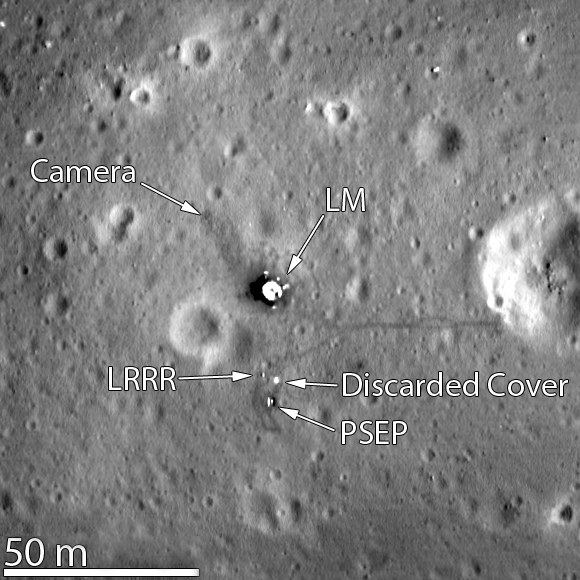
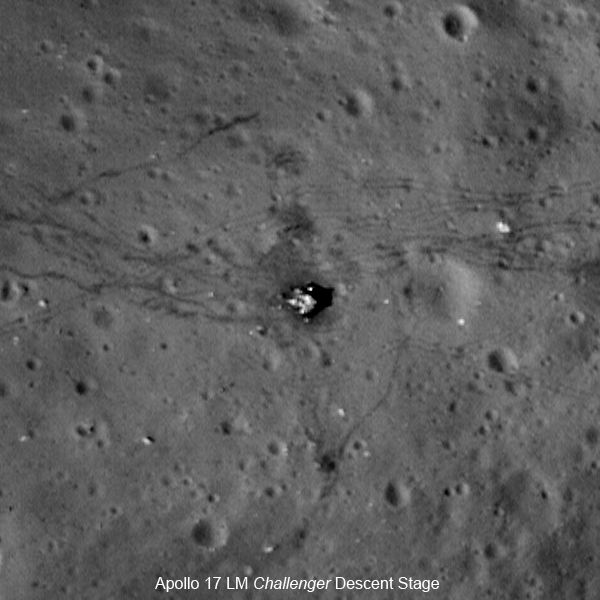
However, since 2009, an unmanned probe called the Lunar Reconnaissance Orbiter (LRO) has been circling the moon. Over its six year (so far) mission, its orbit has been raised and lowered a number of times in order to allow high resolution images of the surface for possible future manned landing sites.
During the course of these low level passes, it has crossed over the old Apollo sites a number of times and imaged quite a lot of the equipment left behind.
The easiest object to spot at each site is the Descent Stage of the Lunar Module - simply because it is the biggest piece of Apollo hardware on the moon. However, footprints, tracks, smaller item of equipment and, of course, the Rovers have all been imaged. Even the shadows cast by the flags are visible in some shots (not Apollo 11's - because the blast from the Lunar Module ascent engine knocked it over into the dust).
Here's a couple of LRO Apollo site images -
Apollo 11
Apollo 17
To view something like a relatively small item of equipment on the surface of another world you need to have a fairly low orbiting spacecraft in orbit around that body. Earth has had thousands of such satellites (usually military - but increasingly civilian as well) that can, as you say, read small detail on earth from space.
Up until 2009, we had no such satellite in orbit around the moon.
However, since 2009, an unmanned probe called the Lunar Reconnaissance Orbiter (LRO) has been circling the moon. Over its six year (so far) mission, its orbit has been raised and lowered a number of times in order to allow high resolution images of the surface for possible future manned landing sites.
During the course of these low level passes, it has crossed over the old Apollo sites a number of times and imaged quite a lot of the equipment left behind.
The easiest object to spot at each site is the Descent Stage of the Lunar Module - simply because it is the biggest piece of Apollo hardware on the moon. However, footprints, tracks, smaller item of equipment and, of course, the Rovers have all been imaged. Even the shadows cast by the flags are visible in some shots (not Apollo 11's - because the blast from the Lunar Module ascent engine knocked it over into the dust).
Here's a couple of LRO Apollo site images -
Apollo 11
Apollo 17
RosscoPCole said:
Apologies if this is a stupid question, but could NASA use the Hubble telescope to look at the moon and get a better view of the landing sites. Or am I being too simplistic?
Hubble is designed for far distant viewing, maybe it's too close for it to focus? Hubble is longsighted, send up some specs 
Gassing Station | Boats, Planes & Trains | Top of Page | What's New | My Stuff