
Theoretically, how big could a plane be made ?
Discussion


Take the practicalities of airport infrastructure out of it, to fly between two points that have massive runways and are geared up for it, how big could a plance be built relative tot he current largest airliner, an A380 ?
Twice as big, fice times as big, ten times as big ?
What are the limits, materials, engines, physics, does it all just scale up and up or do things sag and bend and you cant make a given part any bigger ?
Twice as big, fice times as big, ten times as big ?
What are the limits, materials, engines, physics, does it all just scale up and up or do things sag and bend and you cant make a given part any bigger ?
J4CKO said:
Take the practicalities of airport infrastructure out of it, to fly between two points that have massive runways and are geared up for it, how big could a plance be built relative tot he current largest airliner, an A380 ?
Twice as big, fice times as big, ten times as big ?
What are the limits, materials, engines, physics, does it all just scale up and up or do things sag and bend and you cant make a given part any bigger ?
Want a big passenger capacity? want it fuel efficient? want it fast? what are the design constraints?Twice as big, fice times as big, ten times as big ?
What are the limits, materials, engines, physics, does it all just scale up and up or do things sag and bend and you cant make a given part any bigger ?
mebe said:
J4CKO said:
Take the practicalities of airport infrastructure out of it, to fly between two points that have massive runways and are geared up for it, how big could a plance be built relative tot he current largest airliner, an A380 ?
Twice as big, fice times as big, ten times as big ?
What are the limits, materials, engines, physics, does it all just scale up and up or do things sag and bend and you cant make a given part any bigger ?
Want a big passenger capacity? want it fuel efficient? want it fast? what are the design constraints?Twice as big, fice times as big, ten times as big ?
What are the limits, materials, engines, physics, does it all just scale up and up or do things sag and bend and you cant make a given part any bigger ?
I am interested in a proper answer
The Spruce goose had a bigger wingspan than the A380 ( 97.5m vs 79.8m), though not constrained by the 80m 'box' current commercial craft are, and that was made of wood...
The wings are the tough bit, have to be strong and flexible so i would guess that is the limitation.
I would think we could do double the spruce goose with modern materials, but you have wings for lift so what is overall weight you can lift? Antonov 225 has a max liftof weight of around 650tons (250t payload). Its quite old so with a much bigger wing, modern engines a 1000t plane with a 400t carry capacity would be possible ( just a total guess)
The wings are the tough bit, have to be strong and flexible so i would guess that is the limitation.
I would think we could do double the spruce goose with modern materials, but you have wings for lift so what is overall weight you can lift? Antonov 225 has a max liftof weight of around 650tons (250t payload). Its quite old so with a much bigger wing, modern engines a 1000t plane with a 400t carry capacity would be possible ( just a total guess)

shirt said:
Good points rob, I was thinking in terms of an airliner only. I guess if cruise performance and economy isn't an issue you could be a lot more inventive with the wing design.
They might be more efficient, per passenger, than current designs, they are trickier to build and design though. 
davepoth said:
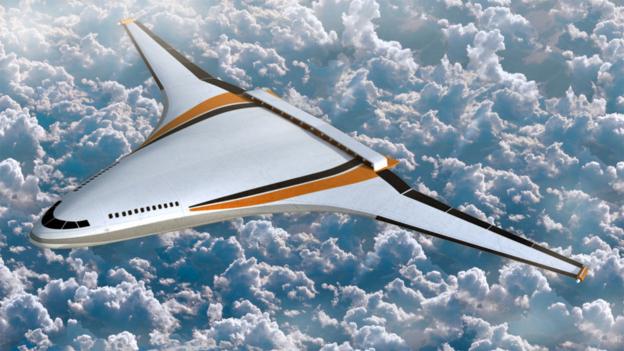
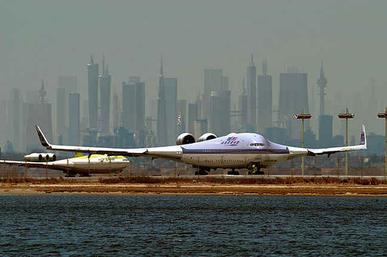
Well, there are a couple of options. Either go for an annular wing (which is a bit like a biplane) or a flying wing, both of which offer a solution to wing flex.
If the wing were large enough, it allows for accommodation so becomes the 'fuselage', I suppose is possible. I am envisaging an airliner, one that flies between my theoretical two runways which arent constrained by aircraft size.
No overly high expectations of passenger numbers or performance but broadly on a par with other airliners, i.e. not a airship doing 50 mph and not concorde doing 1350 mph, or whatever it is in Knots.
No overly high expectations of passenger numbers or performance but broadly on a par with other airliners, i.e. not a airship doing 50 mph and not concorde doing 1350 mph, or whatever it is in Knots.
Well considering the An225 is a product of the 80s, I'd say we could probably go 1.25-1.3 times the size without anything revolutionary. The A380 has some growth left in the design, and it was always designed with efficiency and economics in mind.
The eventual C5 galaxy replacement could be the true test of size.
The eventual C5 galaxy replacement could be the true test of size.
RobDickinson said:
They might be more efficient, per passenger, than current designs, they are trickier to build and design though.
And also much more difficult to evacuate in an emergency. shirt said:
I guess you could also come up with a twin fuselage like a massive version of the Rutan/virgin galactic launcher
Scaled Composites Stratolaunch concept currently under development:
Two 747 fuselages are being cannibalised for parts.
https://en.wikipedia.org/wiki/Scaled_Composites_St...
Slightly O/T
The theory of wing lift is, i think put simply,and ingnoring the thrust needed that a wing generates lift by theair flowing acrossthe top, is at a lower presure that the normal air pressure (14lb per sq in)
does anyone know what wing has the greatest differential between pressure under the wing and that on top. The difference being the amount that the aircraft can lift.
Taking a 747-8 wing area is 554m2 which is about 857390 sq in The max start weight ( t/o weight?) is 442 tons or 990,000 lbs so the difference has to be at least 1.1lb per sq in is this the rough figure to aim at?
The theory of wing lift is, i think put simply,and ingnoring the thrust needed that a wing generates lift by theair flowing acrossthe top, is at a lower presure that the normal air pressure (14lb per sq in)
does anyone know what wing has the greatest differential between pressure under the wing and that on top. The difference being the amount that the aircraft can lift.
Taking a 747-8 wing area is 554m2 which is about 857390 sq in The max start weight ( t/o weight?) is 442 tons or 990,000 lbs so the difference has to be at least 1.1lb per sq in is this the rough figure to aim at?
The limiting factor is the square cube law. Make something bigger and the mass goes up to the cube of length and the wing area goes up by the square.
The wing loading goes up, the take off speed goes up until it's impractical or you end up needing massive wings.
Second thing the square cube law hits is the undercarriage. If all dimensions scale the ground pressure goes up meaning you need more wheels to avoid trashing the wheels and sinking into the runway.

Theoretical limits are around 1500 tonnes, Boeing designed the pelican which was a little larger but was a wing in ground effect.
The biggest flying thing is very much larger, the Saturn 5 rocket was over 3000 tonnes at take off. There probably isn't a limit on airship weight either.
The wing loading goes up, the take off speed goes up until it's impractical or you end up needing massive wings.
Second thing the square cube law hits is the undercarriage. If all dimensions scale the ground pressure goes up meaning you need more wheels to avoid trashing the wheels and sinking into the runway.
Theoretical limits are around 1500 tonnes, Boeing designed the pelican which was a little larger but was a wing in ground effect.
The biggest flying thing is very much larger, the Saturn 5 rocket was over 3000 tonnes at take off. There probably isn't a limit on airship weight either.
Edited by Talksteer on Thursday 25th February 21:44
Gassing Station | Boats, Planes & Trains | Top of Page | What's New | My Stuff