
IJN Kaga, a Japanese fleet carrier. Found
Discussion


Details on here pics and video
She was found 5,400 meters (more than 17,000 feet) below the surface. Kaga sits upright and is missing much of the flight deck.
https://www.facebook.com/rvpetrel/
Wikipedia says the deck only had 1.5" of armour.
Attack by US aircraft ruptured the avgas tanks & the resulting fires set off 80,000 lbs of bombs & torpedoes that were on the hangar deck.
https://en.wikipedia.org/wiki/Japanese_aircraft_ca...
Attack by US aircraft ruptured the avgas tanks & the resulting fires set off 80,000 lbs of bombs & torpedoes that were on the hangar deck.
https://en.wikipedia.org/wiki/Japanese_aircraft_ca...
 ) I worked on her when she was the Acergy, then Seven Petrel until she was laid up in Leith 2014 and subsequently sold to Paul Allen
Eric Mc said:
US Navy carriers of that era also had wooden decks.
Only RN carriers of that era have full armoured flight decks, which proved their worth from early 1945 when the British Pacific Fleet started operations with the USN against Japan. The USN liasion officers with the RN were able to witness first hand the advantages of having armoured flight decks when attacked by Japanese Kamikaze attacks.One USN liaison officer on board the RN carrier HMS Indefatigable, reported back....
"When a kamikaze hits a US carrier it means 6 months of repair at Pearl Harbor. When a kamikaze hits a Limey carrier it's just a case of 'Sweepers, man your brooms."
RedWhiteMonkey said:
Eric Mc said:
I wonder if any of the aircraft that were on board that went down with these ships are recoverable?
Good luck with that, they've been sitting in sea water at a depth of around 3 and a half miles for 77 years.RedWhiteMonkey said:
Eric Mc said:
I wonder if any of the aircraft that were on board that went down with these ships are recoverable?
Good luck with that, they've been sitting in sea water at a depth of around 3 and a half miles for 77 years.If the water gets inside the aeroplane as the ship sinks, the pressure inside and outside the fuselage would remain constant so there would not be damage caused by water pressure. Obviously, the aircraft would sustain damage in other ways, by sliding around and smashing into each other as the ship lists and sinks - or by smashing into bits of the ship structure. And some of the aircraft would have sustained damage due to explosions etc. However, aircraft can survive quite well under the sea.
This is the wing of a fabric covered biplane which is submerged in the wreck of the USS Macon airship - which crashed in 1935.
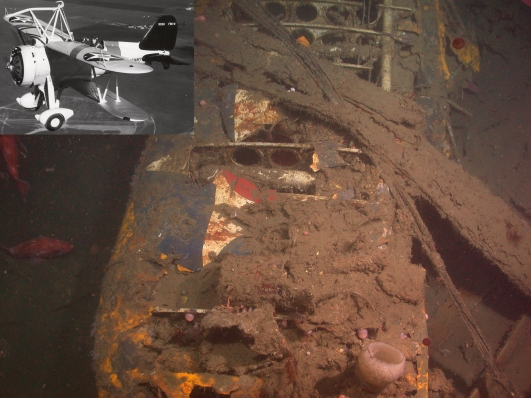
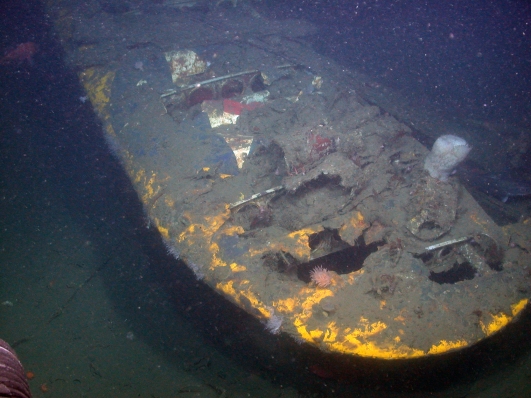
Considering it is fabric, a surprising amount of original material and paint survives. The US national markings are still quite fresh looking. Most of the underlying metal structure is still intact.
The Macon lies at a depth of 1,500 feet - so not as deep as the Japanese carriers - but still pretty deep. Some artifacts have been recovered - but not a whole aeroplane.
Eric Mc said:
RedWhiteMonkey said:
Eric Mc said:
I wonder if any of the aircraft that were on board that went down with these ships are recoverable?
Good luck with that, they've been sitting in sea water at a depth of around 3 and a half miles for 77 years.If the water gets inside the aeroplane as the ship sinks, the pressure inside and outside the fuselage would remain constant so there would not be damage caused by water pressure. Obviously, the aircraft would sustain damage in other ways, by sliding around and smashing into each other as the ship lists and sinks - or by smashing into bits of the ship structure. And some of the aircraft would have sustained damage due to explosions etc. However, aircraft can survive quite well under the sea.
This is the wing of a fabric covered biplane which is submerged in the wreck of the USS Macon airship - which crashed in 1935.
Considering it is fabric, a surprising amount of original material and paint survives. The US national markings are still quite fresh looking. Most of the underlying metal structure is still intact.
The Macon lies at a depth of 1,500 feet - so not as deep as the Japanese carriers - but still pretty deep. Some artifacts have been recovered - but not a whole aeroplane.
Eric Mc said:
The Macon lies at a depth of 1,500 feet - so not as deep as the Japanese carriers - but still pretty deep. Some artifacts have been recovered - but not a whole aeroplane.
But of course all you need to recover in order to 'rebuild' an aircraft is the manufacturers data plate.Dr Jekyll said:
Eric Mc said:
The Macon lies at a depth of 1,500 feet - so not as deep as the Japanese carriers - but still pretty deep. Some artifacts have been recovered - but not a whole aeroplane.
But of course all you need to recover in order to 'rebuild' an aircraft is the manufacturers data plate.For a type that exists in reasonable numbers with access to major parts and engines, and that has currently already been rebuilt/re-manufactured then yes.
For a very rare type, with next to no examples left etc., and/or no original drgs, then having just the data plate would be next to pointless.
Gassing Station | Boats, Planes & Trains | Top of Page | What's New | My Stuff