
Discussion


It was American - sad story, folks dying trying to help others. https://i.redd.it/30xu65szwgc41.jpg
Edited by DavieBNL on Thursday 23 January 09:30
Seems that performing those "water bomb" missions come at a heavy cost to aircraft.
Speculation on my part as to what happened in Australia but I remember this incident a few years ago : https://youtu.be/ybYeJVh1cew?t=5
Speculation on my part as to what happened in Australia but I remember this incident a few years ago : https://youtu.be/ybYeJVh1cew?t=5
Water bombing is dangerous activity compared to more normal flying. You are flying close to the ground - often quite hilly ground - essentially shallow dive bombing - and putting quite a lot of strain on an airframe that wasn't originally designed with that type of flying in mind. It requires bravery and skill to do it properly.
The C-130 is actually a bit of an exception as, being designed as a tactical military transport, it is actually a tough old bird.
When I see MD-80s and 737-300/400/500 aircraft being used today, I wonder how long will it be before they start falling apart in mid-air.
The C-130 is actually a bit of an exception as, being designed as a tactical military transport, it is actually a tough old bird.
When I see MD-80s and 737-300/400/500 aircraft being used today, I wonder how long will it be before they start falling apart in mid-air.
aeropilot said:
Eric Mc said:
Heard that this morning. The BBC news website says the Hercules was Canadian.
Sort of...........The Herc was operated by Coulson Aviation (USA) Inc., which is a wholly owned subsidiary of Coulson Aircrane Ltd., which is a private, family owned company based in Canada.

Eric Mc said:
The C-130 is actually a bit of an exception as, being designed as a tactical military transport, it is actually a tough old bird.
+1On the other hand many of the elderly ones will have been flown to their limits or beyond in the past.
Still it's not that long since Grumman Avengers and B17s were used for this kind of work.
Age is a big factor. By the time the fire tanker companies get their hands on military surplus C-130s, they are usually quite old - often around 30 years of age. That infamous California accident back in 2002 where the wings folded involved a C-130A which had been delivered new to the USAF in 1957 - so it was 45 years old at the time.
This is a recent picture (June 2019) of the Hercules involved in the Australian accident -
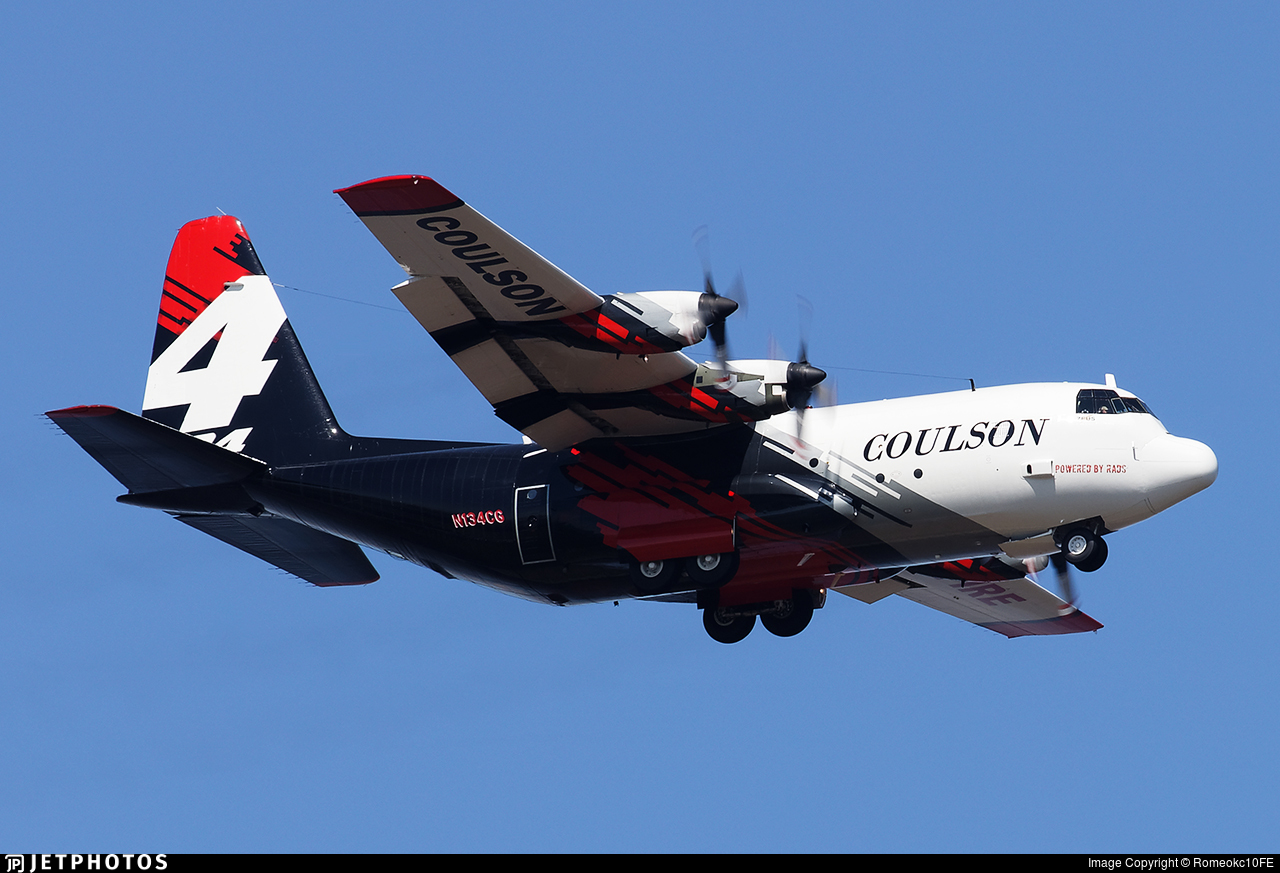
Doing a bit of research, this particular aircraft was built in 1981 (making it just under 30 years old) and had actually served as an EC-130Q which was a specialist communications version used by the US Navy.
This is a recent picture (June 2019) of the Hercules involved in the Australian accident -
Doing a bit of research, this particular aircraft was built in 1981 (making it just under 30 years old) and had actually served as an EC-130Q which was a specialist communications version used by the US Navy.
I was waiting for Juan to do his You Tube update. He knows the aerial firefighting industry.
https://www.youtube.com/watch?v=GSPRNGV9sWI
https://www.youtube.com/watch?v=GSPRNGV9sWI
Eric Mc said:
That puts it in the same ball park as the C-130A back in 2002. The tanker industry does use fairly old hand me downs.
There was an FAA mandate though, after the 2002 wing-fold crash, that any further new C-130 fire tanker conversions could only be done on an aircraft that had already been through the Military wing box spar replacement program.It's not clear why this one crashed. Juan on his channel was saying that the weather was very gusty and that he personally would not have flown such a profile in those conditions.
I hadn't realised that the C-130 was based two hours away from the dropping area - a round trip of four hours.
I hadn't realised that the C-130 was based two hours away from the dropping area - a round trip of four hours.
Eric Mc said:
The C-130 is actually a bit of an exception as, being designed as a tactical military transport, it is actually a tough old bird.
When I see MD-80s and 737-300/400/500 aircraft being used today, I wonder how long will it be before they start falling apart in mid-air.
Your second sentence here is utterly bizarre, so I'm going to assume you worded it badly.When I see MD-80s and 737-300/400/500 aircraft being used today, I wonder how long will it be before they start falling apart in mid-air.
You're right about the C-130 being tough; you simply have to look at how long it has been in service. You could go further and compare it to British transports of the same era. I suppose the Antonov 12 is in a similar bracket. Many An-12s are flying around Africa in a dangerous, unserviced condition, operating out of dirt strips.
From what I gather the Hercs used for fire-fighting are heavily laden with fire retardant and the associated equipment for deploying it. As such they have to fill the wings with fuel to ensure that the wings themselves remain structurally sound, meaning that these aircraft take off very near their maximum weight rating.
Fire fighting conditions can bring about all sort of localised air pressure variations, usually in sub-optimal visibility, over complex terrain. You would be mad to fly a four engined prop transport that low over such terrain on a day with CAVOK conditions, without much training and knowledge of the aircraft and terrain.
Eric Mc said:
It's not clear why this one crashed. Juan on his channel was saying that the weather was very gusty and that he personally would not have flown such a profile in those conditions.
I hadn't realised that the C-130 was based two hours away from the dropping area - a round trip of four hours.
I would say it would be less than an hour to get to that area in a Herc from Richmond. Flightaware is showing it at about 50 minutes to that area. (South of Canberra) I hadn't realised that the C-130 was based two hours away from the dropping area - a round trip of four hours.
 Very sad, as they are here to help with the firefighting effort.
 Think Canberra Airport was shut the same day because of smoke.
Had an MD87 fly into Perth earlier in the week.
ABC has images from the crash site.
The tail is upright at the end of a long straight gouge.
https://www.abc.net.au/news/2020-01-25/nsw-police-...

(pic from the ABC)
The tail is upright at the end of a long straight gouge.
https://www.abc.net.au/news/2020-01-25/nsw-police-...
(pic from the ABC)
Gassing Station | Boats, Planes & Trains | Top of Page | What's New | My Stuff