
Things you wanted to know the answer to (aviation)
Discussion


Thinking about center line thrust/twins, was watching a video about a DA-62, and they remarked about how the prop tips were only a couple of inches away from the fuselage. Why not 1/4 inch to bring them closer to the centerline? Surely there can't be that much flex in the mounts? Is it typically due to engine/UC constraints? I would have thought the benefits of bringing engines closer to the centerline would trump UC geometry?
Aircraft, like most machines, are a compromise. Getting twin engines located closer to the fuselage is beneficial if it can be achieved. Carrier born aircraft have always been sen as types which could benefit from such an arrangement.
In the era of propeller driven aircraft, navies of the world were never enthusiastic about twins. The problem is that aircraft landing on a deck often have the need top go-around, if the pilot feels the approach isn't great or he gets waved off. When that happens, instant power is required to climb away. That's not too bad with a single engine type but on a twin, if one engine delivers a different amount of power compared to the other, or fails completely, the result is almost definitely going to lead to loss of control.
Getting the engines closer to the fuselage was one partial solution as as to try and reduce the yawing moment of one engine delivered more power than the other.
The Short Sturgeon adopted that approach -


Another solution was that used on the Fairey Gannet, have the two engines drive through a shared hub and shaft system, so all the thrust comes through the central line -

In the era of propeller driven aircraft, navies of the world were never enthusiastic about twins. The problem is that aircraft landing on a deck often have the need top go-around, if the pilot feels the approach isn't great or he gets waved off. When that happens, instant power is required to climb away. That's not too bad with a single engine type but on a twin, if one engine delivers a different amount of power compared to the other, or fails completely, the result is almost definitely going to lead to loss of control.
Getting the engines closer to the fuselage was one partial solution as as to try and reduce the yawing moment of one engine delivered more power than the other.
The Short Sturgeon adopted that approach -
Another solution was that used on the Fairey Gannet, have the two engines drive through a shared hub and shaft system, so all the thrust comes through the central line -
Eric Mc said:
Aircraft, like most machines, are a compromise. Getting twin engines located closer to the fuselage is beneficial if it can be achieved. Carrier born aircraft have always been sen as types which could benefit from such an arrangement.
In the era of propeller driven aircraft, navies of the world were never enthusiastic about twins. The problem is that aircraft landing on a deck often have the need top go-around, if the pilot feels the approach isn't great or he gets waved off. When that happens, instant power is required to climb away. That's not too bad with a single engine type but on a twin, if one engine delivers a different amount of power compared to the other, or fails completely, the result is almost definitely going to lead to loss of control.
Getting the engines closer to the fuselage was one partial solution as as to try and reduce the yawing moment of one engine delivered more power than the other.
The Short Sturgeon adopted that approach -
Another solution was that used on the Fairey Gannet, have the two engines drive through a shared hub and shaft system, so all the thrust comes through the central line -
Is that the same short Sturgeon that lurks the corridors of Holyrood?In the era of propeller driven aircraft, navies of the world were never enthusiastic about twins. The problem is that aircraft landing on a deck often have the need top go-around, if the pilot feels the approach isn't great or he gets waved off. When that happens, instant power is required to climb away. That's not too bad with a single engine type but on a twin, if one engine delivers a different amount of power compared to the other, or fails completely, the result is almost definitely going to lead to loss of control.
Getting the engines closer to the fuselage was one partial solution as as to try and reduce the yawing moment of one engine delivered more power than the other.
The Short Sturgeon adopted that approach -
Another solution was that used on the Fairey Gannet, have the two engines drive through a shared hub and shaft system, so all the thrust comes through the central line -
A good example of a twin that was developed for the Royal Navy but which they wouldn't clear for carrier operations was the Sea Mosquito. They just felt that it would be too risky. There were also structural issues. Later they did clear a navalised version of the Hornet.
The US Navy was also reluctant to accept twins - even ones designed from the outset for carrier use. One of the most potent piston engined fighters developed for deck use was the Grumman F7F Tigercat. However, apart from the very last version (of which only a dozen were built), the US Navy never cleared it for ship board operations and the vast bulk of them served with land based Navy and Marine units.

The US Navy was also reluctant to accept twins - even ones designed from the outset for carrier use. One of the most potent piston engined fighters developed for deck use was the Grumman F7F Tigercat. However, apart from the very last version (of which only a dozen were built), the US Navy never cleared it for ship board operations and the vast bulk of them served with land based Navy and Marine units.
Krikkit said:
Has anyone built a helicopter-style linked gearbox between both engines? That would solve the engine-out yaw authority problem, but of course leaves you with something heavier.
The Heinkel He177 had linked engines on each side but not wing to wing. It wasn't terribly successful though.Eric Mc said:
The US Navy was also reluctant to accept twins - even ones designed from the outset for carrier use.
Got over it though didn't they, with the Tracker, Trader, Hawkeye, Greyhound, Viking etc. 
Edited to add that the Hawkeye has (apparently) been in production for 60 years. That must be a record for a frontline aircraft.
Edited by Yertis on Wednesday 1st April 14:34
Brother D said:
Why not 1/4 inch to bring them closer to the centerline?
At a guess, a couple of reasons:- A few inches closer together is probably not going to make a huge difference to the asymmetric thrust in an engine failure
- Take a look at the diagram of the front (https://www.diamondaircraft.com/en/special-mission/aircraft/da62-mpp/tech-specs/), if the engines were any closer part of the fuselage would be in the props' thrust - very wasteful, unavoidable in a single but avoidable in a twin.
- If the props were too close to the nose cone I imagine there'd also be some undesirable interactions between the, presumably laminar, flow over the nose and, presumably turbulent, flow off the prop tips. I also imagine there'd be more erosion from water and ice thrown off the blades.
Eric Mc said:
Krikkit said:
Has anyone built a helicopter-style linked gearbox between both engines? That would solve the engine-out yaw authority problem, but of course leaves you with something heavier.
Would the Gannet have had something like that?Yertis said:
Got over it though didn't they, with the Tracker, Trader, Hawkeye, Greyhound, Viking etc.
Edited to add that the Hawkeye has (apparently) been in production for 60 years. That must be a record for a frontline aircraft.
Once they got decent and reliable turboprops and jet engines with good throttle responses, the dangers inherent in a slow responding engine or asymetric torque or thrust effects lessened. Nose wheels helped as well regarding stability once down. Also, the introduction of angled flight decks made carrier landings that bit less adventurous. Edited to add that the Hawkeye has (apparently) been in production for 60 years. That must be a record for a frontline aircraft.
Edited by Yertis on Wednesday 1st April 14:34
Of the aircraft you listed above, all are nosewheel types, the Tracker/Tracer were piston engined but the Hawkeye/Greyhound is turboprop and the Viking is, of course, a turbofan.
The twin that was probably the most impressive as regards size has to be the Douglas A-3D Skywarrior - again, a jet.
After the Viking, there is no etc (apart from modern versions of the Hawkeye/Greyhound.
Here's a Skywarrior on approach - it was a big old beast -
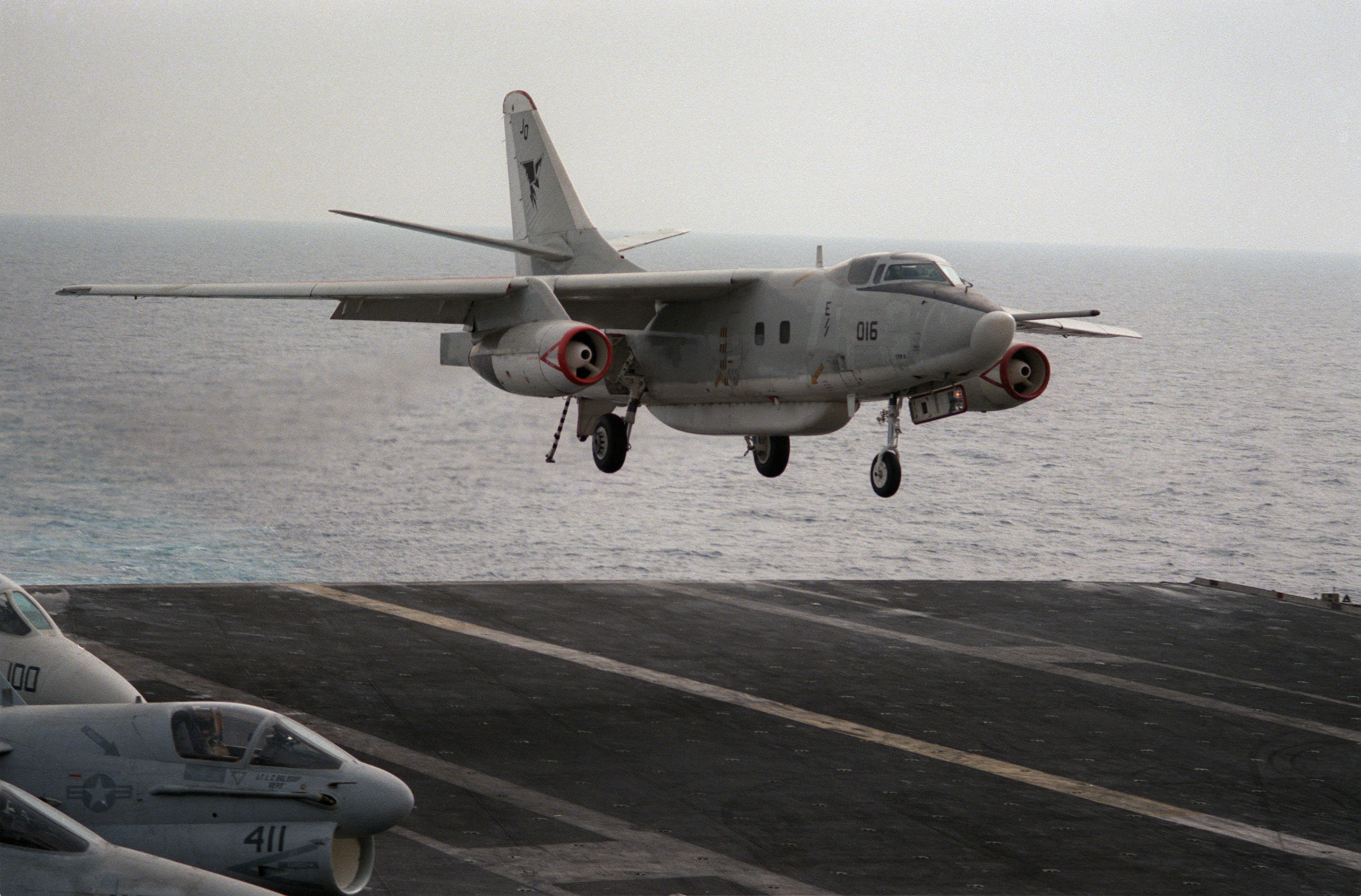
And a video showing what can happen - although this looks like a catapult failure -
https://www.youtube.com/watch?v=tXYSIGqPQmY
Navy personnel joked that the A3D designation for the Skywarrior meant "All Three Dead" - which wasn't altogether funny.
Eric Mc said:
That's not too bad with a single engine type but on a twin, if one engine delivers a different amount of power compared to the other, or fails completely, the result is almost definitely going to lead to loss of control.
What complete and utter nonsense! If that were the case, airfields the world over, where any amount of multi-engine training takes place, would be littered with the wreckage of crashed aircraft!
The correct application of Engine Failure After Take-Off (or go-around) drills tends to maintain control of the aircraft. Even low hours student pilots can usually manage it.
Simpo Two said:
But Eric is talking about WW2 warbirds, so maybe things were different then?
+1He's also talking about aircraft carriers, where go rounds are far more common.
There is the additional issue of having enough power to climb away on one engine if the pilot misses the arrestor wire. Worse if you only have one engine of course, but then you have fewer engine failures. This was part of the reason the naval version of the Jaguar was abandoned.
Edited by Dr Jekyll on Wednesday 1st April 19:49
Eric Mc said:
And a video showing what can happen - although this looks like a catapult failure -
https://www.youtube.com/watch?v=tXYSIGqPQmY
Navy personnel joked that the A3D designation for the Skywarrior meant "All Three Dead" - which wasn't altogether funny.
Towards the tail, underneath, looks like speed brakes out? Also nose is up before it comes off the deck. Missed the wires and didn't have enough oompfff to get back up.https://www.youtube.com/watch?v=tXYSIGqPQmY
Navy personnel joked that the A3D designation for the Skywarrior meant "All Three Dead" - which wasn't altogether funny.
Gassing Station | Boats, Planes & Trains | Top of Page | What's New | My Stuff