
What's wrong with my water tap?
Discussion


I replaced my boat's original water pump, which had failed, with a new one: https://www.amazon.co.uk/dp/B08TJ2GNMT It was recommended by the marine engineer who came out to check.
The problem now is twofold - first, the tap makes a terrible grinding noise when you open it, and second, it's impossible to get a slow flow - it's either full blast or nothing. What's the answer please?
The problem now is twofold - first, the tap makes a terrible grinding noise when you open it, and second, it's impossible to get a slow flow - it's either full blast or nothing. What's the answer please?
Simpo Two said:
I replaced my boat's original water pump, which had failed, with a new one: https://www.amazon.co.uk/dp/B08TJ2GNMT It was recommended by the marine engineer who came out to check.
The problem now is twofold - first, the tap makes a terrible grinding noise when you open it, and second, it's impossible to get a slow flow - it's either full blast or nothing. What's the answer please?
That pump delivers "3GPM 25PSI" so I am guessing your tap is "fighting" 25psi water & as soon as you turn it on the pump is trying to pump 3 gallons/minute.The problem now is twofold - first, the tap makes a terrible grinding noise when you open it, and second, it's impossible to get a slow flow - it's either full blast or nothing. What's the answer please?
Looks like you need a new tap I would think.
E-bmw said:
That pump delivers "3GPM 25PSI" so I am guessing your tap is "fighting" 25psi water & as soon as you turn it on the pump is trying to pump 3 gallons/minute.
Looks like you need a new tap I would think.
The old pump + tap would be able to do a pulsing flow that was usefully between nothing and 100%. Perhaps the new pump is too powerful?Looks like you need a new tap I would think.
Dave Hedgehog said:
air lock? did you prime it as per the instructions?
It's self-priming.HocusPocus said:
Did you over spec the pump?
The engineer chose it after looking at the old one. It may be an extra 5gph. not sure now.I think I've seen pressure cylinders that fit between the pump and tap - if so would that allow me to have a decent controlled flow?
Simpo Two said:
The engineer chose it after looking at the old one. It may be an extra 5gph. not sure now.
I think I've seen pressure cylinders that fit between the pump and tap - if so would that allow me to have a decent controlled flow?
Accumulator was my first thought.I think I've seen pressure cylinders that fit between the pump and tap - if so would that allow me to have a decent controlled flow?
https://www.xylem.com/en-uk/products--services/pum...
Or a new tap.
swanny71 said:
Accumulator, that's the thing, thanks.Thinking about it, the pump is in a direct line between the freshwater tanks in the front of the boat and the taps. But the hot water comes from a calorifier at the back. It is, obviously, pumped, but I can't work out how the cold water pump also pumps the hot water...!
I've asked the engineer for advice too.
On smaller vessels the cold water pump can do both - feeding into the calorifier (cold water in at the bottom, hot water out the top).
Similar to this (yours may be different obviously).
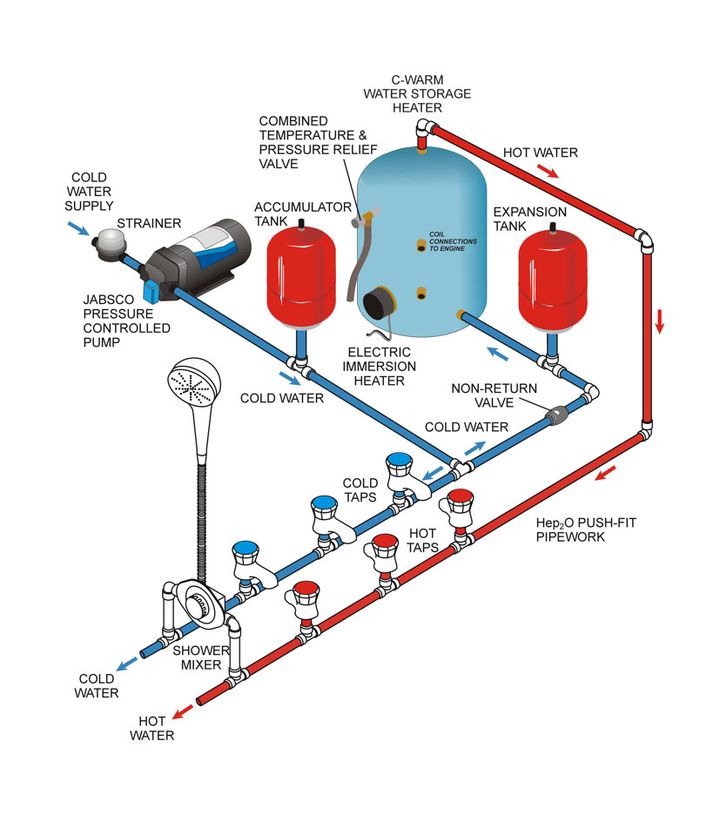
On larger installations there s often a separate circ pump in hot water system that returns a portion of the how water to the calorifier preventing large dead legs.
Similar to this (yours may be different obviously).
On larger installations there s often a separate circ pump in hot water system that returns a portion of the how water to the calorifier preventing large dead legs.
Simpo Two said:
swanny71 said:
I can't work out how the cold water pump also pumps the hot water...!I've asked the engineer for advice too.
ETA.
Yes an accumulator may also help.
As a clue to see if it will, is the hot more controllable?
If so, then it is absolutely worth a try.
swanny71 said:
On smaller vessels the cold water pump can do both - feeding into the calorifier (cold water in at the bottom, hot water out the top).
Similar to this (yours may be different obviously)
That might be it, though I don't have the accumulator and expansion tanks. Boat is 27'.Similar to this (yours may be different obviously)
The hot water comes out much the same, going from nothing to full blast with just a small movement, and it comes out scalding hot so it's currently a risk to use. In other words, since the pump was changed both hot and cold have gone bonkers.
The engineer knows the boat so it will be interesting to see what he thinks.
Normally the pump's pressure switch turns on at say 23 psi and off at say 27, so the accumulator pumps up to pressure then the pump switches off.
The tap should work like a normal tap, you should be able to open the tap a little and get half a cup of water out before the accumulator pressure drops enough for the pump to turn on.
Either the pump's pressure switch is set very low, or the accumulator has either no air in it or too high a pressure. It needs to be about half full of air when the water is at operating pressure. There is normally a bladder between the air and water in the accumulator, but these often fail. Is there a schrader valve on the accumulator to check the pressure and pump it up?
Some of these pumps can be odd when sucking against a blockage or closed tank vent.
I've seen a few boats without a non-return valve on the feed to the calorifier, you then need only one expansion vessel/accumulator, and hot and cold stay track each other in pressure as the calorifier heats up. That can go bad, with hot water coming out of the cold tap in some circumstances. The calorifier can get very very hot if you thrash the engine and the cooling system is dubious.
The tap should work like a normal tap, you should be able to open the tap a little and get half a cup of water out before the accumulator pressure drops enough for the pump to turn on.
Either the pump's pressure switch is set very low, or the accumulator has either no air in it or too high a pressure. It needs to be about half full of air when the water is at operating pressure. There is normally a bladder between the air and water in the accumulator, but these often fail. Is there a schrader valve on the accumulator to check the pressure and pump it up?
Some of these pumps can be odd when sucking against a blockage or closed tank vent.
I've seen a few boats without a non-return valve on the feed to the calorifier, you then need only one expansion vessel/accumulator, and hot and cold stay track each other in pressure as the calorifier heats up. That can go bad, with hot water coming out of the cold tap in some circumstances. The calorifier can get very very hot if you thrash the engine and the cooling system is dubious.
Simpo Two said:
^^ At present there isn't an accumulator. Just freshwater tanks, calorifier, pump and taps.
Sometimes there is enough air space in the calorifier to function as an accumulator.Any air space will do, could be a length of dead-end pipe or hose.
This can be subject to change, more less air in there over time, or as on one boat I raced on, it all changes when you heel the boat 80 degrees....
Also boats can be plumbed with rubbery pipe work, so there is some flexibility and 'stored pressure'.
Check the pressure relief valve on the calorifier, if things are 'scalding hot', then maybe it's over heating and not dumping pressure when it should, that could explain erratic action of the taps and pump?
hidetheelephants said:
Pretty unusual to not have an accumulator, are you certain there isn't one hiding in a locker? There are very small ones available for boats.
No,I've had the boat for 14 years and know every inch of it. The water delivery has always been a bit chug-chug-chug, but it was workable, unlike now.OutInTheShed said:
Check the pressure relief valve on the calorifier, if things are 'scalding hot', then maybe it's over heating and not dumping pressure when it should, that could explain erratic action of the taps and pump?
The hot water has always been scalding, but I did notice a few months ago (before the pump change) some water overflowing from the side of the boat for no obvious reason - one of those WTF moments... I traced the hose back to the calorifier; a plastic cap was bobbling about and water was dripping out. I poked it and it stopped...OutInTheShed said:
Simpo Two said:
^^ At present there isn't an accumulator. Just freshwater tanks, calorifier, pump and taps.
Sometimes there is enough air space in the calorifier to function as an accumulator.Alas, it appears not.
Simpo Two said:
The hot water has always been scalding, but I did notice a few months ago (before the pump change) some water overflowing from the side of the boat for no obvious reason - one of those WTF moments... I traced the hose back to the calorifier; a plastic cap was bobbling about and water was dripping out. I poked it and it stopped...
You can normally twist the cap on the PRV on the calorifier to open the PRV and it's not a bad idea to do it every now and then to clear any scale or crud which may have accumulated in it. Ours twists one click and the cap feels a bit firm, twists again and gets firmer then a third click gets it back to feeling loose again (PRV closed).spitfire-ian said:
You can normally twist the cap on the PRV on the calorifier to open the PRV and it's not a bad idea to do it every now and then to clear any scale or crud which may have accumulated in it. Ours twists one click and the cap feels a bit firm, twists again and gets firmer then a third click gets it back to feeling loose again (PRV closed).
To be frank I didn't know it had a PRV; I just think of the calorifier as a tank of hot water, like at home.The PRV must be at the bottom of the clear hose; IIRC the cap is hidden by the rubber pipe.
Gassing Station | Boats, Planes & Trains | Top of Page | What's New | My Stuff