
DC-9 Skydiving Platform
Discussion


Yes you read that right - the world's last flying example of a DC-9 20 series (only 10 ever built) is used as a skydiving platform in California. Slightly modified to remove the rear air stairs and replace with what is effectively a slide. I am so grateful to the YouTube algorithm for deciding I needed to see this video.
https://www.youtube.com/watch?v=I1Gdar72rMU
https://www.youtube.com/watch?v=I1Gdar72rMU
As far as I know, the only original customer for the Series 20 was SAS. So I expect that this is an ex SAS aircraft.
The 20 had the original short fuselage of the Series 10 and 15 but it featured the more powerful engines of the longer fuselage Series 30 and also the same wing as the 30.
The 20 had the original short fuselage of the Series 10 and 15 but it featured the more powerful engines of the longer fuselage Series 30 and also the same wing as the 30.

RacingStripes said:
Thats been there a long time. I did my jumps course at Perris Valley in 2016 and it was sat to one side then.
I have never, and probably wiil never, understand the attraction of throwing yourself out of a perfectly servicable aircraft but I must admit watching people walk down the aisle of an airliner past the last row of seats and then going down a slide to the outside world at 15000 feet is pretty cool.And it's great to see an old girl still doing a job.
48k said:
I have never, and probably wiil never, understand the attraction of throwing yourself out of a perfectly servicable aircraft but I must admit watching people walk down the aisle of an airliner past the last row of seats and then going down a slide to the outside world at 15000 feet is pretty cool.
And it's great to see an old girl still doing a job.
I did my 20 solo jump to get my licence along with a parachute packing course and then never did it again.And it's great to see an old girl still doing a job.
The jumping out was fun and the landings were fun, I just didnt find the bit in the middle exciting. I went racing instead.
RacingStripes said:
I did my 20 solo jump to get my licence along with a parachute packing course and then never did it again.
The jumping out was fun and the landings were fun, I just didnt find the bit in the middle exciting. I went racing instead.
I did the twenty as well (plus two static line jumps many years ago) - mainly in Australia, then at Netheravon (which I hated) and then Old Buckenham where they were brilliant (and it's where Jimmy Stewart flew B24s from). The jumping out was fun and the landings were fun, I just didnt find the bit in the middle exciting. I went racing instead.
I always hated actually leaving the aircraft, and every time I crouched in the doorway I regretted the decisions that had taken me to that point! But I enjoyed watching the aircraft disappear "upwards", and the time under canopy, but having seen someone flare too early (and break a wrist falling backwards) on my first day, I would never flare enough myself and end up on my face almost every time.
Decided not for me - I lacked the single mindedness necessary for progressing in British weather, and it was always second best to learning to flay an actual aircraft which was beyond my means!
Ive never done static or tandom, just straight into solo and doing it in calafornia was nice. I didnt like the plane ride up but once at the door i was ok, we used the sky van a few times too which is rear exit. (8am at 13000 feet is pretty cold whatever the country though).
We had 1 guy flair early and landed hard, both his legs turned black and blue, other than that plenty rolling after landing in the dusty field so obvious when you came back without landing it.
I managed to land all 20 on my feet, when you run it off it makes you feel like maximus in Gladiator "Are you not entertained"!
We had 1 guy flair early and landed hard, both his legs turned black and blue, other than that plenty rolling after landing in the dusty field so obvious when you came back without landing it.
I managed to land all 20 on my feet, when you run it off it makes you feel like maximus in Gladiator "Are you not entertained"!

Eric Mc said:
As far as I know, the only original customer for the Series 20 was SAS. So I expect that this is an ex SAS aircraft.
The 20 had the original short fuselage of the Series 10 and 15 but it featured the more powerful engines of the longer fuselage Series 30 and also the same wing as the 30.
It was also the base design for a version pitched to the US Navy for supply runs to and from aircraft carriers (COD). Would have various modifications, including an extending front undercarriage similar to the Royal Navy Phantoms. The 20 had the original short fuselage of the Series 10 and 15 but it featured the more powerful engines of the longer fuselage Series 30 and also the same wing as the 30.
Lobbing a small airliner off the deck with a catapult would have been quite the thing to see!
bobthemonkey said:
It was also the base design for a version pitched to the US Navy for supply runs to and from aircraft carriers (COD). Would have various modifications, including an extending front undercarriage similar to the Royal Navy Phantoms.
Lobbing a small airliner off the deck with a catapult would have been quite the thing to see!
Not quite - it was the (similar looking) Fokker F28 COD proposal for the USN Multi Mission Tactical Support project that had the extending nose gear:Lobbing a small airliner off the deck with a catapult would have been quite the thing to see!
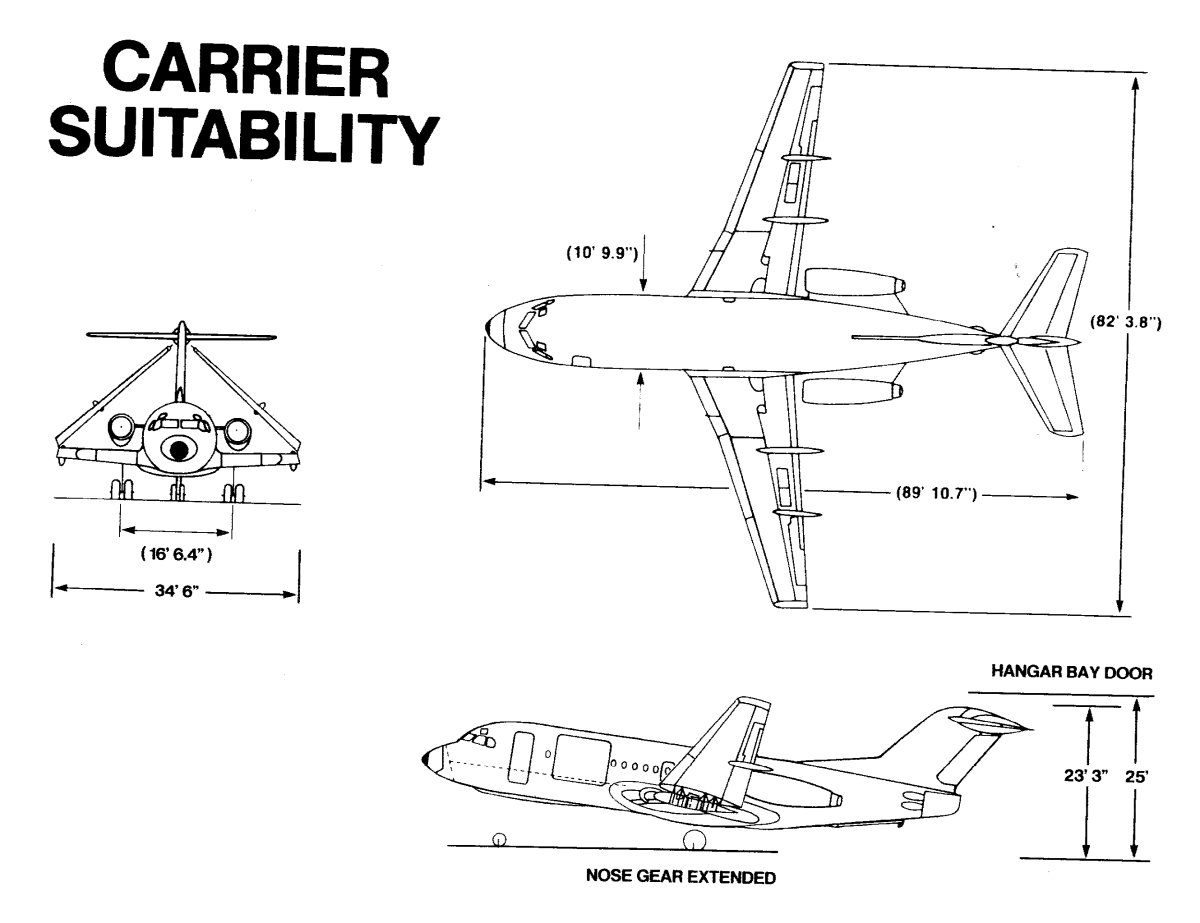
as well as folding outer wings and various other structural and technical changes. The telescopic nose gear was primarily to get the T-tail low enough to fit into the carrier hangar deck, but it did also allow increasing the static angle of attack for improved take-off lift.
McDonnell Douglas did submit two DC-9 variants for the MMTS project. One had the nose gear moved aft and extended, but it wasn't telescopic like the F28.
Boeing submitted a two-plane 'system' - a transport-spec 727 and a carrier-capable version of the 737-100. The idea was that the 727 would get the load from the US to the theatre of operations, and the 737 would get it to the carrier in mid-ocean.
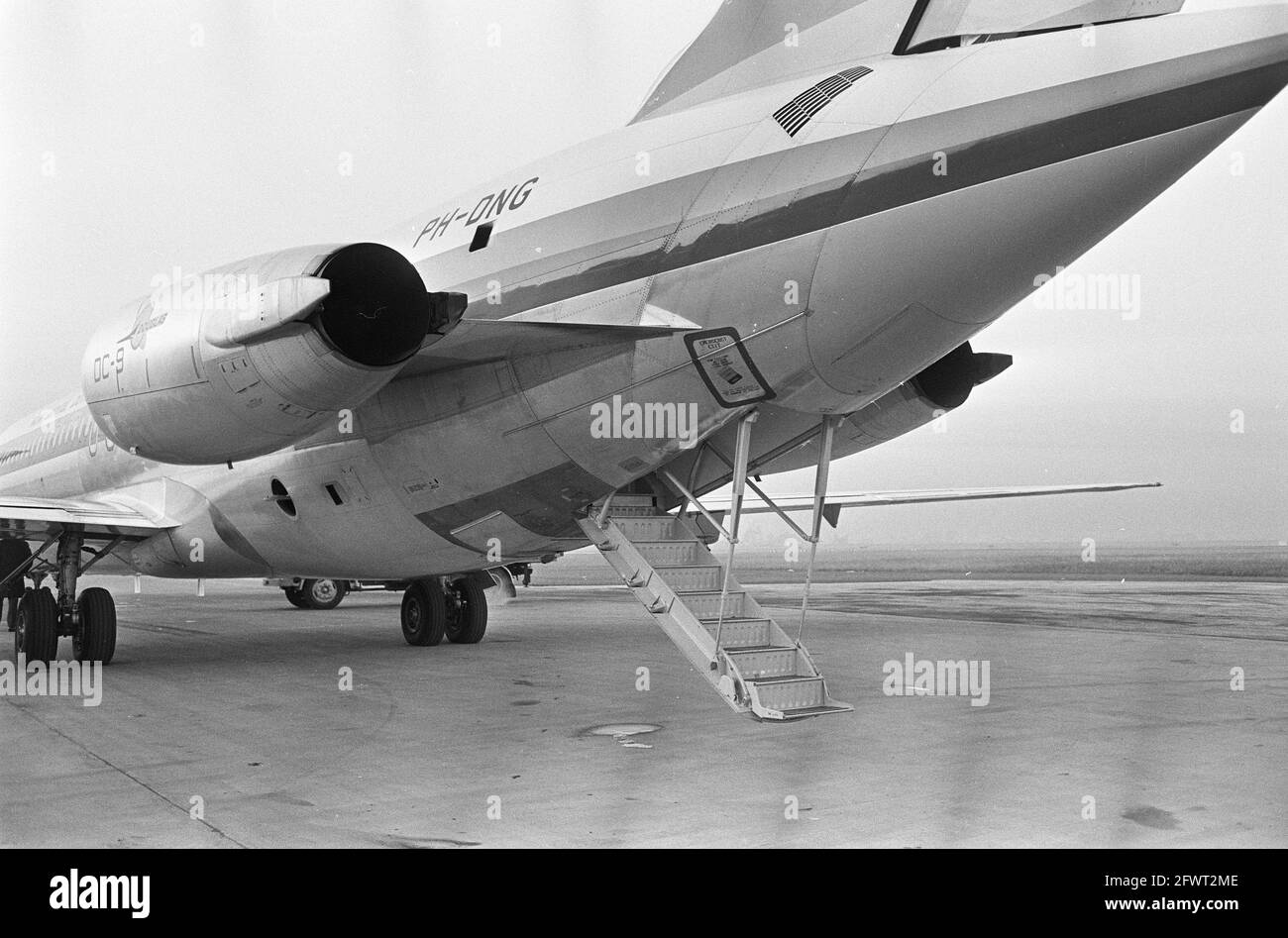
It just means stairs that are fitted to the aircraft rather than the ones that get towed about on the ground or are self-propelled.  On the DC9 and a few other early jet airliners the rear air stair was fitted longitudinally under the tail, meaning it can potentially be used in flight, as made famous by DB Cooper.
On the DC9 and a few other early jet airliners the rear air stair was fitted longitudinally under the tail, meaning it can potentially be used in flight, as made famous by DB Cooper.Air stairs are often fitted to some airliners as a customer option. They allow an airliner to operate into airports which may not have compatible sets of steps and it also allows flexibility at airports where suitable external steps aren't immediately available. The downside is that they add a fair bit of weight to the aircraft which has a detrimental effect on the economics of operating the aircraft.
As has been mentioned, T-Tail airliners of the 60s and 70s (DC-9, BAC 1-1, Boeing 727 etc) often had airstairs in the tail.


However. more conventional airliners like the 737 can also have airstairs, if fitted, in a special receptacle underneath the normal passenger doors.
This is a Ryanair 737 making use of its airstairs. As we all know, Ryanair often operates into fairly remote European airports (usually former military air bases) and some of these airports lack facilities. Having your own set of steps allows flexibility.

As has been mentioned, T-Tail airliners of the 60s and 70s (DC-9, BAC 1-1, Boeing 727 etc) often had airstairs in the tail.
However. more conventional airliners like the 737 can also have airstairs, if fitted, in a special receptacle underneath the normal passenger doors.
This is a Ryanair 737 making use of its airstairs. As we all know, Ryanair often operates into fairly remote European airports (usually former military air bases) and some of these airports lack facilities. Having your own set of steps allows flexibility.
Eric Mc said:
However. more conventional airliners like the 737 can also have airstairs, if fitted, in a special receptacle underneath the normal passenger doors.
This is a Ryanair 737 making use of its airstairs. As we all know, Ryanair often operates into fairly remote European airports (usually former military air bases) and some of these airports lack facilities. Having your own set of steps allows flexibility.
Are Ryanair the only carrier still speccing airstairs as standard on new aircraft? I always thought the reason for fitting them was less about working from facility free fields and more about not having to pay or wait for the ground handlers bringing a front set of steps, obviously they still hire steps for the rear at most airports.This is a Ryanair 737 making use of its airstairs. As we all know, Ryanair often operates into fairly remote European airports (usually former military air bases) and some of these airports lack facilities. Having your own set of steps allows flexibility.
Gassing Station | Boats, Planes & Trains | Top of Page | What's New | My Stuff