
Setting up a floating Floyd Rose etc bridge from scratch
Discussion


The subject came up recently on the 'Our Guitars' thread. I found this and thought it might be of some use to people with this type of guitar
"1) Take all the old strings off and then wind all the intonation screws back (away from the pickups) as far back as they will go. Now find something, a piece of wood, or a ruler, or anything else that will hold the bridge in the position you will want it to float
2) Decide what you want the static position of the FR bridge to be, usually this will be parallel to the face of the body, and set the two fulcrum screws to get the bridge to a suitable height, so as to have the strings whatever distance from the body you require. You may need to alter the packing you used in step one to suit the new bridge height.
3) It’s possible you may need to shim the neck in order to get the string height right. It’s ok to do this, but make sure to use something hard like plastic shim, not compressible like cardboard.
4) Now tighten the spring screws in the cavity at the rear a few turns. If they are stiff to turn, take them out and rub some candle-wax on the threads before replacing them, they will need to be adjusted again later.
5) Now you can string up the guitar with your chosen brand and gauge of strings and bring it up to pitch. Don’t tighten the locking nut yet. If the bridge tilts up when you bring the guitar up to pitch you need to tighten the screws in the rear some more. The bridge should be solidly against the packing at this stage.
6) Set the intonation by winding the screws forward until the fretted note at the twelfth fret equals the harmonic. It’s easier to wind them forwards than backwards, which is why we set them all the way back in step 1.
7) When the guitar is at pitch, and the intonation is set, now is the time to adjust the spring screws. The idea is to back them off a little at a time until when the packing is removed, the bridge stays where it is (in other words, the tension of the strings is perfectly in balance with the springs).
8) Stretch the strings gently and retune, then you can lock the strings at the nut and you are ready for the gig."
"1) Take all the old strings off and then wind all the intonation screws back (away from the pickups) as far back as they will go. Now find something, a piece of wood, or a ruler, or anything else that will hold the bridge in the position you will want it to float
2) Decide what you want the static position of the FR bridge to be, usually this will be parallel to the face of the body, and set the two fulcrum screws to get the bridge to a suitable height, so as to have the strings whatever distance from the body you require. You may need to alter the packing you used in step one to suit the new bridge height.
3) It’s possible you may need to shim the neck in order to get the string height right. It’s ok to do this, but make sure to use something hard like plastic shim, not compressible like cardboard.
4) Now tighten the spring screws in the cavity at the rear a few turns. If they are stiff to turn, take them out and rub some candle-wax on the threads before replacing them, they will need to be adjusted again later.
5) Now you can string up the guitar with your chosen brand and gauge of strings and bring it up to pitch. Don’t tighten the locking nut yet. If the bridge tilts up when you bring the guitar up to pitch you need to tighten the screws in the rear some more. The bridge should be solidly against the packing at this stage.
6) Set the intonation by winding the screws forward until the fretted note at the twelfth fret equals the harmonic. It’s easier to wind them forwards than backwards, which is why we set them all the way back in step 1.
7) When the guitar is at pitch, and the intonation is set, now is the time to adjust the spring screws. The idea is to back them off a little at a time until when the packing is removed, the bridge stays where it is (in other words, the tension of the strings is perfectly in balance with the springs).
8) Stretch the strings gently and retune, then you can lock the strings at the nut and you are ready for the gig."
Edited by singlecoil on Friday 5th July 16:09
Good advice for beginners to double locking trems. Top tip, playing cards make a great packing material because you can add or remove cards to adjust the bridge height very quickly an easily, and with every card making a difference you can really get the bridge level spot on.
With double locking trems, I find myself akin to Paul Gilbert in the late 80s / early 90s, I don't actually use the trem itself all that often, though I am trying to incorporate it more into my lead style ala Steve Vai, Satch, EVH etc. The main benefit from me, aside from unparalleled playing comfort, is the tuning stability. I've played my Ibanez K-7 a lot recently, which uses a modified version of their Lo-Pro 7 (Lo-Pro meaning low profile, and it's modified for the K-7 with an arm hole on each side of the bridge to fit it's unique U bar attachment), probably most nights for the last month, and I haven't had to tune it in nearly 4 weeks. The last time I did tune it, it was only 2 or 3 cents out on every string. I love that dependability, you might lose time on string changes vs a fixed bridge or old fashioned Fender style trem, but the stability of a properly set up locking trem guitar, assuming the trem is of good quality and not some cheapo crap item, is without compare.
With double locking trems, I find myself akin to Paul Gilbert in the late 80s / early 90s, I don't actually use the trem itself all that often, though I am trying to incorporate it more into my lead style ala Steve Vai, Satch, EVH etc. The main benefit from me, aside from unparalleled playing comfort, is the tuning stability. I've played my Ibanez K-7 a lot recently, which uses a modified version of their Lo-Pro 7 (Lo-Pro meaning low profile, and it's modified for the K-7 with an arm hole on each side of the bridge to fit it's unique U bar attachment), probably most nights for the last month, and I haven't had to tune it in nearly 4 weeks. The last time I did tune it, it was only 2 or 3 cents out on every string. I love that dependability, you might lose time on string changes vs a fixed bridge or old fashioned Fender style trem, but the stability of a properly set up locking trem guitar, assuming the trem is of good quality and not some cheapo crap item, is without compare.
HarryFlatters said:
Good advice guys.
I've got two guitars with FR trems and I find them very difficult to set up properly, to the point that I don't really use them very often.
Sounds like they haven't been correctly set-up in the first place, they shouldn't need any further attention. What exactly is the problem?I've got two guitars with FR trems and I find them very difficult to set up properly, to the point that I don't really use them very often.
singlecoil said:
Sounds like they haven't been correctly set-up in the first place, they shouldn't need any further attention. What exactly is the problem?
They almost certainly haven't been set up properly... There's no real issue as such, but I just get the feeling that if it goes out of tune I could spend all day tuning it, only for it to go out of balance and then I've got to start again.One's an Ibanez Iceman IC-350 and the other is a Washburn Dime. I don't actually use a trem very much, so they're kind of sitting about doing nothing and half the time I don't even have the whammy bar screwed in

HarryFlatters said:
They almost certainly haven't been set up properly... There's no real issue as such, but I just get the feeling that if it goes out of tune I could spend all day tuning it, only for it to go out of balance and then I've got to start again.
Definitely not right. Once the trem is set up, you should be able to tune it at the headstock in a few minutes at most, lock the nut, do the bridge tuners and you're done. It shouldn't really go "out of tune" anymore, other than all strings slipping by a few cents over days of playing. I don't know what bridge is on the Ibanez, but my wife's brother had a Dean Dime Razorback thing with a licensed Floyd Rose on it and it was junk - a good design spoiled by manufacturing with the cheapest materials possible. I had all kinds of trouble setting that guitar up for him, but managed it in the end - the trem mounting posts were not stable in the body, which made everything a nightmare. It was stable in the end, but did tend to not hold tuning as well as the real deal Floyds I've played. The trems on both of your guitars should be possible to set up to be fairly stable, as in you should be able to get a few songs out of them with moderate whammy use before needing a quick tune up with the fine-tuners. This is a fact of life with guitars at this end of the market though, play a Prestige Ibanez or something with an Original Floyd Rose (the name of the model, this is the good one) and you can really abuse the trem and still fall back into tune every time, assuming it's set up right.
Don't shy away from setting your trem up, I think the issue you are most likely facing is a balancing issue, you want to have each of the two screws in the back of your guitar holding equal tension on the bridge, if one is pulling more, the bridge will dip on that side. Then you'll tune it, and it will sound ok, then you'll do some bends or use the bar and the tuning will go to pieces.
Hold your guitar as in the picture below, look straight the bridge, this is an Ibanez bridge so yours may look slightly different, but the principle is the same.

The bridge should be level, parallel with the body of the guitar, all the way along. Notice in this picture the bridge does not appear level, it looks a little sunken in on the higher / thinner strings, and looks to be raising towards the lower / thicker strings. You can sort this balance by adding and removing tension on the trem claw springs by tightening and loosening the screws in the back of the guitar. Once it's level on this plane, check the side on level is correct. When setting up your Ibanez, look for a visual reference online or consult your owner's manual, as not all Ibanez bridges as "level" when they appear parallel, as parts of the bridges are angled for better playing ergonomics. When getting the bridge "level" here, I'm talking about on this axis
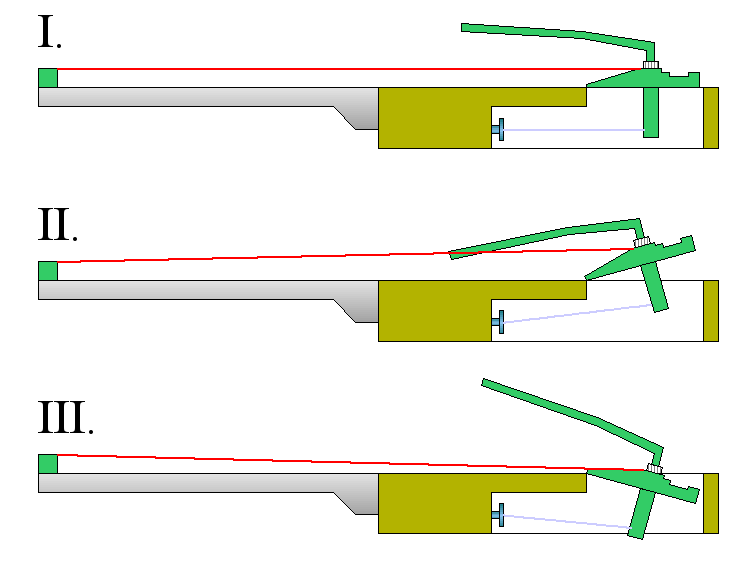
That diagram also shows the relationship between spring and string tension that you need to understand to learn how the bridge works and how to set it up properly. Once you've got it sitting right in both axis, it should hold tune properly. Don't be afraid to have a go at setting them up, its hard to break a guitar unless you are really going some. Just don't undo the screws too much, if you have let all the screws pretty much all the way out and the strings are still giving too much tension, which is unlikely unless you use huge string gauges, put another trem claw spring on. By the sounds of things, you aren't using these guitars to their fullest, you shouldn't be afraid to use a guitar in case it goes out of tune. If the setup really is appalling, with string heights, intonation, bridge level etc all to pot, consider taking it to a pro for a setup, he will ask what you want and do his best to get the guitar how you want it.
There is no shame in not knowing how to set up a locking trem, I've met blokes with incredibly valuable and desirable guitars with locking trems who don't know the first thing about how they work and just have a tech do all the work. Not to mention, I think some of the old timer's brigade don't even know what it's for. I've heard locking trems referred to as "the wah wah" and "the distortion stick" by some!
Edited by Mastodon2 on Tuesday 9th July 17:48


Gassing Station | Music | Top of Page | What's New | My Stuff