
Recording vocals, controlling room acoustics?
Discussion


My new music room is at the moment pretty much bare walls and ceiling with a Karndean (hard) floor 3.8M by 2.5M. I need some sort of acoustic panels but fortunately do not need to absorb bass frequencies.
I have good workshop facilities if the answer is to make up some panels but would like suggestions about materials, dimensions, placing and anything else I need to know.
Thanks in anticipation
I have good workshop facilities if the answer is to make up some panels but would like suggestions about materials, dimensions, placing and anything else I need to know.
Thanks in anticipation
Room treatment is a fine art and you can go as far as your wallet can take you - eg floating room within a room.
A lot will depend on type of music, activities, size of room, equipment etc.
Can I recommend you take a look on the Dogs On Acid production forum - do a google search for "dogs on acid room treatment" (and you could throw in the terms 'tracking' or 'vocal') and take heed of everything Full Clip Audio says on there. DoA was predominantly a drum n bass production forum but the advice is universal and is extremely valuable. FCA is a big producer who has worked on both DnB productions as well as multiple Top40 US chart hits etc.
Some other material:
http://www.p5audio.com/blog/2013/01/treating-your-...
http://www.dogsonacid.com/threads/room-treatment-f...
http://www.dogsonacid.com/threads/too-much-acousti...
"The best way to check your room and see where you need to treat it is to get a reference mic and SIA SMART. Run pink noise (c-weighted) through your system and walk the mic to different positions around the room. This will quickly show you trouble spots. Treat these and then place the mic in the listening/mix position and treat the room until mix position is as flat as possible.
Completely dead wall behind the monitors, diffusion and absorption above the mix position, diffusion and bass traps on the back wall and corners will get you started. "
"
"Definitely do not put carpet on your walls! This will only absorb the high and high mid frequencies and will end up making your room sound boxy. The idea is to get an even response which is why covering your walls with acoustic "foam" alone will often make things sound worse.
As mentioned, start by measuring your rooms response and finding the best position for your monitors, treat your first reflection points and add as much bass trapping as you can in your corners. From there you should measure again and decide if you want or need to target specific frequencies.
For the "tracking" room I would make the ceiling as dead as possible since it is only 3 meters (ideally you want 14" or more). You are going to have a hard time getting a small room to sound good for tracking instruments so unfortunately you may end up having to make the entire room pretty dead. "
A lot will depend on type of music, activities, size of room, equipment etc.
Can I recommend you take a look on the Dogs On Acid production forum - do a google search for "dogs on acid room treatment" (and you could throw in the terms 'tracking' or 'vocal') and take heed of everything Full Clip Audio says on there. DoA was predominantly a drum n bass production forum but the advice is universal and is extremely valuable. FCA is a big producer who has worked on both DnB productions as well as multiple Top40 US chart hits etc.
Some other material:
http://www.p5audio.com/blog/2013/01/treating-your-...
http://www.dogsonacid.com/threads/room-treatment-f...
http://www.dogsonacid.com/threads/too-much-acousti...
"The best way to check your room and see where you need to treat it is to get a reference mic and SIA SMART. Run pink noise (c-weighted) through your system and walk the mic to different positions around the room. This will quickly show you trouble spots. Treat these and then place the mic in the listening/mix position and treat the room until mix position is as flat as possible.
Completely dead wall behind the monitors, diffusion and absorption above the mix position, diffusion and bass traps on the back wall and corners will get you started.
""Definitely do not put carpet on your walls! This will only absorb the high and high mid frequencies and will end up making your room sound boxy. The idea is to get an even response which is why covering your walls with acoustic "foam" alone will often make things sound worse.
As mentioned, start by measuring your rooms response and finding the best position for your monitors, treat your first reflection points and add as much bass trapping as you can in your corners. From there you should measure again and decide if you want or need to target specific frequencies.
For the "tracking" room I would make the ceiling as dead as possible since it is only 3 meters (ideally you want 14" or more). You are going to have a hard time getting a small room to sound good for tracking instruments so unfortunately you may end up having to make the entire room pretty dead. "
Some Gump said:
You mainly need to dampen and stop echoes.
Personally, i'd just put some heavyish drapes up - if you still get slap echoes, add something to break up the regularity of the walls, like a box section or whatever.
Put a rug down.
Job jobbed.
Hate to burst your bubble but it's not as simple as this - you can end up doing more harm than good to both anything you are tracking/recording, and then your mixdowns, in a poorly treated room.Personally, i'd just put some heavyish drapes up - if you still get slap echoes, add something to break up the regularity of the walls, like a box section or whatever.
Put a rug down.
Job jobbed.
Also forgot to mention Gearslutz production forum will also have a lot of valuable material.
I created this in one part of the live room:
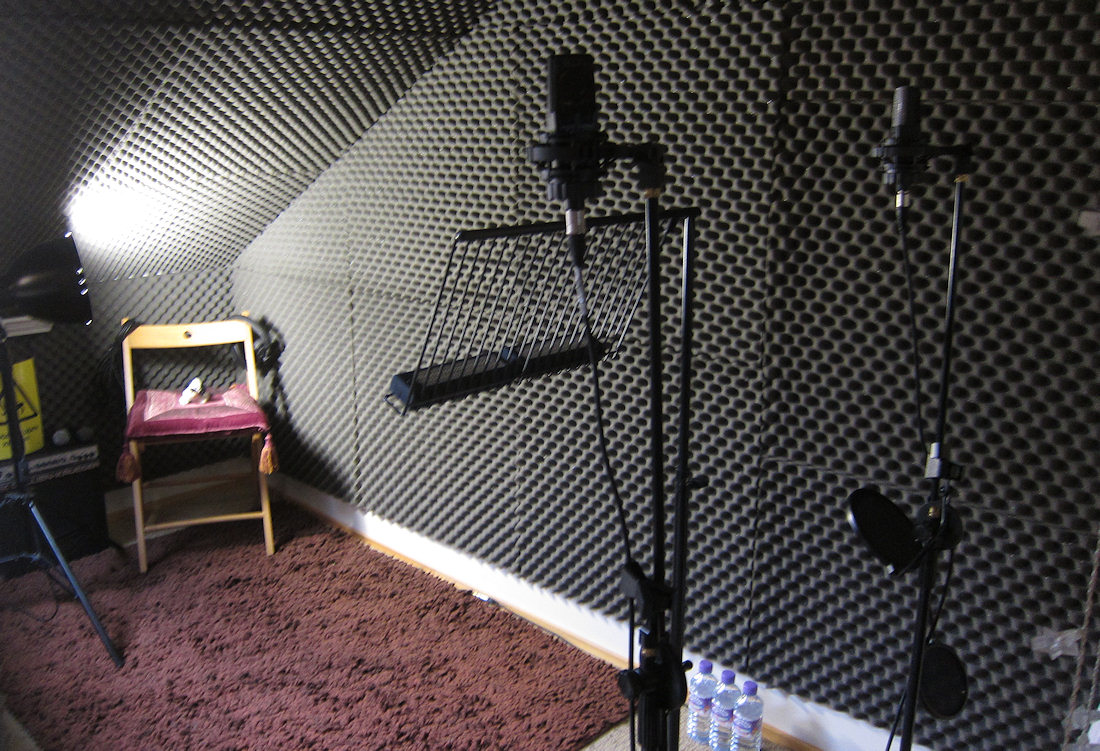
and then put one of these round the AKG414c (not in the above pic)
http://www.seelectronics.com/reflexion-filter-pro
and then put one of these round the AKG414c (not in the above pic)
http://www.seelectronics.com/reflexion-filter-pro
GetCarter said:
I created this in one part of the live room:
and then put one of these round the AKG414c (not in the above pic)
http://www.seelectronics.com/reflexion-filter-pro
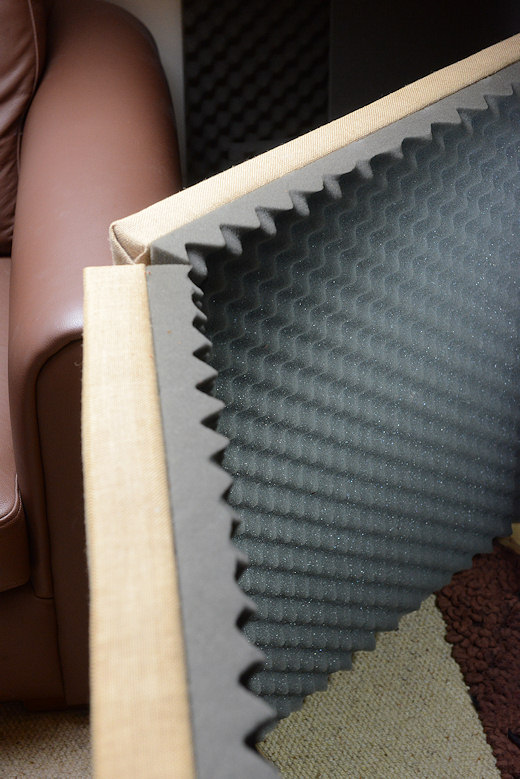
I have one of those reflexion filters on order, but the foam would be impractical in my case especially as I expect it would need gluing to the walls.and then put one of these round the AKG414c (not in the above pic)
http://www.seelectronics.com/reflexion-filter-pro
Is the sloping ceiling to reduce standing waves?

Some good practical info here http://www.soundonsound.com/sos/jul98/articles/aco... There are a further 4 related parts to the article.
Vicoustic have some simple freeware to help measure the performance of your room http://www.vicoustic.com/music-broadcast
This is a great site which has some useful calculators which might help you make your own absorbers and diffusers. There are standing wave, room mode and RT60 reverb calculators to have a play with too; these should help determine the optimum place for the vocalist and mic relative to room boundaries.
http://www.mh-audio.nl/spk_calc.asp
Vicoustic have some simple freeware to help measure the performance of your room http://www.vicoustic.com/music-broadcast
This is a great site which has some useful calculators which might help you make your own absorbers and diffusers. There are standing wave, room mode and RT60 reverb calculators to have a play with too; these should help determine the optimum place for the vocalist and mic relative to room boundaries.
http://www.mh-audio.nl/spk_calc.asp
Gassing Station | Music | Top of Page | What's New | My Stuff