
Just found this little Gem of a Company....
Discussion


http://www.jandssafeguard.com/index.html
There Interceptor unit is setup and calibrated for the GM LS 2 wire knock sensors, just read how the unit works its a great bit of kit and will help any budding Tuner reach the limit of tuning without getting into unsafe Detonation....
Perfect for my Turbo LS Build....
http://www.jandssafeguard.com/SafeGuardTestimonial...
Just read some of these guys reports on the unit.....
There Interceptor unit is setup and calibrated for the GM LS 2 wire knock sensors, just read how the unit works its a great bit of kit and will help any budding Tuner reach the limit of tuning without getting into unsafe Detonation....
Perfect for my Turbo LS Build....
http://www.jandssafeguard.com/SafeGuardTestimonial...
Just read some of these guys reports on the unit.....
It interrupts the signals indivualy so has to be wired to all 8 coil triggers. Then it will delay the signal of any coil it wants to retard, and it's always trying to get back to the original timing in the map which is great as you can run closer margins and still be safe.
A few degrees on a turbo engine can make a lot of power as your no ware near BMT due to threat of detonation. They normally run not much more advance than 15 deg in a boosted engine running pump Gass, to be safe. But 17 deg could be as much as 50 bhp more so this unit could make you run closer to the limit safely and if for some reason you end up with some lower quality Gass one day the unit will stop me getting damage if I put my foot down.
Cost was $600 with a loom which is really cheap insurance for my liking .
A few degrees on a turbo engine can make a lot of power as your no ware near BMT due to threat of detonation. They normally run not much more advance than 15 deg in a boosted engine running pump Gass, to be safe. But 17 deg could be as much as 50 bhp more so this unit could make you run closer to the limit safely and if for some reason you end up with some lower quality Gass one day the unit will stop me getting damage if I put my foot down.
Cost was $600 with a loom which is really cheap insurance for my liking .
thanks I checked their website and was exactly missing this part where this unit interconnects with the indicidual coils.
seems like a nice toy, very tempted to install one. Does it have an extra output when knock has been detected ?
As I have not a really standard LS7 engine I wonder where the know sensor is going to be installed ?
seems like a nice toy, very tempted to install one. Does it have an extra output when knock has been detected ?
As I have not a really standard LS7 engine I wonder where the know sensor is going to be installed ?
The problem with aftermarket devices like that is the lack of "windowing" to the knock signal. Many, many things in your engine make a knocking sound, and a "proper" knock detection system (i.e. an OEM ems one) uses a crank angle "window" to ignore the knock signal outside of that window (for each specific cylinder).
This massively increases the signal to noise ratio and enables it to detect low intensity knocking events. Just listening to a knock sensor, without windowing, or infact in this case without a calibratable bandpass filter on the knock signal is not sufficient in most cases to detect knock (yes, it will probably detect heavy knock, but your ears can also do that)
Certainly you could use that system to avoid any gross knocking events caused maybe by fault conditions (such as running lean, or unusually high intake temperatures etc), but I certainly wouldn't rely on it to actually optimise ignition angle when detonation limited.
This massively increases the signal to noise ratio and enables it to detect low intensity knocking events. Just listening to a knock sensor, without windowing, or infact in this case without a calibratable bandpass filter on the knock signal is not sufficient in most cases to detect knock (yes, it will probably detect heavy knock, but your ears can also do that)
Certainly you could use that system to avoid any gross knocking events caused maybe by fault conditions (such as running lean, or unusually high intake temperatures etc), but I certainly wouldn't rely on it to actually optimise ignition angle when detonation limited.
I'm using a DTA ecu so dont have a Knock system. They use the std LS Knock sensors so if you bought a Crate motor then it has one allready fitted. The GM Bolt on ECU comes with a knock system I think but haven't used one so not sure...
I liked the fact they have been developing this for 10 years now, so there not new to the game, I'll ask them if they use a crank angle window or not cheers..
I liked the fact they have been developing this for 10 years now, so there not new to the game, I'll ask them if they use a crank angle window or not cheers..
GTRCLIVE said:
Reading the ign pulses
Can predict rpm and angle so it is possable still. Other wise how does my rev counter work ?
Your rev counter just counts pulses (or the time between them) does quite a lot of averaging and spits out a number. Having an ignition trigger is only any use if you know at what angle that trigger occured, and have acurately been able to determine engine speed so you know how long to wait to determine any given crank angle window. Proper crank angle windowing needs at least 1 degCA accuracy otherwise it is pointless. You can't get that from an ignition signal and speed averaging.Can predict rpm and angle so it is possable still. Other wise how does my rev counter work ?
The problem with the proper systems is that they take a lot of calibrating, something a typical aftermarket tuning shop or person would simply not be able to do, and then they need validation against in-cylinder pressure measurement to correlate the acoustic amplitude to the peak knocking pressure. Again, you will be handing ove something like £100k+ to someone like AVL to get the neccesary data aquisition systems to do that.
The aftermarket purely acoustic systems ARE better than nothing, but i would only use one to map an engine to well away from any detonation, and then use the system to let me know if any failure or unexpected change causes detonation etc.
the diagram below:there's an explanation of how it works here
http://www.jandssafeguard.com/tech.html
from their website
+++++++++++++++++++++++++++++
Principle of Operation
Using a single knock sensor, the system detects the onset of detonation and retards the timing on a per cylinder basis, up to a total of ten increments. A mode switch lets you select a maximum of either ten degrees or twenty degrees of knock retard. In the ten degree range, each increment is one degree, double that for the twenty degree range.
When knock is detected, software determines knock intensity and decides how many increments to retard this cylinder the next time it fires. The control software retards in proportion to the knock event, up to a maximum of seven steps with one knock event.
The system is always trying to re-advance to stock timing. In the ten degree mode, it re-advances at the rate of one degree every twenty revolutions, double that in the twenty degree mode.
The system does not need a cam or crankshaft reference to determine which cylinder to retard. The unit is programmed to "know" that the knocking cylinder is the one that just fired, and that it won't fire again for two more revolutions. When the knocking cylinder comes around to fire again, software dials in the retard amount for that cylinder. It does this as each cylinder goes by, building up a different retard amount for each cylinder.
The detection algorithm employs a "knock window" to listen for knock at the appropriate time in the combustion cycle. Refer to image below
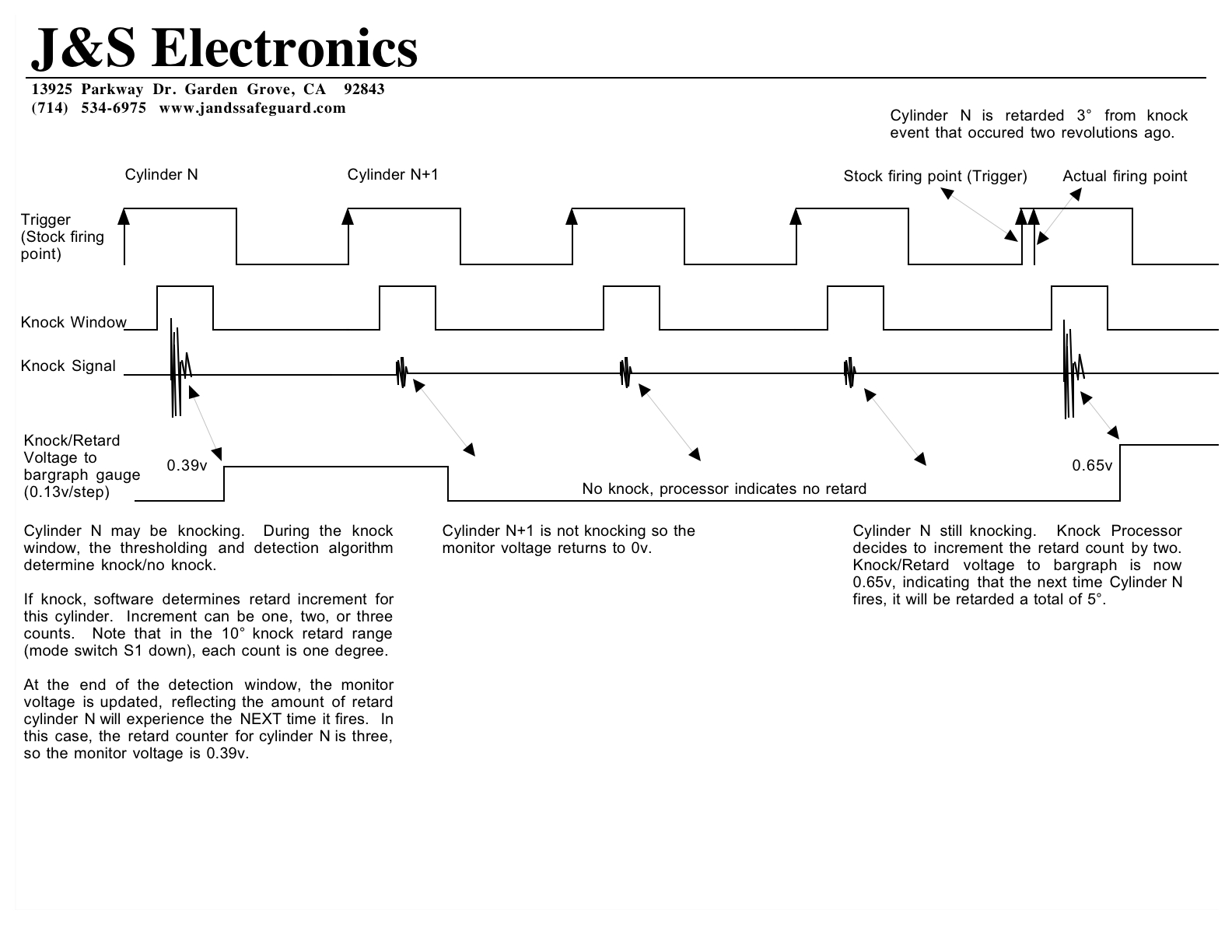
http://www.jandssafeguard.com/tech.html
from their website
+++++++++++++++++++++++++++++
Principle of Operation
Using a single knock sensor, the system detects the onset of detonation and retards the timing on a per cylinder basis, up to a total of ten increments. A mode switch lets you select a maximum of either ten degrees or twenty degrees of knock retard. In the ten degree range, each increment is one degree, double that for the twenty degree range.
When knock is detected, software determines knock intensity and decides how many increments to retard this cylinder the next time it fires. The control software retards in proportion to the knock event, up to a maximum of seven steps with one knock event.
The system is always trying to re-advance to stock timing. In the ten degree mode, it re-advances at the rate of one degree every twenty revolutions, double that in the twenty degree mode.
The system does not need a cam or crankshaft reference to determine which cylinder to retard. The unit is programmed to "know" that the knocking cylinder is the one that just fired, and that it won't fire again for two more revolutions. When the knocking cylinder comes around to fire again, software dials in the retard amount for that cylinder. It does this as each cylinder goes by, building up a different retard amount for each cylinder.
The detection algorithm employs a "knock window" to listen for knock at the appropriate time in the combustion cycle. Refer to image below
Edited by crafty on Sunday 15th January 06:26
So as long as the knock window is directly related to ignition angle and also does not change with load or engine rpm for any particular engine, then that will work perfectly.
Pity then that neither of those are true.
Effectively by using the ignition trigger as a "position" input the system will have a very limited accuracy in the crank angle domain (because ign triggers are in the time domain, and move as spark timing changes with speed and load.) On a V8, you will only have 8 updates per 2 engine revs (90degCA updates) and the system will have to use "time between triggers" to attempt to guess any crank angle between triggers. So when engine speed is rapidly changing (like during a gear change or 1st gear accel etc) the true crank angle could be a long way away from the "expected crank angle". Further to that, using "time between triggers" only works if ignition angle is fixed (or if the system knows what the ignition angle was for each trigger).
I would guess that system simply waits for a fixed amount of time after every trigger input, then integrates the knock signal over a fixed period and sees what the magnitude of that signal is etc.
(also, be very very carefull with modern engines with variable cam timing! (where valve events and the resultant "valve closure event" noise can move up to 60 degCA and you might find yourself retarding as a valve event noise suddenly moves into the "window"......)
As i said, i'm sure it will work to detect "gross" knock, after all the human ear can do that, and it should work to prevent, say, a failure in something else leading to high level of detonation etc.
(although retarding the ignition is only one facet of a competent KCS. For example, at high speed if you retard the ignition you will need to add fuel to limit the corresponding rise in EGT)
My other slight issue with units like that is how do you actually know it is appropriately retarding at the correct times. The biggest issue with a KCS is actually "false retard" where it thinks the engine is knocking and acts, when in fact it is simply an inproper cal/response issue.
On a production ecu, the base spark map will be determined on the confidence rating of the KCS system. In the detonation limited load and speed operation zone, a manufacturer seeking maximumm BMEP will often map the "base spark" some amount into detonation and rely on the KCS to remove sufficient spark from each cylinder to maintain a mean knock intensity to within the set limits.
The other issue is with knock sensor positioning and number. If you use the OEM sensors then at least you know you have a decent sensor SNR, but you still have to decide to which sensor to listen for any given cylinder firing event.
Then we get to the thorny issue of "Thresholding". Assuming you have a signal input that has sufficient SNR (and you have a suitable band pass filter that corresponds to the main harmonics of the knocking pressure wave frequency), you have to decide how to determine what is a knock event of significance and what isn't. The background noise level, even with windowing changes with load and speed so a simple "RMS threshold" is insufficient on it's own. Two main methods exist:
1) Fixed noise thresholding:
You "map" the backround RMS noise level, when you are sure there is no knock, against speed and load.(i.e. confirm no knock with something else (will be in-cylinder pressure sensing for an OEM, you can't just retard the spark miles or the rate of rise of cylinder pressure changes and the background noise changes!)
Then set a threshold that is some amount (ideally calibrateable with speed and load to allow for different thresholds vs load and speed) greater than the background. If that threshold is exceeded, act, and your action can be related to by how much it is exceeded (giving you a basic "gain" in your retard response with knock severity).
The danger of course with this method is that if anything changes in the engine (for example you cam/lifter clearance increases or valve guides wear) you might find the system starting to retard for "ghost" knocking events because the system is unable to compensate for background noise changes. To avoid this you have to calibrate the event threshold high enough above the expected background to account for changes in that background, and that of course means the system cannot respond to low intensity events. (a compromise between adaptablity/reliablility and resolution of knocking intensity)
2) Adaptive knocking thresholds:
Have a system that has a concept of "knocking possible" windowing and "knocking impossible" window. Characterise the engine using in-cylinder pressure measurement (requires <0.1degCA resolution!) to determine the combustion systems characteristic knock profile at all speeds and loads where detonation can occur. Determine a window that does not have knocking pressure waves processing in it, and one which contains the majority of the pressure waves. (generally tricky, especially with VVT systems that can swing valve events all over the shop!)
Integrate the KCS signal (after band pass and anti-alias filtering) in each of these windows for every firing event, and determine the ratio between them. Set thresholding against load and speed for a ratio that corresponds to a knocking pressure at which you decide to take action.
Systems can also use a filtered "historical" value for the comparitor window, averaging previous event noises for any given cylinder to actively "adapt" the knock ratio to changing background noise. (but it is imperative that this filtered value is not updated when you detect a real knock event, or the threshold will be artifically increased and for cases of continued knock will eventually ignore the true knock events)
Most modern EMS systems will use both methods 1 and 2, in an effort to achieve a wide ranging tolerance to false knock events at the same time as having a high resolution to low intensity knock events. They will also be validated across lots of different hardwares (max /min tollerance components) and across a worldwide environmental validation fleet (hot, cold, altitude, poor fuels etc etc)
Even after all that, it is not uncommon to find issues with a production KCS late into the development program, even silly things such as incorrect spark retard being caused by gravel hitting the engine sump on rough road testing etc!
Now, i am no way suggesting that an aftermarket KCS will have anything like the level of complexity and capability of an OEM KCS, but hopefully it is clear that knock control is NOT an easy thing to do. The worst possible case is that someone buys one of the aftermarket systems, without understanding the necessary limitations under which it must operate, fits it and assumes that their engine is now fully protected from detonation!
(and it should also be noted for completeness, that the best control system is one which has to do the least, i.e. having a KCS is no excuse for not having an accurate and repeatable basic engine calibration. if your basic spark mapping is good then your KCS won't have to do a lot, and hence you are much less likely to get issues with erratic or inapporpriate ignition timing)
Pity then that neither of those are true.
Effectively by using the ignition trigger as a "position" input the system will have a very limited accuracy in the crank angle domain (because ign triggers are in the time domain, and move as spark timing changes with speed and load.) On a V8, you will only have 8 updates per 2 engine revs (90degCA updates) and the system will have to use "time between triggers" to attempt to guess any crank angle between triggers. So when engine speed is rapidly changing (like during a gear change or 1st gear accel etc) the true crank angle could be a long way away from the "expected crank angle". Further to that, using "time between triggers" only works if ignition angle is fixed (or if the system knows what the ignition angle was for each trigger).
I would guess that system simply waits for a fixed amount of time after every trigger input, then integrates the knock signal over a fixed period and sees what the magnitude of that signal is etc.
(also, be very very carefull with modern engines with variable cam timing! (where valve events and the resultant "valve closure event" noise can move up to 60 degCA and you might find yourself retarding as a valve event noise suddenly moves into the "window"......)
As i said, i'm sure it will work to detect "gross" knock, after all the human ear can do that, and it should work to prevent, say, a failure in something else leading to high level of detonation etc.
(although retarding the ignition is only one facet of a competent KCS. For example, at high speed if you retard the ignition you will need to add fuel to limit the corresponding rise in EGT)
My other slight issue with units like that is how do you actually know it is appropriately retarding at the correct times. The biggest issue with a KCS is actually "false retard" where it thinks the engine is knocking and acts, when in fact it is simply an inproper cal/response issue.
On a production ecu, the base spark map will be determined on the confidence rating of the KCS system. In the detonation limited load and speed operation zone, a manufacturer seeking maximumm BMEP will often map the "base spark" some amount into detonation and rely on the KCS to remove sufficient spark from each cylinder to maintain a mean knock intensity to within the set limits.
The other issue is with knock sensor positioning and number. If you use the OEM sensors then at least you know you have a decent sensor SNR, but you still have to decide to which sensor to listen for any given cylinder firing event.
Then we get to the thorny issue of "Thresholding". Assuming you have a signal input that has sufficient SNR (and you have a suitable band pass filter that corresponds to the main harmonics of the knocking pressure wave frequency), you have to decide how to determine what is a knock event of significance and what isn't. The background noise level, even with windowing changes with load and speed so a simple "RMS threshold" is insufficient on it's own. Two main methods exist:
1) Fixed noise thresholding:
You "map" the backround RMS noise level, when you are sure there is no knock, against speed and load.(i.e. confirm no knock with something else (will be in-cylinder pressure sensing for an OEM, you can't just retard the spark miles or the rate of rise of cylinder pressure changes and the background noise changes!)
Then set a threshold that is some amount (ideally calibrateable with speed and load to allow for different thresholds vs load and speed) greater than the background. If that threshold is exceeded, act, and your action can be related to by how much it is exceeded (giving you a basic "gain" in your retard response with knock severity).
The danger of course with this method is that if anything changes in the engine (for example you cam/lifter clearance increases or valve guides wear) you might find the system starting to retard for "ghost" knocking events because the system is unable to compensate for background noise changes. To avoid this you have to calibrate the event threshold high enough above the expected background to account for changes in that background, and that of course means the system cannot respond to low intensity events. (a compromise between adaptablity/reliablility and resolution of knocking intensity)
2) Adaptive knocking thresholds:
Have a system that has a concept of "knocking possible" windowing and "knocking impossible" window. Characterise the engine using in-cylinder pressure measurement (requires <0.1degCA resolution!) to determine the combustion systems characteristic knock profile at all speeds and loads where detonation can occur. Determine a window that does not have knocking pressure waves processing in it, and one which contains the majority of the pressure waves. (generally tricky, especially with VVT systems that can swing valve events all over the shop!)
Integrate the KCS signal (after band pass and anti-alias filtering) in each of these windows for every firing event, and determine the ratio between them. Set thresholding against load and speed for a ratio that corresponds to a knocking pressure at which you decide to take action.
Systems can also use a filtered "historical" value for the comparitor window, averaging previous event noises for any given cylinder to actively "adapt" the knock ratio to changing background noise. (but it is imperative that this filtered value is not updated when you detect a real knock event, or the threshold will be artifically increased and for cases of continued knock will eventually ignore the true knock events)
Most modern EMS systems will use both methods 1 and 2, in an effort to achieve a wide ranging tolerance to false knock events at the same time as having a high resolution to low intensity knock events. They will also be validated across lots of different hardwares (max /min tollerance components) and across a worldwide environmental validation fleet (hot, cold, altitude, poor fuels etc etc)
Even after all that, it is not uncommon to find issues with a production KCS late into the development program, even silly things such as incorrect spark retard being caused by gravel hitting the engine sump on rough road testing etc!
Now, i am no way suggesting that an aftermarket KCS will have anything like the level of complexity and capability of an OEM KCS, but hopefully it is clear that knock control is NOT an easy thing to do. The worst possible case is that someone buys one of the aftermarket systems, without understanding the necessary limitations under which it must operate, fits it and assumes that their engine is now fully protected from detonation!
(and it should also be noted for completeness, that the best control system is one which has to do the least, i.e. having a KCS is no excuse for not having an accurate and repeatable basic engine calibration. if your basic spark mapping is good then your KCS won't have to do a lot, and hence you are much less likely to get issues with erratic or inapporpriate ignition timing)
Edited by anonymous-user on Sunday 15th January 14:26
BTW, a nice little technique for validating ignition timing setting and the reponse of any KCS is to use fuels of widely different octaine. This can be done easily by even aftermarket/ DIY tuners. Effectively fill the tank with a fuel of the lowest octaine you might ever use (say 95 ron) calibrate the ignition angle advance so that your KCS is just starting to retard the ignition across the BLD zone. Then swap to say 102 octaine "race fuel" and repeat the test. if your system is correctly picking up knock, and only knock, then it should do nothing on the second run ;-)
(if you are feeling super confident then repeat the test the other way around, i.e. map to BLD on 102 octaine, then fill with 95 and check the ignition angle goes back towards the usual 95 levels.......... ;-)
(note a few important points:
1) boundary conditions need to be as similar as possible between the runs, i.e intake temps, BARO, coolant temps etc
2) it takes a while for the engine to respond to changes in octaine level. It is difficult to be sure as to exactly why, but engines seem to have a short "memory" for octaine levels (best explanation to date is that the anti-knocking compounds get "stored" within the carbon of the combustion chamber and continue to provide knock resistance for some time even after the fuel ocatine has changed). So ensure you run the car for some time on the low octaine fuel (> 10 litres of fuel comsumption through engine usually does it) before setting the base map. Likewise, ensure your fuel tank is empty before filling up with the lower octaine fuel spec.)
(if you are feeling super confident then repeat the test the other way around, i.e. map to BLD on 102 octaine, then fill with 95 and check the ignition angle goes back towards the usual 95 levels.......... ;-)
(note a few important points:
1) boundary conditions need to be as similar as possible between the runs, i.e intake temps, BARO, coolant temps etc
2) it takes a while for the engine to respond to changes in octaine level. It is difficult to be sure as to exactly why, but engines seem to have a short "memory" for octaine levels (best explanation to date is that the anti-knocking compounds get "stored" within the carbon of the combustion chamber and continue to provide knock resistance for some time even after the fuel ocatine has changed). So ensure you run the car for some time on the low octaine fuel (> 10 litres of fuel comsumption through engine usually does it) before setting the base map. Likewise, ensure your fuel tank is empty before filling up with the lower octaine fuel spec.)
Gassing Station | Ultima | Top of Page | What's New | My Stuff