
Discussion


Hi All,
Has anyone considered a speed- or baking-activated rear wing? Some Porsches have basic movement, upon which I believe the logic can be improved; i.e. quicker movement to multiple positions under certain conditions.
Being an active member of the "EAA" (Experimental Aircraft Assoc.) I have been introduced to building techniques and products that appear to have many potential cross-over applications. Active aerodynamics might be one such area -- like autopilot actuators (or flap positioning motors).
The loads might be an issue. Does anyone know what the wing down-force is at speeds?
Thanks,
-- Scott
Has anyone considered a speed- or baking-activated rear wing? Some Porsches have basic movement, upon which I believe the logic can be improved; i.e. quicker movement to multiple positions under certain conditions.
Being an active member of the "EAA" (Experimental Aircraft Assoc.) I have been introduced to building techniques and products that appear to have many potential cross-over applications. Active aerodynamics might be one such area -- like autopilot actuators (or flap positioning motors).
The loads might be an issue. Does anyone know what the wing down-force is at speeds?
Thanks,
-- Scott
gtrclive said:
Sounds interesting, is there a Websight or Catalogue for this kind of stuff ? (the actuators etc. I take it there mostly 12V )
12 or 24v in the kit aircraft I have been playing with. I am not an electrical engineer, but I think it's possible to generate more juice in the circuit, if needed. Also, active aero might disqualify the car for certain events.
One of the best sources for light aircraft home builders is www.aircraftspruce.com in southern California (been there). It's awesome! Another amazing place is www.eaa.org (there too) in Wisconsin (not a distributor). But I don't think they will have what's needed for this application. Not a bad starting point, though. There may be a similar distributor in GB/Europe.
An accelerometer could be use to detect lateral G-force and to set wing "angle of attack". Same for braking and accelerating. A computer could read output from reluctors at each wheel and determine speed differences indicating slipping, thus increasing down-force. Hmmm, split the wing in right-left halves?
There are lots of aviation actuators for everything from a 2-seater Cessna to an Airbus. So, finding the right size, speed and travel shouldn't be too challenging. If I get to build a GTR (oh please, oh please), this is something I would like to do.
It sounds like Igor may be putting something together too. And it sounds really neat!
Does anyone have a calculation on the range of downforce created by the wing at various speeds? Maybe a question for Ted Marlow.
-- Scott
If you're going to do this sort of thing be careful you don't end up with the sort of thing that happened with the Porsche 917. They thought it would be really cool to strap the wing angle to the amount of roll on a given wheel. First hard lap through the Porsche curves the reversal of steering caused the lightly loaded wheel to have buckets of downforce but the heavy loaded wheel had none...with disasterous consequences (I believe this is how John Woolfe of John Woolfe Racing came to a sticky end...).
It seems to me to be very easy with active aero to create a complex control system whose behaviour may be hard to predict and at the edge cases may be completely unstable. It was banned and has stayed banned in motorsport for a good reason. Tread carefully.

It seems to me to be very easy with active aero to create a complex control system whose behaviour may be hard to predict and at the edge cases may be completely unstable. It was banned and has stayed banned in motorsport for a good reason. Tread carefully.
davefiddes said:
...caused the lightly loaded wheel to have buckets of downforce but the heavy loaded wheel had none...with disasterous consequences (I believe this is how John Woolfe of John Woolfe Racing came to a sticky end...).
It seems to me to be very easy with active aero to create a complex control system whose behaviour may be hard to predict and at the edge cases may be completely unstable. It was banned and has stayed banned in motorsport for a good reason. Tread carefully.
Dave Wow! Not the kind of feedback I was hoping for, but clearly good advice!
It might be easy to "desktop drive" and imagine what active aero could acomplish, but your recount of an historical event is solid evidence for adopting a “safety first” attidude. However, it sounds like the example above may have pushed the limits of creativity. I would certainly be very conservative with a first iteration.
There is production Porsches with some sort of active tail. It may just be speed activated. The right/left split-wing is probably good in theory, but definitely not for a first go. A prototype might look something like:
Default: Fails to max angle.
Sensor: Speed –
Increase angle of attack (+30 degrees?) starting at 40 mph through 80 and maintain.
Sensor: Steering Position -
Sensor: G-force –
1G forward (braking): Max angle.
0.5G back (accelerate): 50% max angle with wheels straight.
Something basic would be the start. But, I have no idea about it yet...have done zero research. I am still figuring out how to buy the GTR kit!
Would still like to see if someone knows the amount of downforce the wing generates. And, are the numbers calculated, or has it been tested in a wind tunnel?
-- Scott
Hi all
Surly if you only have an active rear wing you are going to be completely changing the balance of the car as you change the angle of attack of the wing. Not saying this is a bad thing just that it might be worth considering having some form of active wing or under body aero type thing going on at the front allowing possibly finer tuning on the balance / increase of stability.
PS unfortunately I am not building an Ultima but I am working on a scratch build and was considering something similar and a couple of runs in fluent and a CFD package developed in part by me makes me think that if I am going to go to the bother of this sort of thing I should also seriously consider both front and rear active control.
PPS I am sorry for my pore spelling and grammar.
Blake
Surly if you only have an active rear wing you are going to be completely changing the balance of the car as you change the angle of attack of the wing. Not saying this is a bad thing just that it might be worth considering having some form of active wing or under body aero type thing going on at the front allowing possibly finer tuning on the balance / increase of stability.
PS unfortunately I am not building an Ultima but I am working on a scratch build and was considering something similar and a couple of runs in fluent and a CFD package developed in part by me makes me think that if I am going to go to the bother of this sort of thing I should also seriously consider both front and rear active control.
PPS I am sorry for my pore spelling and grammar.
Blake
Hi all
Surly if you only have an active rear wing you are going to be completely changing the balance of the car as you change the angle of attack of the wing. Not saying this is a bad thing just that it might be worth considering having some form of active wing or under body aero type thing going on at the front allowing possibly finer tuning on the balance / increase of stability.
PS unfortunately I am not building an Ultima but I am working on a scratch build and was considering something similar and a couple of runs in fluent and a CFD package developed in part by me makes me think that if I am going to go to the bother of this sort of thing I should also seriously consider both front and rear active control.
PPS I am sorry for my pore spelling and grammar.
Blake
Surly if you only have an active rear wing you are going to be completely changing the balance of the car as you change the angle of attack of the wing. Not saying this is a bad thing just that it might be worth considering having some form of active wing or under body aero type thing going on at the front allowing possibly finer tuning on the balance / increase of stability.
PS unfortunately I am not building an Ultima but I am working on a scratch build and was considering something similar and a couple of runs in fluent and a CFD package developed in part by me makes me think that if I am going to go to the bother of this sort of thing I should also seriously consider both front and rear active control.
PPS I am sorry for my pore spelling and grammar.
Blake
I think I remember the numbers for the amount of downforce being mentioned in at least one of the articles on the Ultima website. The aerodynamics and the stability of the car with and without rear wing have all been tested in a full size wind tunnel. There are videos on the website to prove it!
davefiddes said:
It seems to me to be very easy with active aero to create a complex control system whose behaviour may be hard to predict and at the edge cases may be completely unstable. It was banned and has stayed banned in motorsport for a good reason.
Well .... wasn't it originally banned because the air brakes on the Mercs at the 1955 Le Mans accident were implicated in the accident? Things have moved on just a tad since then.
zumbruk said:The FIA banned movable aerodynamic devices in 1968 but I believe they relaxed the rules for the 1969 running of Le Mans to allow the 917s to run. As an aside the John Woolfe accident is why they stopped running across the track at the start of Le Mans. His injuries were largely caused by loose seat belts...
Well .... wasn't it originally banned because the air brakes on the Mercs at the 1955 Le Mans accident were implicated in the accident? Things have moved on just a tad since then.
It may seem a long time ago and perhaps in general aerodynamic development terms it is. But when it comes to movable aero has the world moved on that much? I mean, nobody in motorsport has used that tech for 30-35 years!...knowledge gets forgotten. The few cars that do use it now are built by comparatively big car manufacturers with megabucks to spend on test programs.
On the other hand we do have lightweight, powerful electro-mechanical actuators and reliable electronics and software(hah!) for control systems. This means its a lot easier to have systems that play safe. We also know what can go wrong and what has happened to others in the past...so hopefully stand a better chance of repeating their mistakes.


didn't chapperall (don't think i spelt that right) have a type of active aero system on their can am cars? which meant that going flat out down the straights the wing flattened it self making very low downforce hence higher speed yet when it came to braking and cornering the wing changed position and created higher levels of downforce meaning they had best of both worlds. i cant remember which car had it but i think the wing was controlled by the driver not sure how though.
The easy way to do it is the Chaparral way. We have someone who's used the Chaparral design on an S2000, and it turns out it works *very well* (though it doesn't look too great):
[img]www.nsxfiles.com/images2/wurth_jan_03_jzr_wing.jpg[/img]
2 state, 0 angle and "downforce". Just flip a switch in the car depending on what you want.
A little more info avail 3/4 of the way down, here:
www.nsxfiles.com/wurth_jan_03.htm
>> Edited by fluxen on Wednesday 7th April 23:52
[img]www.nsxfiles.com/images2/wurth_jan_03_jzr_wing.jpg[/img]
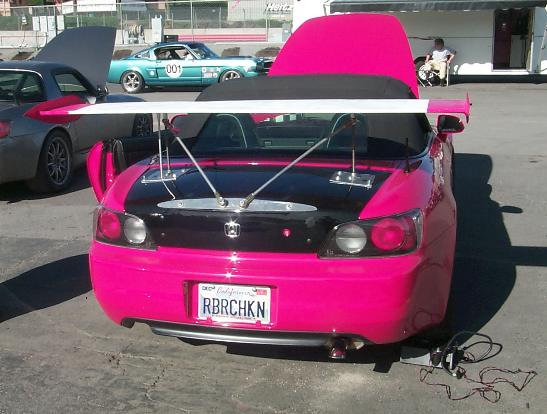
2 state, 0 angle and "downforce". Just flip a switch in the car depending on what you want.
A little more info avail 3/4 of the way down, here:
www.nsxfiles.com/wurth_jan_03.htm
>> Edited by fluxen on Wednesday 7th April 23:52
ccharlie6 said:
didn't chapperall (don't think i spelt that right) have a type of active aero system on their can am cars? ... i cant remember which car had it but i think the wing was controlled by the driver not sure how though.
I think it was 2C:
The Chaparrals used an automatic transmission, so there was no clutch pedal, which allowed Hall to add a third pedal. While accelerating, the driver would hold the pedal down with his left foot. This kept the wings horizontal for less drag. Releasing the pedal put the wings in an angled position, for greater downforce in the corners (the increased drag also helping slow the car).
that S2000 looks very impressive! could that not be used upon an ultima? i would have thought a system like that would be ideal as long as it could be made reliable and actually worked.. of course the other option is the porsche carrera type winglet that pops out of the rear of the body at 60mph (i think)
Gassing Station | Ultima | Top of Page | What's New | My Stuff