
Acoustic deadening etc
Discussion


Not quite sure where to put this but I suspect those most knowledgeable might be here?
Basically I have a big project. I need to significantly reduce noise levels in a school dining hall. Apart from telling the kids to be quiet (which doesnt work) I'm looking at practical measures.
Like most school halls its multi-purpose with a hard floor, no furnishings and a high suspended ceiling.
Every noise gets reflected and bounced around. I'm looking at ways in which we can deaden the noise.
So far we are looking at using office divider screens to create a quiet area and putting panels on the walls which are decorated foam. Can't really to anything about the floor but would love to cover the top half of the walls with something. Issue is, as ever, cost.
So, can anyone suggest low cost, simple methods in which we could improve things. Basically my theory being absorb as much noise as possible?
Thanks
Basically I have a big project. I need to significantly reduce noise levels in a school dining hall. Apart from telling the kids to be quiet (which doesnt work) I'm looking at practical measures.
Like most school halls its multi-purpose with a hard floor, no furnishings and a high suspended ceiling.
Every noise gets reflected and bounced around. I'm looking at ways in which we can deaden the noise.
So far we are looking at using office divider screens to create a quiet area and putting panels on the walls which are decorated foam. Can't really to anything about the floor but would love to cover the top half of the walls with something. Issue is, as ever, cost.
So, can anyone suggest low cost, simple methods in which we could improve things. Basically my theory being absorb as much noise as possible?
Thanks
Try fixing as much heavy material to the walls & ceilings as you can. Maybe look at ebay, Gumtree & Freecycle for curtains & get the mums to cut them to a standard height with an open hem along top & bottom. You can then slide them onto poles which can be fix to the wall. You could double them up to increase the absorption.
I suspect you are going to hit issues with H&S though. any fabric will probably need to be certificated fireproof & anything fixed overhead will need approved fixing with safety cables to hold the panel if it should fall.
I suspect you are going to hit issues with H&S though. any fabric will probably need to be certificated fireproof & anything fixed overhead will need approved fixing with safety cables to hold the panel if it should fall.
Marine soundproofing is fire resistant certified. If it's good enough for dampening the sound of big diesels, should work.
Make sure it's high enough so the kids don't pick at it.
http://www.asap-supplies.com/marine/boat-soundproo...
Make sure it's high enough so the kids don't pick at it.
http://www.asap-supplies.com/marine/boat-soundproo...
We had a coffee shop opposite the entrance to the library. Coffee shop had hard floors, hard seating and a solid ceiling. Library entrance was a suspended ceiling and carpeted.
We used a number of Ecophon Solo panels to absorb the noise generated in the cafe. Above the cafe, we installed 2.4m x 1.2m panels horizontally between the lights. Then between the cafe and the entrance, we installed a number of 1.2m x 0.3m panels vertically to act as baffles. Then in the library we replaced the ceiling tiles with acoustic tiles, rather than budget ones. Made a huge difference, but wasn't cheap.
http://www.ecophon.com/uk/about-ecophon/newsroom/E...
It worked so well that we are looking at using the same product in our lecture theatres to improve acoustic comfort.
If it's of interest to you, I can email you some photos.
One thing to bear in mind though is that the standard panels aren't impact resistant, you'd need the fabric covered ones.
We used a number of Ecophon Solo panels to absorb the noise generated in the cafe. Above the cafe, we installed 2.4m x 1.2m panels horizontally between the lights. Then between the cafe and the entrance, we installed a number of 1.2m x 0.3m panels vertically to act as baffles. Then in the library we replaced the ceiling tiles with acoustic tiles, rather than budget ones. Made a huge difference, but wasn't cheap.
http://www.ecophon.com/uk/about-ecophon/newsroom/E...
It worked so well that we are looking at using the same product in our lecture theatres to improve acoustic comfort.
If it's of interest to you, I can email you some photos.
One thing to bear in mind though is that the standard panels aren't impact resistant, you'd need the fabric covered ones.
Fishtigua said:
Marine soundproofing is fire resistant certified. If it's good enough for dampening the sound of big diesels, should work.
Make sure it's high enough so the kids don't pick at it.
http://www.asap-supplies.com/marine/boat-soundproo...
Could be an idea, just realised its about 1000 square metres of wall ((!!))Make sure it's high enough so the kids don't pick at it.
http://www.asap-supplies.com/marine/boat-soundproo...
GuinnessMK said:
We had a coffee shop opposite the entrance to the library. Coffee shop had hard floors, hard seating and a solid ceiling. Library entrance was a suspended ceiling and carpeted.
We used a number of Ecophon Solo panels to absorb the noise generated in the cafe. Above the cafe, we installed 2.4m x 1.2m panels horizontally between the lights. Then between the cafe and the entrance, we installed a number of 1.2m x 0.3m panels vertically to act as baffles. Then in the library we replaced the ceiling tiles with acoustic tiles, rather than budget ones. Made a huge difference, but wasn't cheap.
http://www.ecophon.com/uk/about-ecophon/newsroom/E...
It worked so well that we are looking at using the same product in our lecture theatres to improve acoustic comfort.
If it's of interest to you, I can email you some photos.
One thing to bear in mind though is that the standard panels aren't impact resistant, you'd need the fabric covered ones.
Interesting. Might be an idea here as I guess the panels could be polystyrene?We used a number of Ecophon Solo panels to absorb the noise generated in the cafe. Above the cafe, we installed 2.4m x 1.2m panels horizontally between the lights. Then between the cafe and the entrance, we installed a number of 1.2m x 0.3m panels vertically to act as baffles. Then in the library we replaced the ceiling tiles with acoustic tiles, rather than budget ones. Made a huge difference, but wasn't cheap.
http://www.ecophon.com/uk/about-ecophon/newsroom/E...
It worked so well that we are looking at using the same product in our lecture theatres to improve acoustic comfort.
If it's of interest to you, I can email you some photos.
One thing to bear in mind though is that the standard panels aren't impact resistant, you'd need the fabric covered ones.
Maybe if we cut them and suspended them or fixed them to wall as in the link?
We have people in the school who can produce things like this and the caretakers could put them up over the summer.
Anyone know if that would work? I have access to large sheets of EPS pretty cheap or is it some magic material?
Thanks
As is often the case people are getting confused with sound isolation ("sound proofing") and acoustic treatment.
You are looking for acoustic treatment.
This means placing high and midrange absorbers (no need for bass absorbers for your purposes) spaced around the walls and if necessary suspended from the ceiling (ie ceiling clouds).
The material has to have the correct acoustic qualities for it to be useful.
"Acoustic foam" is actually not the best performing material and is relatively expensive but is aesthetically pleasing.
Much cheaper and better performing absorbers can be made using fiberglass or rockwall placed in frames and covered with an acoustically transparent material like hessian or burlap.
For my studio I used galvanised steel wall studs riveted together with reconstituted cotton panels, with Camira Fabrics "Cara"acoustic material over the top.
http://www.camirafabrics.com/fabrics-and-samples/c...
Performance and aesthetics are great and the cotton avoids allergies.
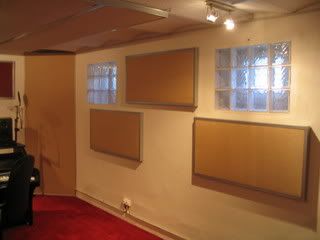

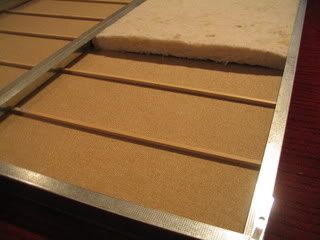
ETA Polystyrene is useless! It will reflect sound not absorb it.
ETA 2 I appreciate your room is not a rehearsal room/studio but the principles remain exactly the same
ETA Asyou can see in the photo, you don't need to cover all of the walls/ceilings but just a portion of them for this to be effective. Besides, an overly dead room is quite disconcerting to be in.
You are looking for acoustic treatment.
This means placing high and midrange absorbers (no need for bass absorbers for your purposes) spaced around the walls and if necessary suspended from the ceiling (ie ceiling clouds).
The material has to have the correct acoustic qualities for it to be useful.
"Acoustic foam" is actually not the best performing material and is relatively expensive but is aesthetically pleasing.
Much cheaper and better performing absorbers can be made using fiberglass or rockwall placed in frames and covered with an acoustically transparent material like hessian or burlap.
For my studio I used galvanised steel wall studs riveted together with reconstituted cotton panels, with Camira Fabrics "Cara"acoustic material over the top.
http://www.camirafabrics.com/fabrics-and-samples/c...
Performance and aesthetics are great and the cotton avoids allergies.
ETA Polystyrene is useless! It will reflect sound not absorb it.
ETA 2 I appreciate your room is not a rehearsal room/studio but the principles remain exactly the same
ETA Asyou can see in the photo, you don't need to cover all of the walls/ceilings but just a portion of them for this to be effective. Besides, an overly dead room is quite disconcerting to be in.
Edited by Driller on Saturday 7th March 14:20
Edited by Driller on Saturday 7th March 15:29
Driller said:
As is often the case people are getting confused with sound isolation ("sound proofing") and acoustic treatment.
You are looking for acoustic treatment.
This means placing high and midrange absorbers (no need for bass absorbers for your purposes) spaced around the walls and if necessary suspended from the ceiling (ie ceiling clouds).
The material has to have the correct acoustic qualities for it to be useful.
"Acoustic foam" is actually not the best performing material and is relatively expensive but is aesthetically pleasing.
Much cheaper and better performing absorbers can be made using fiberglass or rockwall placed in frames and covered with an acoustically transparent material like hessian or burlap.
For my studio I used galvanised steel wall studs riveted together with reconstituted cotton panels, with Camira Fabrics "Cara"acoustic material over the top.
http://www.camirafabrics.com/fabrics-and-samples/c...
Performance and aesthetics are great and the cotton avoids allergies.
ETA Polystyrene is useless! It will reflect sound not absorb it.
ETA 2 I appreciate your room is not a rehearsal room/studio but the principles remain exactly the same
ETA Asyou can see in the photo, you don't need to cover all of the walls/ceilings but just a portion of them for this to be effective. Besides, an overly dead room is quite disconcerting to be in.
Thanks for the advice and links. Do you think standard office dividers would work if mounted on the walls?You are looking for acoustic treatment.
This means placing high and midrange absorbers (no need for bass absorbers for your purposes) spaced around the walls and if necessary suspended from the ceiling (ie ceiling clouds).
The material has to have the correct acoustic qualities for it to be useful.
"Acoustic foam" is actually not the best performing material and is relatively expensive but is aesthetically pleasing.
Much cheaper and better performing absorbers can be made using fiberglass or rockwall placed in frames and covered with an acoustically transparent material like hessian or burlap.
For my studio I used galvanised steel wall studs riveted together with reconstituted cotton panels, with Camira Fabrics "Cara"acoustic material over the top.
http://www.camirafabrics.com/fabrics-and-samples/c...
Performance and aesthetics are great and the cotton avoids allergies.
ETA Polystyrene is useless! It will reflect sound not absorb it.
ETA 2 I appreciate your room is not a rehearsal room/studio but the principles remain exactly the same
ETA Asyou can see in the photo, you don't need to cover all of the walls/ceilings but just a portion of them for this to be effective. Besides, an overly dead room is quite disconcerting to be in.
Edited by Driller on Saturday 7th March 14:20
Edited by Driller on Saturday 7th March 15:29
Reason I ask is I may be able to get hold a lot of them for almost nothing. Save a lot of time and effort.
21TonyK said:
Thanks for the advice and links. Do you think standard office dividers would work if mounted on the walls?
Reason I ask is I may be able to get hold a lot of them for almost nothing. Save a lot of time and effort.
If the stucture of them is what I think it is (boards covered in some sort of mousse or foam in turn covered by acoustically transparent fabric) then yes, for the purposes of taming reflections from voices, this could make a difference.Reason I ask is I may be able to get hold a lot of them for almost nothing. Save a lot of time and effort.
You need to have enough to be able to distribute then around the room.
What is the ceiling shape/structure like?
Driller said:
If the stucture of them is what I think it is (boards covered in some sort of mousse or foam in turn covered by acoustically transparent fabric) then yes, for the purposes of taming reflections from voices, this could make a difference.
You need to have enough to be able to distribute then around the room.
What is the ceiling shape/structure like?
The room is around 12m x 12m, hard vinyl floor, painted walls and a flat suspended tile ceiling I'd guess 5m. That really is about it. The idea is to get panels on the wall which will be painted by our resident artists and resources guy. We discussed the painting and he says he knows what hes doing with painting material with dyes etc as opposed to paint.You need to have enough to be able to distribute then around the room.
What is the ceiling shape/structure like?
On 3 walls we though about panelled areas around 6 metres long, 2 metres high. The fourth wall includes a servery and doorways so not a lot can be done in that area.
It does leave a huge area above the murals untouched and the ceiling which is why i thought about suspending panels from the ceiling, its a steel and concrete construction under all the panelling etc.
We would then have a several freestanding panels to divide the space into two maybe three areas.
21TonyK said:
The room is around 12m x 12m, hard vinyl floor, painted walls and a flat suspended tile ceiling I'd guess 5m. That really is about it. The idea is to get panels on the wall which will be painted by our resident artists and resources guy. We discussed the painting and he says he knows what hes doing with painting material with dyes etc as opposed to paint.
On 3 walls we though about panelled areas around 6 metres long, 2 metres high. The fourth wall includes a servery and doorways so not a lot can be done in that area.
It does leave a huge area above the murals untouched and the ceiling which is why i thought about suspending panels from the ceiling, its a steel and concrete construction under all the panelling etc.
We would then have a several freestanding panels to divide the space into two maybe three areas.
The 6m x 2m panels idea sounds fine. I don't think you'll need to go higher than this on the walls to get a significant effect although as ever with acoustics you don't know until you try.On 3 walls we though about panelled areas around 6 metres long, 2 metres high. The fourth wall includes a servery and doorways so not a lot can be done in that area.
It does leave a huge area above the murals untouched and the ceiling which is why i thought about suspending panels from the ceiling, its a steel and concrete construction under all the panelling etc.
We would then have a several freestanding panels to divide the space into two maybe three areas.
The suspended panelling will make a big difference as will the room dividers.
I would be wary of the painting of the panels unless it can really be done in a way as to not coat the surface of the material and seal off the underlying foam.
There has to be access for the air to pass through the covering material and reach the foam underneath as this is how the sound is absorbed especially for the mid and higher frequencies which is what you're interested in.
For example, some home studio enthusiasts cover their fiberglass absorbers in plastic to stop the fibers escaping but this massively reduces their effectiveness as the sound waves bounce off the plastic rather than being absorbed by the fiberglass.
If he's dying the material this might be ok if the dye is thin enough to not block up the holes in the weave of the covering fabric.
Driller said:
The 6m x 2m panels idea sounds fine. I don't think you'll need to go higher than this on the walls to get a significant effect although as ever with acoustics you don't know until you try.
The suspended panelling will make a big difference as will the room dividers.
I would be wary of the painting of the panels unless it can really be done in a way as to not coat the surface of the material and seal off the underlying foam.
There has to be access for the air to pass through the covering material and reach the foam underneath as this is how the sound is absorbed especially for the mid and higher frequencies which is what you're interested in.
For example, some home studio enthusiasts cover their fiberglass absorbers in plastic to stop the fibers escaping but this massively reduces their effectiveness as the sound waves bounce off the plastic rather than being absorbed by the fiberglass.
If he's dying the material this might be ok if the dye is thin enough to not block up the holes in the weave of the covering fabric.
All noted. Many thanks.The suspended panelling will make a big difference as will the room dividers.
I would be wary of the painting of the panels unless it can really be done in a way as to not coat the surface of the material and seal off the underlying foam.
There has to be access for the air to pass through the covering material and reach the foam underneath as this is how the sound is absorbed especially for the mid and higher frequencies which is what you're interested in.
For example, some home studio enthusiasts cover their fiberglass absorbers in plastic to stop the fibers escaping but this massively reduces their effectiveness as the sound waves bounce off the plastic rather than being absorbed by the fiberglass.
If he's dying the material this might be ok if the dye is thin enough to not block up the holes in the weave of the covering fabric.
Gassing Station | Home Cinema & Hi-Fi | Top of Page | What's New | My Stuff