
Why is 4k resolution enough for cinema?
Discussion


Not sure if this belongs in Science! forum or even TV, Film and Radio, but.....
It seems most modern projection cinemas are 4k resolution (4096×2160) and this is the same as a new, large home TV.
Cinema screens are typically 70 feet by 30 feet, or 840" by 360"
Home TVs are averaging 48" by 27"
I don't get how the image on the screen at the cinema doesn't appear pixelated, the screen is almost 20 times bigger and you've got 4096 pixels in 840" or 2130cm at one pixel per 0.5cm
one pixel per 5mm,
perhaps I have answered my own question here, and obviously we sit very much further away, I just figured a cinema resolution would be 40,000 by 20,000. We are not talking about IMAX here, which is 16K
comments....., or go away and shut up
It seems most modern projection cinemas are 4k resolution (4096×2160) and this is the same as a new, large home TV.
Cinema screens are typically 70 feet by 30 feet, or 840" by 360"
Home TVs are averaging 48" by 27"
I don't get how the image on the screen at the cinema doesn't appear pixelated, the screen is almost 20 times bigger and you've got 4096 pixels in 840" or 2130cm at one pixel per 0.5cm
one pixel per 5mm,
perhaps I have answered my own question here, and obviously we sit very much further away, I just figured a cinema resolution would be 40,000 by 20,000. We are not talking about IMAX here, which is 16K
comments....., or go away and shut up
Edited by The_Doc on Wednesday 29th April 11:02
4K is just another way to sell you a new TV. It's overkill for home use unless you are sat with your nose on the screen.
I'm sure someone will be along soon to tell us they can tell the difference between 1080p and 4K on a 32" TV from 10 metres away.....
Monitors are a little different as you do sit with your nose against the screen.
I'm sure someone will be along soon to tell us they can tell the difference between 1080p and 4K on a 32" TV from 10 metres away.....
Monitors are a little different as you do sit with your nose against the screen.

The technology behind a professional 4k cinema projector and a domestic 4k TV is very different, so you can't really draw meaningful comparisons between the two, but the rule of thumb for cinema projectors is that the audience may be able to see the pixels at 2k but won't be able to at 4k.
It all depends on viewing distances. I am in no hurry to replace my 55" 1080p TV as I don't think that I'd notice a difference with 4k from 12 feet away.
However, I would replace by 1080p projector that I view on a 92" screen from the same distance if I was ever able to afford a 4k one!
However, I would replace by 1080p projector that I view on a 92" screen from the same distance if I was ever able to afford a 4k one!
Interesting
To sell us new TVs I have noticed the following, not strictly in order
0th: sub 28" CRTs
1st: LCD/Plasma
2nd: Death of CRT
3rd: 1080 minimum with HDMI input
4th: 3D TV
5th: Internet/Smart TVs with/without gesture control (wave hands at telly)
6th: 4k resolution
7th: curved TVs
I'm not convinced that each step is needed for any other reason then simply to sell us NEW stuff.
And what's even better, driven by industry, is that if you go from 28" (@480p) to 50", whaddayouknow you suddenly need a 1080 source and you'll be back in the shop or on the phone to Sky BUYING a 1080 signal source.
I'm very happy with my 40" SONY viewed at about 7' away, bought about 7 yrs ago, but I am an obstacle to company profits
To sell us new TVs I have noticed the following, not strictly in order
0th: sub 28" CRTs
1st: LCD/Plasma
2nd: Death of CRT
3rd: 1080 minimum with HDMI input
4th: 3D TV
5th: Internet/Smart TVs with/without gesture control (wave hands at telly)
6th: 4k resolution
7th: curved TVs
I'm not convinced that each step is needed for any other reason then simply to sell us NEW stuff.
And what's even better, driven by industry, is that if you go from 28" (@480p) to 50", whaddayouknow you suddenly need a 1080 source and you'll be back in the shop or on the phone to Sky BUYING a 1080 signal source.
I'm very happy with my 40" SONY viewed at about 7' away, bought about 7 yrs ago, but I am an obstacle to company profits
Edited by The_Doc on Wednesday 29th April 11:04
FurtiveFreddy said:
When it comes to projectors, there's more to it than just resolution. You might find spending the same amount of money on a good 2K projector with a top quality lens will give better results than an average 4k one.
It's the same as cameras, but in reverse
I think Imax only uses 2k (currently) but uses 2 very high end projectors that overlap in order to give a better image and sense of density.It's the same as cameras, but in reverse
I personally think DPI is more relevant than a total (4k or 1080) as it really does depend on the size of the screen
Also relevant are colour quality, brightness/contrast, black accuracy, and frequency.
The human eye has an angular resolution of around 0.07 degrees, ie you can't really tell things apart that are closer than that. It will vary a bit between individuals but not by a huge amount. therefore you can work out for a given resolution and screen size if the average person can see the difference

I can't see the difference between 1080 and 720 on my TV, and can only see the difference between 720 and 480 if I sit on the sofa which is a bit closer than my usual chair. IMO 4K is a sales gimmick or for people who sit so close to their TV they can't see the whole picture at once.
I can't see the difference between 1080 and 720 on my TV, and can only see the difference between 720 and 480 if I sit on the sofa which is a bit closer than my usual chair. IMO 4K is a sales gimmick or for people who sit so close to their TV they can't see the whole picture at once.
Foliage said:
I think Imax only uses 2k (currently) but uses 2 very high end projectors that overlap in order to give a better image and sense of density.
I personally think DPI is more relevant than a total (4k or 1080) as it really does depend on the size of the screen
Also relevant are colour quality, brightness/contrast, black accuracy, and frequency.
Proper IMAX is FILM!!!!!!I personally think DPI is more relevant than a total (4k or 1080) as it really does depend on the size of the screen
Also relevant are colour quality, brightness/contrast, black accuracy, and frequency.
Sadly, they had to dilute their brand a while back and opened all those faux-IMAX theatres using digital projectors.
If you want to see an IMAX movie, please go to a proper IMAX theatre and see what a proper 70mm film projector delivers on a proper IMAX screen!
The_Doc said:
7th: curved TVs
I had one of those years before it became the fashion
A lot of it is re-invention or just thinking of a new feature and seeing if anyone will buy it. It's not necessarily progress. The Japanese have been marketing electronic products this way for decades. What sells becomes the standard and that's often not what is technically a better product.
FurtiveFreddy said:
Foliage said:
I think Imax only uses 2k (currently) but uses 2 very high end projectors that overlap in order to give a better image and sense of density.
I personally think DPI is more relevant than a total (4k or 1080) as it really does depend on the size of the screen
Also relevant are colour quality, brightness/contrast, black accuracy, and frequency.
Proper IMAX is FILM!!!!!!I personally think DPI is more relevant than a total (4k or 1080) as it really does depend on the size of the screen
Also relevant are colour quality, brightness/contrast, black accuracy, and frequency.
Sadly, they had to dilute their brand a while back and opened all those faux-IMAX theatres using digital projectors.
If you want to see an IMAX movie, please go to a proper IMAX theatre and see what a proper 70mm film projector delivers on a proper IMAX screen!
I've been to the IMAX at the NMM in Bradford and the IMAX in West Las Vegas ( ho ho !)
It's worthile remembering that the move to 4K /UHD is more than just a resolution change. The wider colour gamut afforded by 4K (DCI and not Rec.709) allows for much better colour reproduction, something which is far easier to notice than resolution increases at the average viewing distance. DCI colour space is what you get at a commercial cinema, so the move to that as the broadcast standard is logical and quite economical in the long run.
At present very few retailers that are offering 4K displays which can produce a wider colour gamut, have much in the way of HDR content to show off the benefits.
At present very few retailers that are offering 4K displays which can produce a wider colour gamut, have much in the way of HDR content to show off the benefits.
The_Doc said:
how can I tell which is proper and which is digital trickery?

Digital 'imax' on the left, 70mm proper IMAX on the right
Here's another nice comparison between digital/film formats.
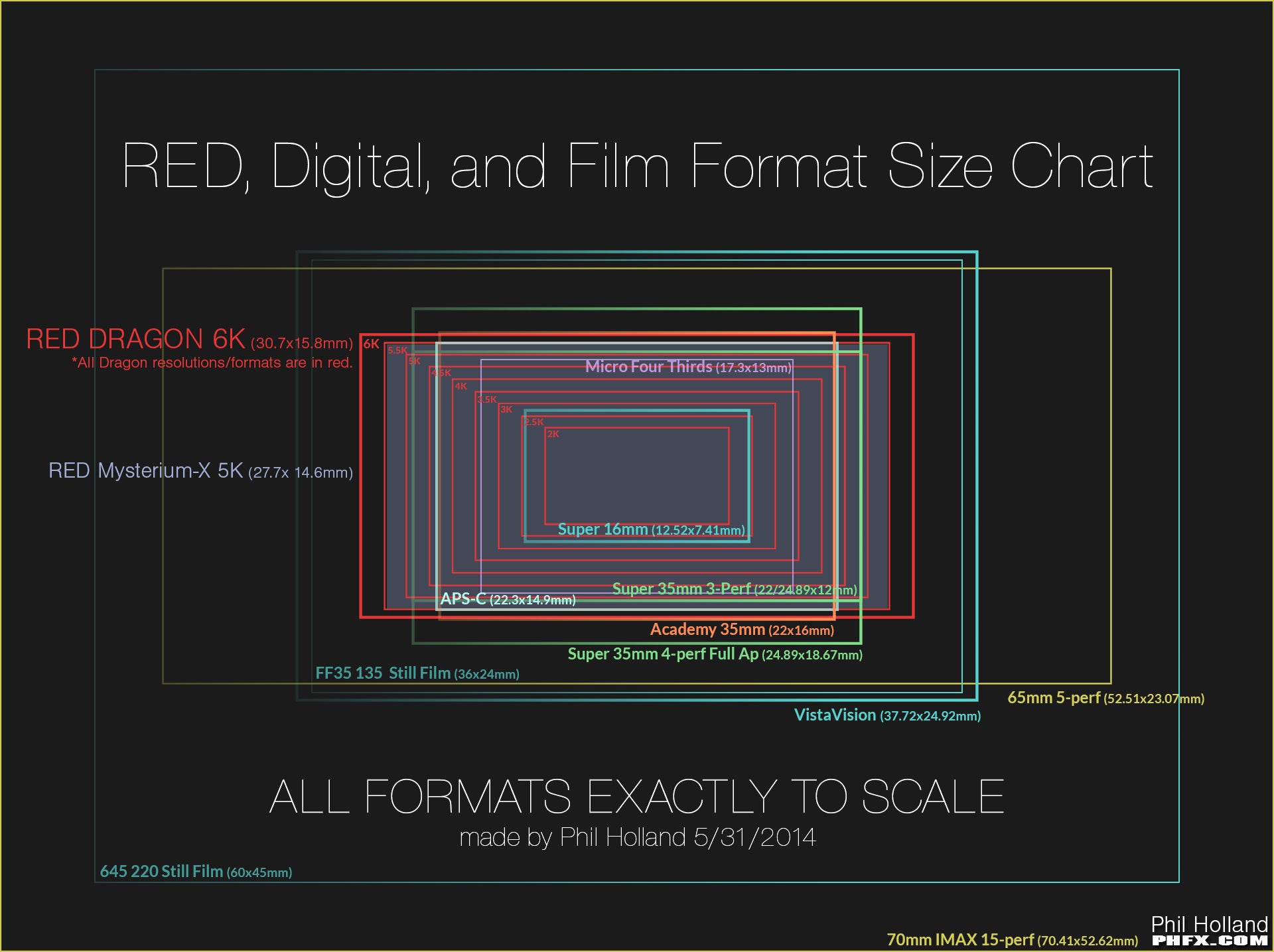
In case you can't make it out, 4k is one of the red rectangles inside the Super 35mm outline
Edited by FurtiveFreddy on Wednesday 29th April 13:05
Foliage said:
I was thinking about getting a pico projector that upscales to 1080, that table may come in handy to work out if its viable.
Before you do, check the specs for the term 'native resolution' as many of these small projectors only accept a 1080p input, but then downscale it to whatever resolution the panels are (probably 1280 x 720 or maybe less).4K is also about bit depth for colours, so in theory there should be less banding. Higher frame rate too in the future which will put further strain on the HDMI cables/interfaces.
I take the view that for most viewers a 4K TV isn't really going to be worth the bother though. For many it will be just a badge to point at (and then watch mostly SD content on).
Apparent image quality is about more than spatial resolution. Equally (or possibly more) important is contrast resolution.
High Contrast resolution is what gives an OLED screen an advantage. Seeing properly handled 1080p material through a 55" OLED in a home environment is pretty impressive. Sadly there is not enough 4k material yet to make a 4k monitor worthwhile but hopefully that will change.
For the person above who claims not to be able to differentiate 720 to 1080, if it's 720p versus 1080i, I would agree with you. On the other hand 1080i versus 1080p is very easy to differentiate., even on a 32" screen. The extra natural sharpness is quite easy to see.
The other factor that's important is motion handling. That's one reason plasma TVs look much better than LCD TVs on subjects like sports.
High Contrast resolution is what gives an OLED screen an advantage. Seeing properly handled 1080p material through a 55" OLED in a home environment is pretty impressive. Sadly there is not enough 4k material yet to make a 4k monitor worthwhile but hopefully that will change.
For the person above who claims not to be able to differentiate 720 to 1080, if it's 720p versus 1080i, I would agree with you. On the other hand 1080i versus 1080p is very easy to differentiate., even on a 32" screen. The extra natural sharpness is quite easy to see.
The other factor that's important is motion handling. That's one reason plasma TVs look much better than LCD TVs on subjects like sports.
fulgurex said:
On the other hand 1080i versus 1080p is very easy to differentiate., even on a 32" screen. The extra natural sharpness is quite easy to see.
1080i and 1080p should look very similar, it's just the 1080i you might notice jaggies on movement because of the interlacing and possible flickering.Gassing Station | Home Cinema & Hi-Fi | Top of Page | What's New | My Stuff