
England and English identity/culture
Discussion


This is strangely an emotive and political subject for some but many in the UK can produce a brief definition of what it is to be "Scottish", similarly many in the UK can produce a brief definition of what it is to be "Welsh", "Irish", even "Northern Irish", but yet when it comes to "what is being English", then strangely many choose to run and hide away from offering anything, resorting to this particular definition being nothing less than racist, irrelevant or often simply "nothing, it doesn't exist".
But, it does exist, because outside of the UK, when people are asked to give a brief definition of an "English person" or "English culture", they can often give one with striking similarity what other non-UK residents from around the world give.
As with many cultures and 'identities' they are formed by things by which many within the nation (or even region) have in common with each other, such as institutions, shared history, common food, traditions, local accents, urban and rural environments etc.
Some of these cross regions and nations, such that the UK as a whole can form a common identity, and with that also a particular Nation or even region/county can be its own culture/identity.
The problem though is that when it comes to "English", due to political narratives from certain activists, this term is suppressed. And it is often quickly narrated to have connections with nationalism and racism.
Whether this is down to how England has always been the main nation within the British Empire, and that certain political narratives will always focus on any bad aspects of the Empire and then link that straight back to England rather than Scotland, Wales or Ireland? Or whether its because the idea of an English culture goes against certain people's "global citizen" beliefs, whereby any identity of being part of a nation means it hampers their narratives that everywhere should be borderless, then who knows, but this thread is open for such discussion.
So, as we approach the Queen's Jubilee, how would you describe your English culture? Does the monarch for example play a significant part in how you view your English identity?
Please also for any Scottish, Welsh and Northern Irish on the thread, it would also be nice to hear how you yourself describe your national culture from within.
But, it does exist, because outside of the UK, when people are asked to give a brief definition of an "English person" or "English culture", they can often give one with striking similarity what other non-UK residents from around the world give.
As with many cultures and 'identities' they are formed by things by which many within the nation (or even region) have in common with each other, such as institutions, shared history, common food, traditions, local accents, urban and rural environments etc.
Some of these cross regions and nations, such that the UK as a whole can form a common identity, and with that also a particular Nation or even region/county can be its own culture/identity.
The problem though is that when it comes to "English", due to political narratives from certain activists, this term is suppressed. And it is often quickly narrated to have connections with nationalism and racism.
Whether this is down to how England has always been the main nation within the British Empire, and that certain political narratives will always focus on any bad aspects of the Empire and then link that straight back to England rather than Scotland, Wales or Ireland? Or whether its because the idea of an English culture goes against certain people's "global citizen" beliefs, whereby any identity of being part of a nation means it hampers their narratives that everywhere should be borderless, then who knows, but this thread is open for such discussion.
So, as we approach the Queen's Jubilee, how would you describe your English culture? Does the monarch for example play a significant part in how you view your English identity?
Please also for any Scottish, Welsh and Northern Irish on the thread, it would also be nice to hear how you yourself describe your national culture from within.
My English culture includes being proud that I'm not that bothered about about being English and can never remember when St George's day is. But I also enjoy the mix of cultures in England (I live in the south east) which I think has given rise to great music, fashion and other art forms for decades or even centuries. I like that when asked what their favourite food is, many English people will say curry or chinese or pizza. Other than that I'd say that England has managed to combine a good food history with often rotten cooking and crappy ingredients. I think that's getting better though.
A bit of an obsession with history and tradition is probably part of English culture as is drinking crappy warm beer that tastes like ditch water whilst simultaneously thinking that it's actually the whole of the rest of the world that drinks rubbish beer. (Only joking.)
I'm not sure you'll ever get to the bottom of what English people think of the royal family unless you ask them all.
I love the English countryside and all sorts of other English things but they are probably mostly the same things that most people like about their country.
One last thing - hobbies. I wonder if England is big on hobbies like train spotting, bird watching or making model train sets, but I bet it's no different from the rest of the UK in that respect.
A bit of an obsession with history and tradition is probably part of English culture as is drinking crappy warm beer that tastes like ditch water whilst simultaneously thinking that it's actually the whole of the rest of the world that drinks rubbish beer. (Only joking.)
I'm not sure you'll ever get to the bottom of what English people think of the royal family unless you ask them all.
I love the English countryside and all sorts of other English things but they are probably mostly the same things that most people like about their country.
One last thing - hobbies. I wonder if England is big on hobbies like train spotting, bird watching or making model train sets, but I bet it's no different from the rest of the UK in that respect.
I find it quite an interesting subject.
I think “English Identity” has been minimised over the years to address the imbalance between the size of UK nations. As England (and the UK) has changed quite drastically in modern history but the changes link to the UK rather than England so it’s hard to associate.
I think if Welsh and Scottish nationalism gets louder, more people in England will associate more closely with England.
I think “English Identity” has been minimised over the years to address the imbalance between the size of UK nations. As England (and the UK) has changed quite drastically in modern history but the changes link to the UK rather than England so it’s hard to associate.
I think if Welsh and Scottish nationalism gets louder, more people in England will associate more closely with England.

I don't think there are many things which make us English very different from Scots or Welsh, other than accent and a few cultural oddities like Morris dancing, kilts and Bara Brith. I think we share much the same values and outlook and in general get along pretty well in the UK. We're also pretty accepting of difference in general, although not perfect.
From time spent living abroad (mainly US) one thing I do think is particularly English is when a course of action is suggested, we spend a lot of time thinking of reasons why we might not do it, whereas in the US they decide what they want to do, and then think of ways to get round the problems.
However, when we feel something is really important we get on with it and see things through. The "sense of right and wrong" thing I guess.
From time spent living abroad (mainly US) one thing I do think is particularly English is when a course of action is suggested, we spend a lot of time thinking of reasons why we might not do it, whereas in the US they decide what they want to do, and then think of ways to get round the problems.
However, when we feel something is really important we get on with it and see things through. The "sense of right and wrong" thing I guess.
I consider myself British first and English second.
If asked, I always state that I'm British, as calling myself English seems a little prosaic and limiting. Additionally, there has been so much movement between the nations over the last 2000 years, that I doubt there's anyone who can't claim ancestry from some other part of the United Kingdom.
Who doesn't want to be part of a kingdom which has a dragon on it's flag, grown men that wear 'skirts' and love flinging logs about, and one which gave us George Best, the worlds greatest ever footballer?
If asked, I always state that I'm British, as calling myself English seems a little prosaic and limiting. Additionally, there has been so much movement between the nations over the last 2000 years, that I doubt there's anyone who can't claim ancestry from some other part of the United Kingdom.
Who doesn't want to be part of a kingdom which has a dragon on it's flag, grown men that wear 'skirts' and love flinging logs about, and one which gave us George Best, the worlds greatest ever footballer?
Cecil Rhodes said:
Remember that you were born an Englishman, and have consequently won first prize in the lottery of life.
The interesting thing about that 19th century quotation is that it was spoken without a shred of irony, satire, or cynicism. It was believed without question.Some years ago when Towersey Folk Festival was still held in the village that gave its name to it, I found myself in a stone barn next to a pub where some amateur folk musicians were quaffing ale and taking turns at entertaining the pub clientele in the bar. The barn, whilst on the pub grounds, was not really part of the pub but was used to host occasional events. Inside, in almost cathedral silence, was a small number of mainly middle and older aged men and women sitting around the walls on chairs. After a few moments, without a word from anyone, one of these people would stand and sing an unaccompanied traditional folk song. When they had finished they would sit and after a short interval another would stand and sing. Some were accomplished singers, and others were frankly bad, but there was no choreography nor any programme, it was a purely spontaneous event with an audience comprising mainly other like-minded singers or locals, plus a handful of flabbergasted visitors who had found themselves - like me - drawn in by the sounds emanating from the barn. It was simply magical and truly enchanting, but most of all it was one hundred percent English and 'of the people' in a way that no media tycoon could ever concoct. While there are barns and country inns like this no amount of forced multi-culturalism or pop culture can ever destroy that essence of the country. That was probably two decades ago or thereabouts and the Towersey festival has moved to a larger, more accessible location and it has lost its atmosphere and this slightly anarchic spirit from the real country folk.
There are several strata of society which whilst substantially independent of social class, exist in parallel to one another and each is almost oblivious of the others and their only points of contact are fleeting. The commuters live in ignorance of the farming community for example and they meet only occasionally. It's like a glimpse into another world that is there but invisible.
GroundZero said:
This is strangely an emotive and political subject for some but many in the UK can produce a brief definition of what it is to be "Scottish", similarly many in the UK can produce a brief definition of what it is to be "Welsh", "Irish", even "Northern Irish", but yet when it comes to "what is being English", then strangely many choose to run and hide away from offering anything, resorting to this particular definition being nothing less than racist, irrelevant or often simply "nothing, it doesn't exist".
Probably because we are generally tolerant, forward thinking and not nationalistic pigsThe Scottish are becoming more and more nationalistic as time goes on, as are the French.
As another poster stated, I am also not fussed about my 'identity' as a Brit. Our society is that diverse now its hardly surprising people are considered racists for being proud to be British. Do you fly the st George flag from your bedroom window? or out the balcony in the Spanish resort youre staying in?
Bathroom_Security said:
Probably because we are generally tolerant, forward thinking and not nationalistic pigs
The Scottish are becoming more and more nationalistic as time goes on, as are the French.
As another poster stated, I am also not fussed about my 'identity' as a Brit. Our society is that diverse now its hardly surprising people are considered racists for being proud to be British. Do you fly the st George flag from your bedroom window? or out the balcony in the Spanish resort youre staying in?
38% of registered voters in Scotland voted Yes to independence in 2014.The Scottish are becoming more and more nationalistic as time goes on, as are the French.
As another poster stated, I am also not fussed about my 'identity' as a Brit. Our society is that diverse now its hardly surprising people are considered racists for being proud to be British. Do you fly the st George flag from your bedroom window? or out the balcony in the Spanish resort youre staying in?
39% of registered voters in England voted Leave in 2016.
How does that make the English tolerant and forward thinking, whilst making the Scottish 'nationalistic pigs'?
Eric Mc said:
Because England does not really have a unified culture. Different parts of England seem to revel in their particular regional identity more than a sense of pure "Englishness". Just as a resident of Cornwall or Yorkshire how they feel about their Englishness.
Whereas Scots are all the same? That's just not correct. Not even nearly.anonymous said:
[redacted]
It's not uncommon to see veritable forests of St Geroge's crosses draped from windows and adorning flat roofed Sky Sports pubs alongside an unhealthy sprinkling of Confederate flags in the more stabby areas of Essex, and that should tell you all you need to know.
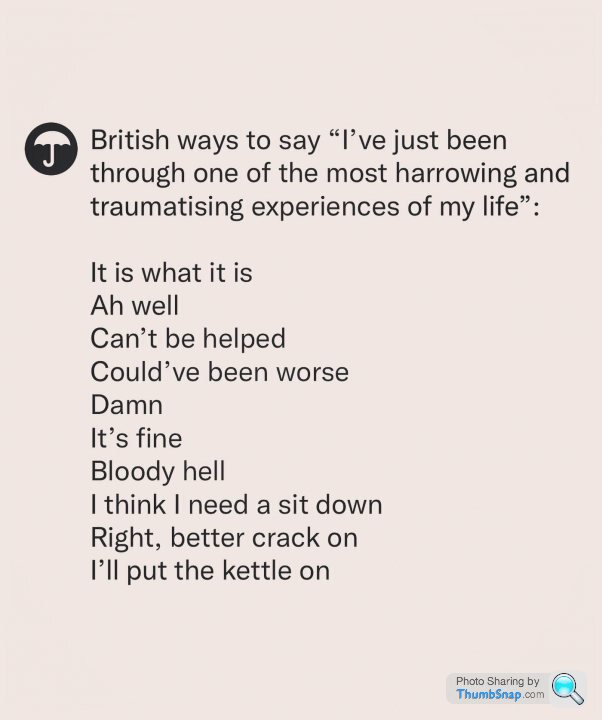
Jaguar steve said:
It's not uncommon to see veritable forests of St Geroge's crosses draped from windows and adorning flat roofed Sky Sports pubs alongside an unhealthy sprinkling of Confederate flags in the more stabby areas of Essex, and that should tell you all you need to know.
Exactly this. As such, i'd rather not refer to myself as English or indeed, British. I think in years past many other nationalities associated being British with being well spoken. Unfortunately most now think of the British as chavs.thewarlock said:
Eric Mc said:
Because England does not really have a unified culture. Different parts of England seem to revel in their particular regional identity more than a sense of pure "Englishness". Just as a resident of Cornwall or Yorkshire how they feel about their Englishness.
Whereas Scots are all the same? That's just not correct. Not even nearly.The difference though is simply the scale of the regions. For example, Yorkshire has a similar population to Scotland and thus can sustain the institutions of a strong regional identity.
How would the English feel if they lost their local BBC and instead only had a BBC England for example. Whereas the BBC don't split their output in Scotland (STV do but it's not particularly strong).

Gassing Station | News, Politics & Economics | Top of Page | What's New | My Stuff