
Shares / dividend ratio?
Discussion


Hi all, I've just found the following shares fell about TWICE the value of dividend just prior to dividend announcement. . . I have been historically under the impression shares fell by the dividend value once it was announced, has anyone else come across this and have knowledge of why?
T Clarke PLC (CTO)
John Laing Group Plc (JLG)
Emis Group Plc (EMISG)
Thanks in advance
T Clarke PLC (CTO)
John Laing Group Plc (JLG)
Emis Group Plc (EMISG)
Thanks in advance
I really dont know, a dividend is just another way of giving you a share of the profit so there must be other factors which caused the drop - maybe poorer results than expected....
good article on dividend investing here
https://www.forbes.com/sites/jimdahle/2018/11/11/f...
good article on dividend investing here
https://www.forbes.com/sites/jimdahle/2018/11/11/f...
bogie said:
I really dont know, a dividend is just another way of giving you a share of the profit so there must be other factors which caused the drop - maybe poorer results than expected....
good article on dividend investing here
https://www.forbes.com/sites/jimdahle/2018/11/11/f...
Nice article; appreciatedgood article on dividend investing here
https://www.forbes.com/sites/jimdahle/2018/11/11/f...
Once a company has received the funds from an equity release then the value of the equity has less to do to with the actual value of the company and more to do with peoples perception of the company and the value of their shared.
So, if a share price changes dramatically it's often that the market has learnt something they weren't expecting.
A lot of sectors tend to release their accounts at the same time of year, so if there's a few in the sector who have worse than expected results then the market will assume that the others in the sector will also have worse than expected results which will lead to shareholders taking their profit/cutting their losses and selling.
The market won't want to be owning shares in a market which is in decline as they could end up taking a loss, so they will often reduce the price ahead of the bad news to try and dissuade shareholders from selling whilst encouraging others to buy.
The whole dividend price adjustment is another matter entirely.
A company recommends a dividend per share to be voted for by the shareholders at the AGM/EGM etc.
The share price will only change in the light of the AGM/EGM if what is announced is not what the market is expecting.
Part of that recommendation the company will state a date the dividend is to be paid on, all shareholders will receive the dividend if they are a holder at 23:59 on the specified date.
The next morning the share price will be shown as "xd" or "excluding dividend" and the share price reduced by the value of the share as a shareholder owns the share plus has the dividend in the bank so in effect the value of the share to him is the same.
I don't think I've explained it that well but hope it helps explain why a share price may change around an announcement to a different value from the dividend.
So, if a share price changes dramatically it's often that the market has learnt something they weren't expecting.
A lot of sectors tend to release their accounts at the same time of year, so if there's a few in the sector who have worse than expected results then the market will assume that the others in the sector will also have worse than expected results which will lead to shareholders taking their profit/cutting their losses and selling.
The market won't want to be owning shares in a market which is in decline as they could end up taking a loss, so they will often reduce the price ahead of the bad news to try and dissuade shareholders from selling whilst encouraging others to buy.
The whole dividend price adjustment is another matter entirely.
A company recommends a dividend per share to be voted for by the shareholders at the AGM/EGM etc.
The share price will only change in the light of the AGM/EGM if what is announced is not what the market is expecting.
Part of that recommendation the company will state a date the dividend is to be paid on, all shareholders will receive the dividend if they are a holder at 23:59 on the specified date.
The next morning the share price will be shown as "xd" or "excluding dividend" and the share price reduced by the value of the share as a shareholder owns the share plus has the dividend in the bank so in effect the value of the share to him is the same.
I don't think I've explained it that well but hope it helps explain why a share price may change around an announcement to a different value from the dividend.
mgsontour said:
I have been historically under the impression shares fell by the dividend value once it was announced, has anyone else come across this and have knowledge of why?
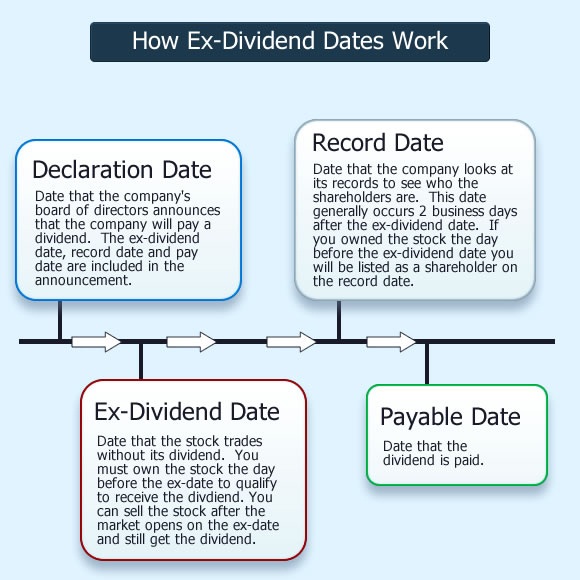
I believe what you are thinking about is when shares start trading "ex-div".When a company ANNOUNCES a dividend they will determine the date when the shares will trade ex-div.
On the ex-div date, anyone who buys the shares is not entitled to the next dividend payment (which is usually shortly after that date).
(Companies need this otherwise the logistics of determining who to pay would all have to be done overnight!)
So "cum-div" (before the ex-dive date), as a shareholder you have the right to be paid the next dividend.
Ex-div, you don't.
Cum-div you effectively own the rights to ALL the future dividends (which some claim is a way to value the stock).
Ex-div you own the rights to all the future dividends EXCEPT the next one.
Soooo.... after all that.... traditionally on the ex-div day the shares will drop by the value of the dividend (ceteris paribus).
Bloomberg usually adjusts for this so when you see a stock down £1 or something but the % change on the day being tiny, that £1 move is usually the dividend.
(Ignore the record date below, not really relevant.)
mgsontour said:
Hi all, I've just found the following shares fell about TWICE the value of dividend just prior to dividend announcement. . . I have been historically under the impression shares fell by the dividend value once it was announced, has anyone else come across this and have knowledge of why?
T Clarke PLC (CTO)
John Laing Group Plc (JLG)
Emis Group Plc (EMISG)
Thanks in advance
Do you mean that they opened lower than the div amount on the ex date or that the stock sold down in the run up to the announcement of what the next year’s div would be?T Clarke PLC (CTO)
John Laing Group Plc (JLG)
Emis Group Plc (EMISG)
Thanks in advance
The two are very different. The former is a typically a matter of mechanics whereas the latter is sentiment based.
Re the former, in a vacuum when a stock goes ex with a 10p div it will open 10p lower as the value of the share has obviously fallen 10p as it’s hust paid 10p out. The reason you have deviation from this is down to a combination of funds exiting at the open and/or a weak overall market or if the stock doesn’t fall as much as the divi (which is the more common event) it is because funds have been buying ahead for the divi and/or positive overall market/sector.
It’s a key arbitrage opportunity for traders. We used to run a fund that specifically arbed ex div events. The issue we had was when the ex date was changed from Wednesdays to Thursdays. The problem was that Wednesday is when major economic data is announced such as the FED. That means that the arb becomes nothing more than a punt on US after hours data. I would go so far as to say that the art on UK divs no longer works as an investment strategy and is just gambling now.
If you are referring to a general sell down ahead of the announcement then it is most likely to be long term holders reducing or hedging against an elevated concern that the company will announce a reduction in dividend and thus a fall in yield which in term means a fall in share price.

Gassing Station | Finance | Top of Page | What's New | My Stuff