
I feel safe with a savings account. Stock market is a casino
Discussion


The topic title is partly correct. Everyone should keep their emergency money in an instant access savings account.
However it is after that, where Mr Warren Buffett's quotation becomes applicable.
"As for the people who now feel 'comfortable' holding cash and waiting for good news: They have opted for a terrible long-term asset, one that pays virtually nothing and is certain to depreciate in value."
National Savings Account interest rate = 1.15%
Inflation: Retail Price Index = 2.2%
Your savings including the interest, is losing value. After say 10 years, the loss can amount to a significant sum of money.
I am only starting this post, in case anyone who has never been a stock market investor, might want to learn a little about the possibilities. The increasing effect of compounding, can eventually be remarkable.
If you have never heard about Mr Buffett, take a look on the internet. He enjoys teaching investment, has made many famous helpful quotes, has become one of the wealthiest people in America and firmly believes in choosing shares in good steady businesses, then holding those shares for an extremely long time. A gentleman who likes to make money work, has no desire for extravagant possessions and will be giving his vast wealth to charity. Very long-term is certainly a sensible way of investing (compounding), as WB has proved.
I have followed the same method and to reduce anxiety, have mostly selected shares in non-cyclical businesses ie. companies which are less affected by economic cycles. The chart below illustrates this. As you can see, the minerals firm does do best over the past 20 years, but what a roller coaster ride. The other business is Compass Group, the biggest catering company, which has produced steady continual growth.
Using Compass Group purely as an example;
Every 100 shares in January 2001 = £805
Dividend income during 2001 = £5-70
Dividend income during 2019 = £40-00
Total income = £ 423
Every 100 shares in January 2020, including income received = £2,381
This example equates to a compound growth of 5.87% annually, every year since 2001.
An enormously different result, from losing out by holding cash in a savings account.
The example used here is certainly not an exception by any means. The market average over that period has been 5%.
SHOWING THE DIFFERENCE BETWEEN CYCLICAL AND NON-CYCLICAL STEADY GROWTH BUSINESSES
(Rio Tinto vs Compass Group)

Cyclical businesses can be big winners, but buying into some non-cyclical companies first, can give your investment holdings a solid base, and can help reduce worries during the inevitable stock market downturns.
Edited by Jon39 on Monday 10th February 21:13
Jon39 said:
The topic title is partly correct. Everyone should keep their emergency money in an instant access savings account.
However it is after that, where Mr Warren Buffett's quotation becomes applicable.
"As for the people who now feel 'comfortable' holding cash and waiting for good news: They have opted for a terrible long-term asset, one that pays virtually nothing and is certain to depreciate in value."
National Savings Account interest rate = 1.15%
Inflation: Retail Price Index = 2.2%
Your savings including the interest, is losing value. After say 10 years, the loss can amount to a significant sum of money.
I am only starting this post, in case anyone who has never been a stock market investor, might want to learn a little about the possibilities. The increasing effect of compounding, can eventually be remarkable.
If you have never heard about Mr Buffett, take a look on the internet. He enjoys teaching investment, has made many famous helpful quotes, has become one of the wealthiest people in America and firmly believes in choosing shares in good steady businesses, then holding those shares for an extremely long time. A gentleman who likes to make money work, has no desire for extravagant possessions and will be giving his vast wealth to charity. Very long-term is certainly a sensible way of investing (compounding), as WB has proved.
I have followed the same method and to reduce anxiety, have mostly selected shares in non-cyclical businesses ie. companies which are less affected by economic cycles. The chart below illustrates this. As you can see, the minerals firm does do best over the past 20 years, but what a roller coaster ride. The other business is Compass Group, the biggest catering company, which has produced steady continual growth.
Using Compass Group purely as an example;
Every 100 shares in January 2001 = £805
Dividend income during 2001 = £5-70
Dividend income during 2019 = £40-00
Total income = £ 423
Every 100 shares in January 2020, including income received = £2,381
This example equates to a compound growth of 5.87% annually, every year since 2001.
An enormously different result, from losing out by holding cash in a savings account.
The example used here is certainly not an exception by any means. The market average over that period has been 5%.
SHOWING THE DIFFERENCE BETWEEN CYCLICAL AND NON-CYCLICAL STEADY GROWTH BUSINESSES
(Rio Tinto vs Compass Group)
Cyclical businesses can be big winners, but buying into some non-cyclical companies first, can give your investment holdings a solid base, and can help reduce worries during the inevitable stock market downturns.
Edited by Jon39 on Monday 10th February 21:13
For anyone new, or nervous about investing, that's a decent place to start.
Drip feeding any money into this is also a wise move, to average out the up and down movement of price.
snorkel sucker said:
Low cost index funds in a tax free ISA wrapper.
For anyone new, or nervous about investing, that's a decent place to start.
Drip feeding any money into this is also a wise move, to average out the up and down movement of price.
You have basically described me, I have a decent five figure sum in a Marcus account and want a better return, but I am too nervous to buy shares. I have just opened a Vanguard account with an ISA wrapper and have setup a monthly direct debit for an average lease car payment amount.For anyone new, or nervous about investing, that's a decent place to start.
Drip feeding any money into this is also a wise move, to average out the up and down movement of price.
I came to the conclusion long ago that a savings account was ultimately a waste of time, but had no idea what to invest in.
Joey Deacon said:
You have basically described me, I have a decent five figure sum in a Marcus account and want a better return, but I am too nervous to buy shares. I have just opened a Vanguard account with an ISA wrapper and have setup a monthly direct debit for an average lease car payment amount.
I came to the conclusion long ago that a savings account was ultimately a waste of time, but had no idea what to invest in.
The most important thing about index funds, is not to pull your money in the event of a market downturn. You will almost certainly miss buying the bottom and probably end up buying back in once the market has rallied past where you sold.I came to the conclusion long ago that a savings account was ultimately a waste of time, but had no idea what to invest in.
A downturn is a buying opertunity, not a time for selling.
Many years ago I used to pay work expenses cheques into a savings account at the Nationwide, and every time I went in they'd tell me that the money would "do better" if it wasn't in one. I finally gave in, had a listen to what they had to say, and moved it into various investment-based accounts, some in an ISA and some not. Pretty much the first statement I got showed the value had dropped by about 40%, which was lovely, and it took some years for it to get back even to the same starting numbers. You can see why many people are put off by it - probably lots of people know someone who has a similar story.
My problem now is persuading myself to do more. I am convinced that it's better than cash holdings, but I find it difficult to actually press the button to move stuff around. The annoying thing is that I have a plan - pull money out of the GIA and stick it in an ISA, until the GIA is all gone and it's all tax-free - but I just don't get around to doing anything until the end of March, then just stick some cash in an ISA to use the allowance as it'll take too long to sell / re-invest. Thing is, I'm here another year on, tax return done, plenty of time before April 5th, but not done anything about it. Again.
My problem now is persuading myself to do more. I am convinced that it's better than cash holdings, but I find it difficult to actually press the button to move stuff around. The annoying thing is that I have a plan - pull money out of the GIA and stick it in an ISA, until the GIA is all gone and it's all tax-free - but I just don't get around to doing anything until the end of March, then just stick some cash in an ISA to use the allowance as it'll take too long to sell / re-invest. Thing is, I'm here another year on, tax return done, plenty of time before April 5th, but not done anything about it. Again.
droopsnoot said:
Many years ago I used to pay work expenses cheques into a savings account at the Nationwide, and every time I went in they'd tell me that the money would "do better" if it wasn't in one. I finally gave in, had a listen to what they had to say, and moved it into various investment-based accounts, some in an ISA and some not. Pretty much the first statement I got showed the value had dropped by about 40%, which was lovely, and it took some years for it to get back even to the same starting numbers. You can see why many people are put off by it - probably lots of people know someone who has a similar story.
My problem now is persuading myself to do more. I am convinced that it's better than cash holdings, but I find it difficult to actually press the button to move stuff around. The annoying thing is that I have a plan - pull money out of the GIA and stick it in an ISA, until the GIA is all gone and it's all tax-free - but I just don't get around to doing anything until the end of March, then just stick some cash in an ISA to use the allowance as it'll take too long to sell / re-invest. Thing is, I'm here another year on, tax return done, plenty of time before April 5th, but not done anything about it. Again.
Do it, DO IT NOW (or maybe later).My problem now is persuading myself to do more. I am convinced that it's better than cash holdings, but I find it difficult to actually press the button to move stuff around. The annoying thing is that I have a plan - pull money out of the GIA and stick it in an ISA, until the GIA is all gone and it's all tax-free - but I just don't get around to doing anything until the end of March, then just stick some cash in an ISA to use the allowance as it'll take too long to sell / re-invest. Thing is, I'm here another year on, tax return done, plenty of time before April 5th, but not done anything about it. Again.
HTH

A few lessons learned from my own somewhat amateur investing history:
- don't touch AIM stocks with a bargepole if you are a novice investor or starting out...I did start with AIM and I made some spectacular gains but overall got burned very bad though mainly due to taking silly risk and selling on a whim during market drops...never ever do this unless you really need to sell..usually followed by a price increase as others hoover up shares at the lower prices!
- only invest what you can afford to lose...this might sound a bit extreme but to put it another way if you invested X amount and it drops by 40% in a market correction/downturn are you comfortable with that? Not all investments would drop that much..some less some more but just to think about your risk tolerance.
- emergency fund comes first before investing as mentioned by the OP
- investing should be 5 yrs minimum apparently...ideally longer to take advantage of the full market cycles etc
I dripfeed 5% of my monthly take home into a a vanguard tracker fund(in a S&S ISA Wrapper)....not a low risk tracker by any means but for now am comfortable with the level of risk and 5% of my monthly pay is quite conservative, I know others who invest double/triple what I put in. From an investing perspective I am fairly sure investing a lump sum upfront is better for compounding Vs dripfeeding but whatever works best right.
Oh and my tracker is currently 28% up..Vs my 1.5% current account....but the market could easily move downwards so don't get hung up on the short term movements!
- don't touch AIM stocks with a bargepole if you are a novice investor or starting out...I did start with AIM and I made some spectacular gains but overall got burned very bad though mainly due to taking silly risk and selling on a whim during market drops...never ever do this unless you really need to sell..usually followed by a price increase as others hoover up shares at the lower prices!
- only invest what you can afford to lose...this might sound a bit extreme but to put it another way if you invested X amount and it drops by 40% in a market correction/downturn are you comfortable with that? Not all investments would drop that much..some less some more but just to think about your risk tolerance.
- emergency fund comes first before investing as mentioned by the OP
- investing should be 5 yrs minimum apparently...ideally longer to take advantage of the full market cycles etc
I dripfeed 5% of my monthly take home into a a vanguard tracker fund(in a S&S ISA Wrapper)....not a low risk tracker by any means but for now am comfortable with the level of risk and 5% of my monthly pay is quite conservative, I know others who invest double/triple what I put in. From an investing perspective I am fairly sure investing a lump sum upfront is better for compounding Vs dripfeeding but whatever works best right.
Oh and my tracker is currently 28% up..Vs my 1.5% current account....but the market could easily move downwards so don't get hung up on the short term movements!
VR99 said:
A few lessons learned from my own somewhat amateur investing history:
- don't touch AIM stocks with a bargepole if you are a novice investor or starting out...I did start with AIM and I made some spectacular gains but overall got burned very bad though mainly due to taking silly risk and selling on a whim during market drops...never ever do this unless you really need to sell..usually followed by a price increase as others hoover up shares at the lower prices!
- only invest what you can afford to lose...this might sound a bit extreme but to put it another way if you invested X amount and it drops by 40% in a market correction/downturn are you comfortable with that? Not all investments would drop that much..some less some more but just to think about your risk tolerance.
- emergency fund comes first before investing as mentioned by the OP
- investing should be 5 yrs minimum apparently...ideally longer to take advantage of the full market cycles etc
I dripfeed 5% of my monthly take home into a a vanguard tracker fund(in a S&S ISA Wrapper)....not a low risk tracker by any means but for now am comfortable with the level of risk and 5% of my monthly pay is quite conservative, I know others who invest double/triple what I put in. From an investing perspective I am fairly sure investing a lump sum upfront is better for compounding Vs dripfeeding but whatever works best right.
Oh and my tracker is currently 28% up..Vs my 1.5% current account....but the market could easily move downwards so don't get hung up on the short term movements!
^^- don't touch AIM stocks with a bargepole if you are a novice investor or starting out...I did start with AIM and I made some spectacular gains but overall got burned very bad though mainly due to taking silly risk and selling on a whim during market drops...never ever do this unless you really need to sell..usually followed by a price increase as others hoover up shares at the lower prices!
- only invest what you can afford to lose...this might sound a bit extreme but to put it another way if you invested X amount and it drops by 40% in a market correction/downturn are you comfortable with that? Not all investments would drop that much..some less some more but just to think about your risk tolerance.
- emergency fund comes first before investing as mentioned by the OP
- investing should be 5 yrs minimum apparently...ideally longer to take advantage of the full market cycles etc
I dripfeed 5% of my monthly take home into a a vanguard tracker fund(in a S&S ISA Wrapper)....not a low risk tracker by any means but for now am comfortable with the level of risk and 5% of my monthly pay is quite conservative, I know others who invest double/triple what I put in. From an investing perspective I am fairly sure investing a lump sum upfront is better for compounding Vs dripfeeding but whatever works best right.
Oh and my tracker is currently 28% up..Vs my 1.5% current account....but the market could easily move downwards so don't get hung up on the short term movements!
Some good stuff there.
Personally if I were simply looking to beat a savings account I wouldn't go near individual shares as if you're not used to the swings in individual shares it can be quite the surprise when you wake up one morning and 10% of the value is lost.
I'd concur with looking at something like the low cost Vanguard funds (other options are available) suited to your risk/tolerance for downside.
Broadly speaking a much smoother ride and you don't have to think about "market timing" just dump money in on a steady basis.
b hstewie said:
hstewie said: Personally if I were simply looking to beat a savings account I wouldn't go near individual shares as if you're not used to the swings in individual shares it can be quite the surprise when you wake up one morning and 10% of the value is lost.
Pleased to see contributors making helpful comments, many of which are some of the basic rules of sensible investment.
Low-cost index tracker funds are certainly a good way to begin.
If you want to gain greater practical experience though, hold a few individual shares in addition. You can feel more involved by having direct part ownership, and if you are interested, will probably learn more about how individual businesses progress, and the practicalities of business investment.
With gradually increased experience, you may then become more confident of trying to do better, than simply approximating stock market index performance. Remember this works in two directions. The inevitable downturns are important too. In the 2008/9 economic crash, the Index (and index funds) went down about 40%. My holdings (big UK international, mostly non-cyclical) went down only 22%. You are two laps in the lead, for the following recovery. Perhaps an unexpected way of beating the market, but it all counts.
Waking up to lose 10% overall would be highly unusual with a carefully constructed portfolio, but it can happen during a crash. History shows more ups than downs, so there is reassurance to help get used to weekly volatility. When the index drops say 2% during a week, and your total holdings drop 1%, take that as a good result. One aspect as the years go by is compounding. A bad time in the market, noting the percentage fall, then realising perhaps £30,000 has gone in just one week. Don't panic.
Another important aspect are dividends. Over time, they can represent a surprisingly significant portion of investment returns. Can either be treated as an increasing income, or as more money to reinvest.
Keep posting your investment experiences.
The minimum time thing is the biggest issue for me, and I suspect many others..
I've been planning to move house for about the last 5 or 6 years so have kept savings in cash ISAs and 123/Marcus to be available at no risk (ok low risk as they're losing out slightly to inflation). but changing circumstances keep delaying it. Hopefully we'll be buying somewhere this year so can start doing something more sensible with the rest.
My pensions are in a mix of medium and higher risk though as I plan to leave them there for the next 20+ years.
I've been planning to move house for about the last 5 or 6 years so have kept savings in cash ISAs and 123/Marcus to be available at no risk (ok low risk as they're losing out slightly to inflation). but changing circumstances keep delaying it. Hopefully we'll be buying somewhere this year so can start doing something more sensible with the rest.
My pensions are in a mix of medium and higher risk though as I plan to leave them there for the next 20+ years.
Been weighing this up recently myself as I currently hold all my savings in a cash savings account generating 1.25%. No Cash or S&S ISA either.
Decided to open up a S&S ISA with HL this morning. As this is a long term holding (I'm 26) I will be putting 250 a month into the 80% equity accumulation fund.
Decided to open up a S&S ISA with HL this morning. As this is a long term holding (I'm 26) I will be putting 250 a month into the 80% equity accumulation fund.
Yup. I think everything above is pretty logical. Everyone’s personal circumstances, desires and goals are obviously different but in the whole there are three basic needs in terms of money, this excludes basic pension savings which are kind of a given:
We need a chunk of wealth that is instantly accessible and is there as a hedge against those minor things that just come out of the blue regularly in normal life. The sudden need to repair or replace something for example. In very crude terms that would be 1-5k and we trade return for instant access etc.
The next chunk is the sort of ‘security blanket’. A larger amount that would be used to tide you over the less likely but larger life events that can befall us, whether that is job loss, illness or the illness of a child or spouse etc. It’s size is more than anything defined by the amount that makes us feel genuinely relaxed that we are in a good position to handle the bigger events that can crop up as best as possible. As such it can be any amount up to maybe around 100k. Again we trade growth for the security of easy access in a savings account. In real terms it loses value every year but it’s a loss that we take in exchange for the less tangible gains that it gives us.
The third pool is basically the excess wealth. You can spend this now buying goods and services or save it for later or for generally expanding your family wealth. If the latter then it makes almost no sense to store it as cash. You are holding this wealth to be more wealthy and cash will not achieve that but the opposite. Never more so in our current era of currency devaluation. It needs to be exchanged for assets that have a clear expectation of increasing in real value over a suitable time period and we have a range of tax efficient wrappers to assist this wealth growth, along with some pretty good protections.
We are still in the money printing era so equities overall seem a logical basis. If there is considerable excess wealth then diversifying into physical property becomes viable and potentially sensible.
While holding too much cash makes you poorer nothing can match the ability of the investor to go gambling in the equity markets to eradicate wealth. You want to avoid the individual selection of small caps or emerging markets. Anyone who is keen to try and Turbo their gains by small cap stock selection should as an absolute matter of course attend one of the free penny share/money shows that take place in the UK each year just to stand in the middle of the room and look at all the chaps shuffling around looking for their last hit with their last bit of cash that will win them back all their wife’s savings which they’ve tinned on imaginary holes in the ground full of imaginary minerals or imaginary tech that will will do amazing imaginary things. Even the emerging markets is nigh on impossible to play at the individual stock level, regardless of how many amazing, fool proof tips one gets given on the next big thing. Access those high risk markets via suitable funds but personally, I prefer to get my additional risk by leveraging the most boring blue chip equities than going near either emerging or small caps.
Overall, I like the big, boring equities. The ones where the MD can fall under a bus and the shareprice doesn’t give a damn, where they have cash reserves to ride out market evolutions and trends. Even the big tech companies are better than small caps just because they may be equally volatile and equally at risk of rapid market changes but they have the odds stacked in their favour of surviving and thriving over their smaller equivalents. Again, I’d rather hear up two times on a FANG stock than run unleveraged in any small cap tech stock.
And today it’s never been easier to invest in low fee sane products. Charges, comms and spreads have never been lower. Execution and maintenance has never been easier and the range of sensible products never wider.
If in doubt when starting out then head towards the big ETFs that replicate key global indices and for individual stocks aim for the boring defensive like the utilities. This should minimise your downside risks while getting started and finding your feet and give you a basis to expand your remit as you feel more comfortable or not at all.
Be tax efficient. Be low cost. And be boring. Those are the three key elements to focus on initially as most people throw enormous percentages of wealth and potential wealth away on paying taxes they never needed to pay or not getting back taxes that they could, over paying in charges, comms and spreads and then bizarrely thinking gambling on some colonial gangster to leave some money on the table for their mug investors is a sensible way to build wealth.
We need a chunk of wealth that is instantly accessible and is there as a hedge against those minor things that just come out of the blue regularly in normal life. The sudden need to repair or replace something for example. In very crude terms that would be 1-5k and we trade return for instant access etc.
The next chunk is the sort of ‘security blanket’. A larger amount that would be used to tide you over the less likely but larger life events that can befall us, whether that is job loss, illness or the illness of a child or spouse etc. It’s size is more than anything defined by the amount that makes us feel genuinely relaxed that we are in a good position to handle the bigger events that can crop up as best as possible. As such it can be any amount up to maybe around 100k. Again we trade growth for the security of easy access in a savings account. In real terms it loses value every year but it’s a loss that we take in exchange for the less tangible gains that it gives us.
The third pool is basically the excess wealth. You can spend this now buying goods and services or save it for later or for generally expanding your family wealth. If the latter then it makes almost no sense to store it as cash. You are holding this wealth to be more wealthy and cash will not achieve that but the opposite. Never more so in our current era of currency devaluation. It needs to be exchanged for assets that have a clear expectation of increasing in real value over a suitable time period and we have a range of tax efficient wrappers to assist this wealth growth, along with some pretty good protections.
We are still in the money printing era so equities overall seem a logical basis. If there is considerable excess wealth then diversifying into physical property becomes viable and potentially sensible.
While holding too much cash makes you poorer nothing can match the ability of the investor to go gambling in the equity markets to eradicate wealth. You want to avoid the individual selection of small caps or emerging markets. Anyone who is keen to try and Turbo their gains by small cap stock selection should as an absolute matter of course attend one of the free penny share/money shows that take place in the UK each year just to stand in the middle of the room and look at all the chaps shuffling around looking for their last hit with their last bit of cash that will win them back all their wife’s savings which they’ve tinned on imaginary holes in the ground full of imaginary minerals or imaginary tech that will will do amazing imaginary things. Even the emerging markets is nigh on impossible to play at the individual stock level, regardless of how many amazing, fool proof tips one gets given on the next big thing. Access those high risk markets via suitable funds but personally, I prefer to get my additional risk by leveraging the most boring blue chip equities than going near either emerging or small caps.
Overall, I like the big, boring equities. The ones where the MD can fall under a bus and the shareprice doesn’t give a damn, where they have cash reserves to ride out market evolutions and trends. Even the big tech companies are better than small caps just because they may be equally volatile and equally at risk of rapid market changes but they have the odds stacked in their favour of surviving and thriving over their smaller equivalents. Again, I’d rather hear up two times on a FANG stock than run unleveraged in any small cap tech stock.
And today it’s never been easier to invest in low fee sane products. Charges, comms and spreads have never been lower. Execution and maintenance has never been easier and the range of sensible products never wider.
If in doubt when starting out then head towards the big ETFs that replicate key global indices and for individual stocks aim for the boring defensive like the utilities. This should minimise your downside risks while getting started and finding your feet and give you a basis to expand your remit as you feel more comfortable or not at all.
Be tax efficient. Be low cost. And be boring. Those are the three key elements to focus on initially as most people throw enormous percentages of wealth and potential wealth away on paying taxes they never needed to pay or not getting back taxes that they could, over paying in charges, comms and spreads and then bizarrely thinking gambling on some colonial gangster to leave some money on the table for their mug investors is a sensible way to build wealth.
What is difference between a Lifestrategy and a S&S ISA?
Basically I want to throw a couple of hundred quid a month into $something, that results in long term growth, some form of passive income when I'm older, and fairly low fees. I don't want to be managing it myself.
I already have a Fiver A Day ISA from last year, which I put 400 a month in.
Basically I want to throw a couple of hundred quid a month into $something, that results in long term growth, some form of passive income when I'm older, and fairly low fees. I don't want to be managing it myself.
I already have a Fiver A Day ISA from last year, which I put 400 a month in.
Taita said:
What is difference between a Lifestrategy and a S&S ISA?
Basically I want to throw a couple of hundred quid a month into $something, that results in long term growth, some form of passive income when I'm older, and fairly low fees. I don't want to be managing it myself.
I already have a Fiver A Day ISA from last year, which I put 400 a month in.
An ISA is a tax wrapper so you could (for example) go and buy Netflix stocks or most of the examples above and hold them in an ISA wrapper subject to the rules on ISA allowances.Basically I want to throw a couple of hundred quid a month into $something, that results in long term growth, some form of passive income when I'm older, and fairly low fees. I don't want to be managing it myself.
I already have a Fiver A Day ISA from last year, which I put 400 a month in.
LifeStrategy is a specific fund from Vanguard and can be held in an ISA wrapper or in a range of other types of investment account.
a stocks and shares ISA is just a tax wrapper. Within in it you can hold all sorts of investments. Generally equities, fixed income (bonds) or property REITs.
LifeStrategy is an index fund from Vanguard. Its a one stop shop (fund of funds) that makes accessing world markets very easy & cheap.
Its ideal starting point for your investements (and tbh for more experienced investors).
LifeStrategy is an index fund from Vanguard. Its a one stop shop (fund of funds) that makes accessing world markets very easy & cheap.
Its ideal starting point for your investements (and tbh for more experienced investors).
So should I get a S&S from Vanguard then 'point it' at LifeStrategy, or do I just give them Xpounds and invest it directly into LifeStrategy.
Or should they be separate, with some cash in a S&S ISA from Vanguard (then they admin it, same as Fiver A Day), whilst also chucking some cash into LifeStrategy?
Or should they be separate, with some cash in a S&S ISA from Vanguard (then they admin it, same as Fiver A Day), whilst also chucking some cash into LifeStrategy?
Taita said:
So should I get a S&S from Vanguard then 'point it' at LifeStrategy, or do I just give them Xpounds and invest it directly into LifeStrategy.
Or should they be separate, with some cash in a S&S ISA from Vanguard (then they admin it, same as Fiver A Day), whilst also chucking some cash into LifeStrategy?
Well, you can directly open a LifeStrategy S&S ISA with Vanguard - read their web site for more detail. Unless you exceed the £20k pa deposits, you wouldn't want to 'just' use a normal GIA (general investment account) when you can take advantage of using ISAs to 'wrap around' the funds you chose.Or should they be separate, with some cash in a S&S ISA from Vanguard (then they admin it, same as Fiver A Day), whilst also chucking some cash into LifeStrategy?
I'd also suggest a look at the IM sticky - they also offer active (Optimum) or passive (Index) ISAs you might want to consider (ask questions there for more detail, I would suggest).
Taita said:
So should I get a S&S from Vanguard then 'point it' at LifeStrategy, or do I just give them Xpounds and invest it directly into LifeStrategy.
Or should they be separate, with some cash in a S&S ISA from Vanguard (then they admin it, same as Fiver A Day), whilst also chucking some cash into LifeStrategy?
Vanguard Lifestrategy 60Or should they be separate, with some cash in a S&S ISA from Vanguard (then they admin it, same as Fiver A Day), whilst also chucking some cash into LifeStrategy?
Vanguard Lifestrategy 80
Either of those 2 depending on your age and timeframe. Lump sum, then monthly contributions.
Taita said:
So should I get a S&S from Vanguard then 'point it' at LifeStrategy, or do I just give them Xpounds and invest it directly into LifeStrategy.
Or should they be separate, with some cash in a S&S ISA from Vanguard (then they admin it, same as Fiver A Day), whilst also chucking some cash into LifeStrategy?
Yes, very similar to FiveraDay except Vanguard is a MUCH BIGGER company with AUM $6.0 trillion, so definitely no tinpot corner shop!Or should they be separate, with some cash in a S&S ISA from Vanguard (then they admin it, same as Fiver A Day), whilst also chucking some cash into LifeStrategy?
There are 5 Vanguard Lifestrategy funds to select depending on your risk profile and investment duration (for simple reference, the LS 20% = lowest risk and LS 100% = highest risk). When you click into the fund of your choice (click on the circle in the diagram below), new page pops up with details of the fund objectives, composition, charges, risk, performance, important documents such as the Key Investor Document etc..Basically, all the critical info are there for your assessment prior to making any investment decision.
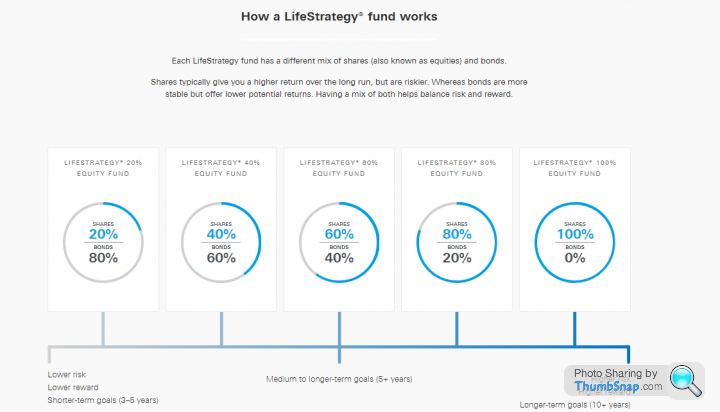
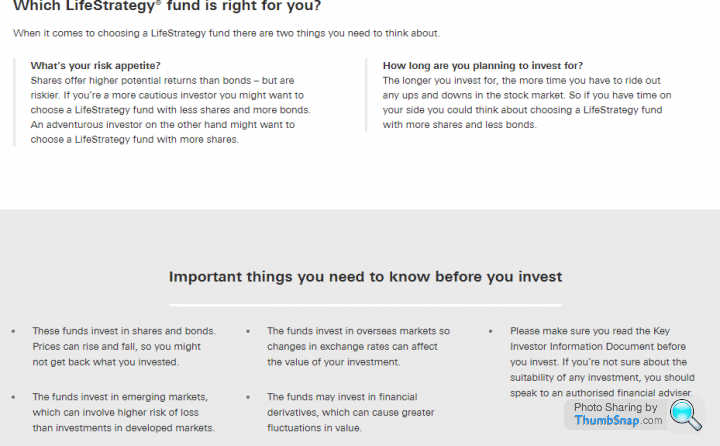
See link for full details https://www.vanguardinvestor.co.uk/investing-expla...
Please note, if you open an Account with Vanguard, you can only buy their products i.e. like going into Apple shop, but although with a restricted choice, they do have over 70 different funds available which is pretty impressive.
Per above link, imo the Vanguard website is pretty well presented with relevant information to assist DIY investor like yourself. At the top of the website, they have the "Investing Education" section which is an easy to follow guide covering all the usual basic areas. Otherwise, if you have any questions, just post them up here and I am sure someone will help out.
Happy reading

I am early 30’s and was going to open a stocks and shares isa (Vangaurd from what I have read on here) and put £100 a month in. Looking at leaving it for at least 18 years.
I just can’t get over investing when I have mortgage debt though. Might be the wrong decision money wise. But I think I am going to try and pay the mortgage off (15 years worst case scenario) before getting a S+S isa.
Am I looking at this totally wrong though?
I just can’t get over investing when I have mortgage debt though. Might be the wrong decision money wise. But I think I am going to try and pay the mortgage off (15 years worst case scenario) before getting a S+S isa.
Am I looking at this totally wrong though?
Gassing Station | Finance | Top of Page | What's New | My Stuff