
Discussion


Not a super common topic on PH, people naturally mostly discuss capital markets and their country weights and here we go. Most people usually do not have access to alternative (private) in a great ability, but there has been a massive trend I would say for smart money at least to shift their allocations from usual stock bonds to alternatives.
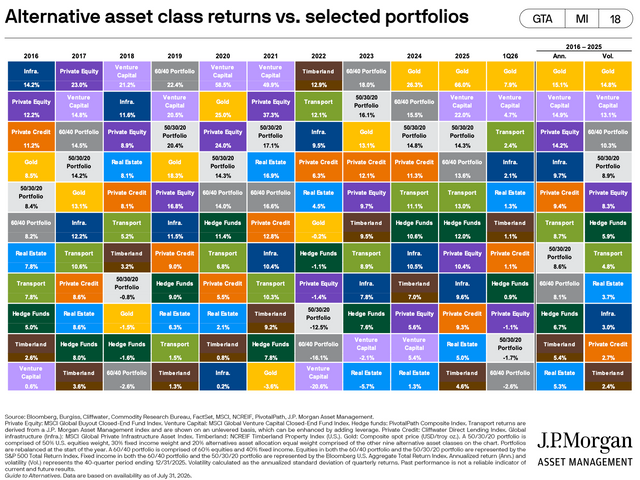
US Farmland, has probably one of the few asset classes that has zero capital loss in the last decade.
US Farmland, has probably one of the few asset classes that has zero capital loss in the last decade.
You’re swimming with sharks here so unless you are or have access to a reliable specialist, you will likely be the last buyer. I spent a good amount investigating buying the lease on small oil wells, it’s not uncommon to own a few of these. Anyway I did know someone who had experience and the bottom line was that after management costs and fees, it was just a headache, add in the risk of being ripped off and then in Colorado, it wasn’t for me.
ooid said:
Not a super common topic on PH, people naturally mostly discuss capital markets and their country weights and here we go. Most people usually do not have access to alternative (private) in a great ability, but there has been a massive trend I would say for smart money at least to shift their allocations from usual stock bonds to alternatives.
US Farmland, has probably one of the few asset classes that has zero capital loss in the last decade.
I guess it depends on what is considered "smart money". US Farmland, has probably one of the few asset classes that has zero capital loss in the last decade.
ooid said:
Not a super common topic on PH, people naturally mostly discuss capital markets and their country weights and here we go. Most people usually do not have access to alternative (private) in a great ability, but there has been a massive trend I would say for smart money at least to shift their allocations from usual stock bonds to alternatives.
US Farmland, has probably one of the few asset classes that has zero capital loss in the last decade.
When you look at a chart like that, the first question should be "how have they arrived at those numbers?".US Farmland, has probably one of the few asset classes that has zero capital loss in the last decade.
Broad brush categorisation can hide tremendous variability within each category.
Aside from the lack of accessibility (which just strikes me as a recipe for being the buyer of last resort) I think the problem many retail investors would have with these sorts of asset classes is that a lot of the return is really illiquidity premium for holding through the cycle, and they don't necessarily have the duration or temperament to want to hold them long enough to earn that premium. Hence you see in periods like 2022-24 all the infrastructure/renewables etc trusts getting absolutely whacked and discounts blowing out for ages.
Derek Chevalier said:
I guess it depends on what is considered "smart money".
Institutional investors.LooneyTunes said:
When you look at a chart like that, the first question should be "how have they arrived at those numbers?".
Broad brush categorisation can hide tremendous variability within each category.
Well, you can see the data source and relevant indices/index for each class, bottom left. Obviously volatility is missing and most of these valuations rather than market values, so they would look less volatile in comparison to equities.Broad brush categorisation can hide tremendous variability within each category.
ooid said:
Well, you can see the data source and relevant indices/index for each class, bottom left. Obviously volatility is missing and most of these valuations rather than market values, so they would look less volatile in comparison to equities.
Buying an index is quite a different proposition compared to buying the actual assets or a more focussed offering.Gassing Station | Finance | Top of Page | What's New | My Stuff