
Bonds v equities
Discussion


Depends on which bonds and what trouble firstly. Stick to investment grade bonds and short-medium duration for least volatility. Long-duration and you start to increase the volatility - especially if that "trouble" is inflation related. Non investment grade and again you increase risk (default). Two ways to look at bonds is: 1/ The starting point. Today is a much better risk/reward proposition to 5 years ago when yields were historically very low and inflation was a bigger risk. 2/ The fundamentals of equity markets - are they healthy or looking unbalanced?
That's a spectacularly vague question. 
My only advice would be to understand the subtle difference between holding a bond fund and holding actual bonds. Take a look at what happened to mixed duration bond funds (particularly gilts) over the last five years. When interest rates rose, the prices collapsed. That's not such a problem if you hold the actual bonds to maturity (you get back their par value at redemption). However with a rolling duration fund you lock in the losses.
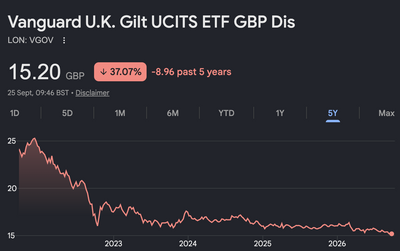
This is less likely to happen going forward now we're out of the ZIRP era, but you never know.
I've moved to a 'safer' strategy of holding gilts with a maturity date that matches my investment time horizon, e.g. a ten-year gilt bought now yields ~5.3% guaranteed until I want the cash back out. Obviously that's still a gamble on interest rates not going through the roof, but you can't have everything!
My only advice would be to understand the subtle difference between holding a bond fund and holding actual bonds. Take a look at what happened to mixed duration bond funds (particularly gilts) over the last five years. When interest rates rose, the prices collapsed. That's not such a problem if you hold the actual bonds to maturity (you get back their par value at redemption). However with a rolling duration fund you lock in the losses.
This is less likely to happen going forward now we're out of the ZIRP era, but you never know.
I've moved to a 'safer' strategy of holding gilts with a maturity date that matches my investment time horizon, e.g. a ten-year gilt bought now yields ~5.3% guaranteed until I want the cash back out. Obviously that's still a gamble on interest rates not going through the roof, but you can't have everything!
deggles said:
However with a rolling duration fund you lock in the losses.
I wouldn't say the loss is "locked" in. You still make an immediate capital loss in an individual bond too, but I agree one safety aspect with an individual bond is at worse case you can hold to maturity.. but lets not kid ourselves we are miles better off individual than fund. A fund will drop in (unit) price but will increase in yield (income). Always consider the average duration of a fund like you would an individual bond and understand what happens to a funds *unit* price if yields rise. That way you are less likely to sell and consequently blame the structure of fund for your losses. The way a fund is structured is relatively low risk but if you require absolute certainty of payment date then individual over fund.Edited by Phooey on Friday 25th September 10:22
The key thing is knowing why you want to hold bonds - the main reasons are:
- You needs predictable cashflows. For example, if you buy a nominal gilt today, you know to the penny how much interest you will receive every 6 months, when you will receive and when you'll get your money back (on maturity date). There are currently around 60 of these in issue for various maturity dates from this year until 2073.
- You need inflation protection. For example, if you buy an inflation-linked gilt today, you get predictable cashflows of interest and maturity value in real terms such as when you planning to buy an annuity. There are currently around 30 such gilts in issue.
- You need to diversify your investments from equities. This is generally done via a bond fund.
In general, the riskier the bond, the higher interest rate (yield). Government bonds (eg. Gilts and Treasuries) are generally seen as safer because central banks can print money but this isn't always the case. They are seen as a diversifier from equities which is why bonds are generally held in a standard 60/40 portfolio - to reduce portfolio volatility over long time periods.
Many people are scared of bonds because of the massive price drops in 2022 but they've really just normalised to the kind of yields we saw before the credit crunch. As an example, gilt T41F pays you 5.4% every year until 2041 then you get your money back which sounds fantastic but the real value depends on what happens with inflation in that period.
- You needs predictable cashflows. For example, if you buy a nominal gilt today, you know to the penny how much interest you will receive every 6 months, when you will receive and when you'll get your money back (on maturity date). There are currently around 60 of these in issue for various maturity dates from this year until 2073.
- You need inflation protection. For example, if you buy an inflation-linked gilt today, you get predictable cashflows of interest and maturity value in real terms such as when you planning to buy an annuity. There are currently around 30 such gilts in issue.
- You need to diversify your investments from equities. This is generally done via a bond fund.
In general, the riskier the bond, the higher interest rate (yield). Government bonds (eg. Gilts and Treasuries) are generally seen as safer because central banks can print money but this isn't always the case. They are seen as a diversifier from equities which is why bonds are generally held in a standard 60/40 portfolio - to reduce portfolio volatility over long time periods.
Many people are scared of bonds because of the massive price drops in 2022 but they've really just normalised to the kind of yields we saw before the credit crunch. As an example, gilt T41F pays you 5.4% every year until 2041 then you get your money back which sounds fantastic but the real value depends on what happens with inflation in that period.
Huzzah said:
I think what I'm trying to get at is the traditional ratio for cautious retired person in drawdown always used to be recommended as 20/80 bond/equity ratio. But this no longer seems applicable 40/60 or even 80/20 seems to work better and beat inflation.
It works better until it doesn't."The worst bonds can do is give you indigestion. Stocks can make you vomit."
I've never understood bonds held in a portfolio.
Is there much difference between bonds and say a fixed rate cash ISA?
My S&S ISA is 100% equities but I also have a couple of cash ISAs which I tend to fix for one year at the best rate going, currently around 5%. I have been thinking of ditching them and transferring to my S&S ISA when they finish next year.
Is there much difference between bonds and say a fixed rate cash ISA?
My S&S ISA is 100% equities but I also have a couple of cash ISAs which I tend to fix for one year at the best rate going, currently around 5%. I have been thinking of ditching them and transferring to my S&S ISA when they finish next year.
Mazinbrum said:
I m in equities and a money market fund, no bonds. Thoughts?
A relatively good strategy whilst interest rates are set to increase.Another option would be building a short term duration bond ladder.
If the money is not in a sipp/isa, then the ladder would be better (no cgt on uk govt gilts).
ChrisH72 said:
I've never understood bonds held in a portfolio.
Is there much difference between bonds and say a fixed rate cash ISA?
My S&S ISA is 100% equities but I also have a couple of cash ISAs which I tend to fix for one year at the best rate going, currently around 5%. I have been thinking of ditching them and transferring to my S&S ISA when they finish next year.
You get the tax arbitrage when feeding your pension pot (where your bond allocation would reside). Also, typically your pension pot would be substantially larger than your isa, so compounding over time would produce better results for larger investment pot. Utlimately I guess there are arguments for/against - depends on how you want to structure your money for retirement. Is there much difference between bonds and say a fixed rate cash ISA?
My S&S ISA is 100% equities but I also have a couple of cash ISAs which I tend to fix for one year at the best rate going, currently around 5%. I have been thinking of ditching them and transferring to my S&S ISA when they finish next year.
ChrisH72 said:
Do money market funds offer better rates than cash ISAs?
Also, with the changes coming in April next year wouldn't interest be taxed?
Depends. Most will be slightly above BOE/SONIA. But you can also sell and hold in a S&S ISA v needing to fix etc.Also, with the changes coming in April next year wouldn't interest be taxed?
As for April not sure the full rules have been published yet but last I think I read was long as you're not holding just money market/cash type products in an ISA you're OK.
ChrisH72 said:
I've never understood bonds held in a portfolio.
Is there much difference between bonds and say a fixed rate cash ISA?
My S&S ISA is 100% equities but I also have a couple of cash ISAs which I tend to fix for one year at the best rate going, currently around 5%. I have been thinking of ditching them and transferring to my S&S ISA when they finish next year.
I suppose in practical terms over a year there isn’t any difference.Is there much difference between bonds and say a fixed rate cash ISA?
My S&S ISA is 100% equities but I also have a couple of cash ISAs which I tend to fix for one year at the best rate going, currently around 5%. I have been thinking of ditching them and transferring to my S&S ISA when they finish next year.
But in a portfolio balance people look at bonds over the long term and they’re supposed to do better than cash deposits. Also they’re supposed to go up in value when equity markets fall, but that notably didn’t happen in 2022.
I remember there was quite a good article about it on Bogleheads, although not everyone agreed that bonds still have a place.
There is currently a greater chance that yields will rise further, but rather than waiting for them to rise you have to look at the yield on offer today and decide if that is sufficient for you to buy now. The only thing that is for almost certain is yields won’t fall dramatically while governments aren’t serious about inflation and deficits, plus we have the supply of bonds (particularly IG) increasing.
Adding an almost risk-free 5-6% to a portfolio will appeal to some but not all..
Adding an almost risk-free 5-6% to a portfolio will appeal to some but not all..
Huzzah said:
I think what I'm trying to get at is the traditional ratio for cautious retired person in drawdown always used to be recommended as 20/80 bond/equity ratio. But this no longer seems applicable 40/60 or even 80/20 seems to work better and beat inflation.
I thought the traditional advice was your age in bonds? So age 60 would mean a 60/40 split.I know there is a lot more to it than that in practice but 20/80 while in drawdown does seem towards the riskier end of the spectrum.
Gassing Station | Finance | Top of Page | What's New | My Stuff