
Limestone/travertine tiles and underfloor heating?
Discussion


We built a new house 2 years ago. Our builder advised against these products.
A friend did go ahead with travertine and it has been a disaster. Crumbling all over and looks like the whole ground floor will need to be lifted and replaced.
Builder advised that regardless of underfloor heating or not, do not specify!
Just our experience so maybe do some more research as things may have improved since then.
A friend did go ahead with travertine and it has been a disaster. Crumbling all over and looks like the whole ground floor will need to be lifted and replaced.
Builder advised that regardless of underfloor heating or not, do not specify!
Just our experience so maybe do some more research as things may have improved since then.
If its a flooring thickness specification travertine correctly laid onto a stable floor bonded onto a decoupling matt such as a product as Shluter or similar with flexible adhesives it will be just fine. Its usually people who don't use a correct decoupling matting & flexi adhesives to save a few bob that come out with the horror stories....
Some pals of ours have exactly this as above & no issues after two year of underfloor heating use & they like the house very warm indeed!
Some pals of ours have exactly this as above & no issues after two year of underfloor heating use & they like the house very warm indeed!
dsl2 said:
If its a flooring thickness specification travertine correctly laid onto a stable floor bonded onto a decoupling matt such as a product as Shluter or similar with flexible adhesives it will be just fine. Its usually people who don't use a correct decoupling matting & flexi adhesives to save a few bob that come out with the horror stories....
Some pals of ours have exactly this as above & no issues after two year of underfloor heating use & they like the house very warm indeed!
Exactly this . It is the knowledge of materials and methods that ensure a good job. Some pals of ours have exactly this as above & no issues after two year of underfloor heating use & they like the house very warm indeed!
I've laid loads of trav over underfloor heating. Use a quality powdered flexible rapid set and back butter the tiles. Prep the floor with SBR or acrylic primer (make sure it is dry enough if new screed). Seal the faces prior to laying with Lithofin Stain Stop and again after grouting.
EggsBenedict said:
It's the screed underneath that will crack, and the tiles bonded to it will then crack too.
The screed needs to be 100% dry.
Ask me how I know
Ouch - sorry to hear! The screed needs to be 100% dry.
Ask me how I know
I would be interested to know the full story, if only as for my own ''lessons learnt' log for future ideas/projects/helping others?

Andehh said:
Ouch - sorry to hear!
I would be interested to know the full story, if only as for my own ''lessons learnt' log for future ideas/projects/helping others?
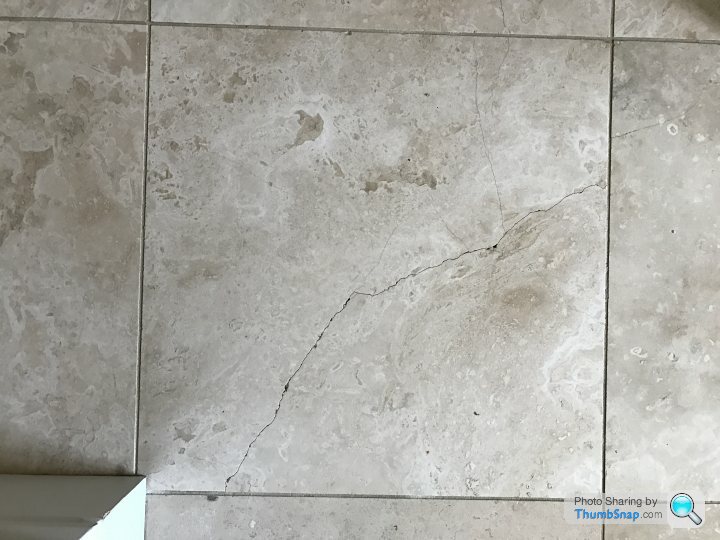
New floor in kitchen, screeded over wet UFH. Screed takes something like a week per 1/2" depth to dry properly. We didn't have that time, so whacked up the UFH to dry it faster. It checked out as dry with a moisture meter, so we went ahead. just over a year later a hairline crack appeared across 3 of the limestone tiles, in a line (e.g. the same crack) - it's in the screed, not the tiles...I would be interested to know the full story, if only as for my own ''lessons learnt' log for future ideas/projects/helping others?
because it's limestone and has loads of included fossils and so on, it's been repaired with some resin treatment to a point where it's not noticeable, but I know it's there.
EggsBenedict said:
New floor in kitchen, screeded over wet UFH. Screed takes something like a week per 1/2" depth to dry properly. We didn't have that time, so whacked up the UFH to dry it faster. It checked out as dry with a moisture meter, so we went ahead. just over a year later a hairline crack appeared across 3 of the limestone tiles, in a line (e.g. the same crack) - it's in the screed, not the tiles...
Did no one tell you not to turn on the heating> ? I would demand the control unit is removed and the system not commissioned until that screed has dried CORRECTLY
Its all rush rush these days .
because it's limestone and has loads of included fossils and so on, it's been repaired with some resin treatment to a point where it's not noticeable, but I know it's there.
Did no one tell you not to turn on the heating> ? I would demand the control unit is removed and the system not commissioned until that screed has dried CORRECTLY
Its all rush rush these days .
because it's limestone and has loads of included fossils and so on, it's been repaired with some resin treatment to a point where it's not noticeable, but I know it's there.
[quote=sidekickdmr]Thanks for all of the replies guys,
So if I put some of this Ditramatting stuff down that will take the movement from the ufh pipes and screed and stop it transferring to the tiles, is that the idea?[/quo
NOT exactly . It works perfectly when ALL parts of the job are well done. I have seen Schluter Ditra been used and the guy used the wrong adhesive before and after . The tiles came off the mat which came off the sub flooring
So if I put some of this Ditramatting stuff down that will take the movement from the ufh pipes and screed and stop it transferring to the tiles, is that the idea?[/quo
NOT exactly . It works perfectly when ALL parts of the job are well done. I have seen Schluter Ditra been used and the guy used the wrong adhesive before and after . The tiles came off the mat which came off the sub flooring
EggsBenedict said:
It's a long story, I just cut to the chase. Suffice to say, rushing wasn't our intention - the project just ended up that way due to people not doing what they said they'd do when they said they'd do it.
Thats a shame. YOu need someone in control to really make sure they have your interest at heart . With in-screed UFH, you lay the pipes then over-pressurise them to beyond what the UFH/normal system would ever run at, then lay the screed. Once the screed sets/few weeks pass you then release the pressure and carry on as normal.
I don't see how a once-set screed (over pressurised pipes) can move sufficiently enough through thermal expansion enough to overcome flexible grout/tile adhesive and crack tiles - no matter what the tile???
I don't see how a once-set screed (over pressurised pipes) can move sufficiently enough through thermal expansion enough to overcome flexible grout/tile adhesive and crack tiles - no matter what the tile???
We have wet UFH and travertine tiles in the kitchen. The tiles are natural and not polished/filled so have lots of "patina". We have seen a few cracks develop, but nothing that looks out of place or seems to compromise the structural integrity of the tile.
They have been down for over 5 years now.
They have been down for over 5 years now.
Gassing Station | Homes, Gardens and DIY | Top of Page | What's New | My Stuff