
Render repair - Any plasterers/builders here?
Discussion


Had a quote to repair some cracked render on the front of the house, which is causing some penetrating damp.
A plasterer that has done some work for me before has quoted to stitch the render using helibar and make good.
I'm under the impression that helibar is for cracked masonry, and you're not supposed to put it in render? Am I right?
Thanks!
A plasterer that has done some work for me before has quoted to stitch the render using helibar and make good.
I'm under the impression that helibar is for cracked masonry, and you're not supposed to put it in render? Am I right?
Thanks!
Helibar is a masonry stitching system.
The render may nevertheless continue to crack even when the crack hes been stitched. What I always specify is a strip of building paper over the crack, say 300mm wide, then stainless EML fixed with brass screws and stainless penny washers, then render. The building paper locally isolates the render from the underlying crack/plane of weakness and prevents it from re cracking. Never had any subsequent issues with this method.
The render may nevertheless continue to crack even when the crack hes been stitched. What I always specify is a strip of building paper over the crack, say 300mm wide, then stainless EML fixed with brass screws and stainless penny washers, then render. The building paper locally isolates the render from the underlying crack/plane of weakness and prevents it from re cracking. Never had any subsequent issues with this method.
wolfracesonic said:
Yes you're right but is he putting the Helibar in the masonry behind the render to address what caused the cracking? Is the affected area over/adjacent to any openings?
The cracks all point toward the corners of the front windows. It's a solid brick wall underneath.The cracks are fairly hairline in the render.
There is no evidence of any cracking at all internally.
Edited by cbmotorsport on Wednesday 17th July 10:50
Lotobear said:
Helibar is a masonry stitching system.
The render may nevertheless continue to crack even when the crack hes been stitched. What I always specify is a strip of building paper over the crack, say 300mm wide, then stainless EML fixed with brass screws and stainless penny washers, then render. The building paper locally isolates the render from the underlying crack/plane of weakness and prevents it from re cracking. Never had any subsequent issues with this method.
Shame you're in Cumbria! The render may nevertheless continue to crack even when the crack hes been stitched. What I always specify is a strip of building paper over the crack, say 300mm wide, then stainless EML fixed with brass screws and stainless penny washers, then render. The building paper locally isolates the render from the underlying crack/plane of weakness and prevents it from re cracking. Never had any subsequent issues with this method.
I'm not a plasterer by the way OP, I'm a building surveyor!
If the cracks are not running through the wall then they are unlikely to be of concern and in that case a layer of stainless mesh before applying the render may be sufficient on it's own.
Let's see the photos however, as cracks running to the windows may signify something else such as lintel or wall tie corrosion - how old is the property and is it cavity construction?
If the cracks are not running through the wall then they are unlikely to be of concern and in that case a layer of stainless mesh before applying the render may be sufficient on it's own.
Let's see the photos however, as cracks running to the windows may signify something else such as lintel or wall tie corrosion - how old is the property and is it cavity construction?
Lotobear said:
I'm not a plasterer by the way OP, I'm a building surveyor!
If the cracks are not running through the wall then they are unlikely to be of concern and in that case a layer of stainless mesh before applying the render may be sufficient on it's own.
Let's see the photos however, as cracks running to the windows may signify something else such as lintel or wall tie corrosion - how old is the property and is it cavity construction?
Ah, I see.If the cracks are not running through the wall then they are unlikely to be of concern and in that case a layer of stainless mesh before applying the render may be sufficient on it's own.
Let's see the photos however, as cracks running to the windows may signify something else such as lintel or wall tie corrosion - how old is the property and is it cavity construction?
Thanks for taking the time to reply.
It's solid wall construction at the front, no cavity. 1920's.
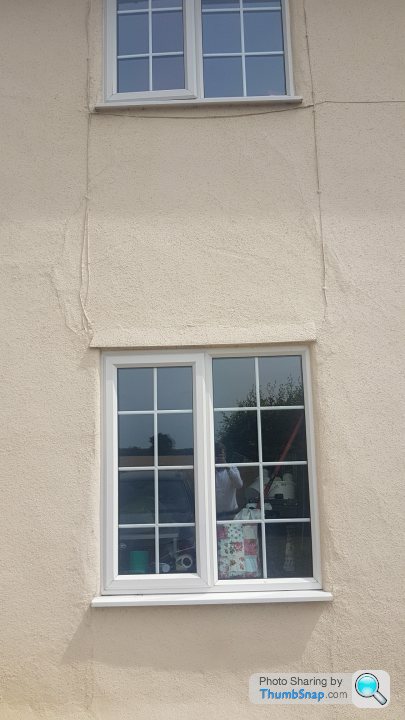
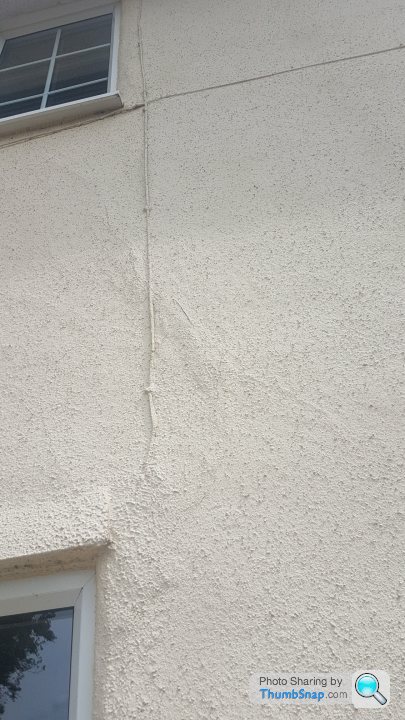
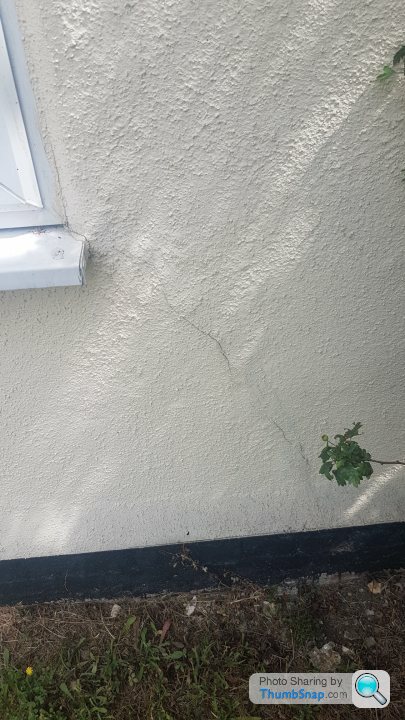
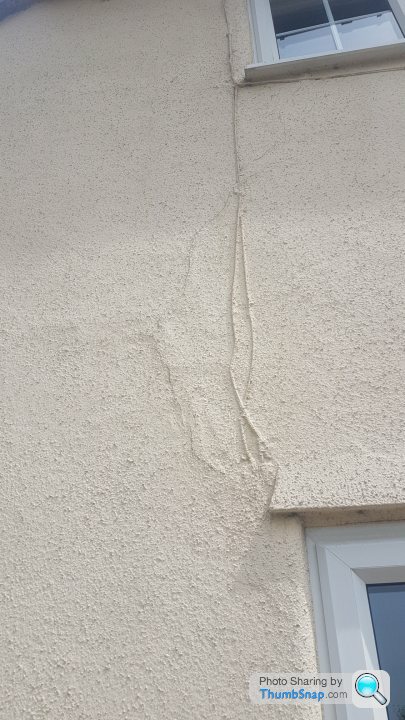
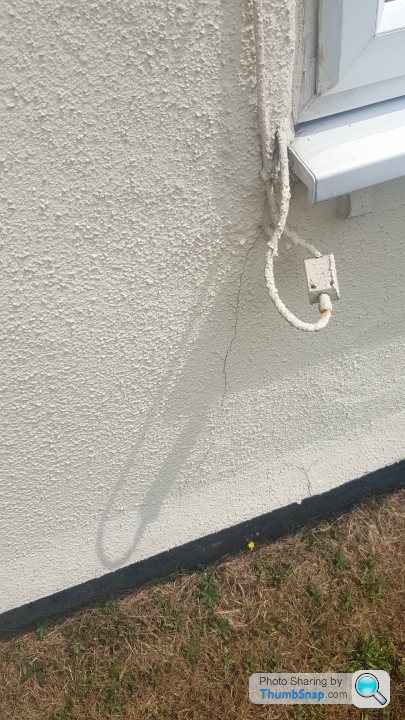
Looks like someone has hit it with the Tyrolean machine
I agree, take it off but I would be reasonably confident it's not foundation related given the pattern of cracking which appears more consistent with differential movement or shrinkage.
I wonder if you'll find the masonry below has been rebuilt with dissimilar bricks or even concrete blockwork, or perhaps the ground floor window was once a doorway?
..or perhaps a rotting timber lintel above the window?
I agree, take it off but I would be reasonably confident it's not foundation related given the pattern of cracking which appears more consistent with differential movement or shrinkage.
I wonder if you'll find the masonry below has been rebuilt with dissimilar bricks or even concrete blockwork, or perhaps the ground floor window was once a doorway?
..or perhaps a rotting timber lintel above the window?
Edited by Lotobear on Wednesday 17th July 16:05
Both front downstairs windows have cracks in the render to the corners of the windows.
If I hack all the render off the whole wall, I'll have to insulate it due to building regs, which could get very costly.
I'm tempted to hack it off around the cracks until there's solid render and repair?
If I hack all the render off the whole wall, I'll have to insulate it due to building regs, which could get very costly.
I'm tempted to hack it off around the cracks until there's solid render and repair?
Lotobear said:
Just expose the cracks and then post some further pics up.
Who told you that!?
https://www.planningportal.co.uk/info/200130/common_projects/18/external_walls/2 Who told you that!?
Part L1B - Conservation of Fuel & Power in Existing Dwellings
Unless I've interpreted it wrongly?
Edited by cbmotorsport on Thursday 18th July 09:20
Reg 23 is highly nuanced (for obvious reasons) and I would argue that a normal external cement render finish does not consitute a 'thermal element' and even if it did it would not be "technically, functionally and economically feasible" to require only one elevation, or part thereof, to be provided with an externally applied insulation and render system.
I've never once seen this invoked in a situation of your kind (though of course it's a different situation in the case of new roofs, new ground floors, complete reconstruction of one solid elevation and similar cases where the work goes beyond a simple 'repair' where it would clearly make sense regardless).
In summary I would disregard it and treat the work as a repair. If you were stripping and rendering all of the elevations on a solid walled property that would doubtless be a different matter where there is a clear case and opportunity for upgrading the structure thermally
I've never once seen this invoked in a situation of your kind (though of course it's a different situation in the case of new roofs, new ground floors, complete reconstruction of one solid elevation and similar cases where the work goes beyond a simple 'repair' where it would clearly make sense regardless).
In summary I would disregard it and treat the work as a repair. If you were stripping and rendering all of the elevations on a solid walled property that would doubtless be a different matter where there is a clear case and opportunity for upgrading the structure thermally
Lotobear said:
Reg 23 is highly nuanced (for obvious reasons) and I would argue that a normal external cement render finish does not consitute a 'thermal element' and even if it did it would not be "technically, functionally and economically feasible" to require only one elevation, or part thereof, to be provided with an externally applied insulation and render system.
I've never once seen this invoked in a situation of your kind (though of course it's a different situation in the case of new roofs, new ground floors, complete reconstruction of one solid elevation and similar cases where the work goes beyond a simple 'repair' where it would clearly make sense regardless).
In summary I would disregard it and treat the work as a repair. If you were stripping and rendering all of the elevations on a solid walled property that would doubtless be a different matter where there is a clear case and opportunity for upgrading the structure thermally
Thanks for the advice! I did think it was totally daft. I've never once seen this invoked in a situation of your kind (though of course it's a different situation in the case of new roofs, new ground floors, complete reconstruction of one solid elevation and similar cases where the work goes beyond a simple 'repair' where it would clearly make sense regardless).
In summary I would disregard it and treat the work as a repair. If you were stripping and rendering all of the elevations on a solid walled property that would doubtless be a different matter where there is a clear case and opportunity for upgrading the structure thermally
I'm going to get a plasterer to have a look at it, hack back the cracks and see what's going on.
Ok interesting to see the photos.....
It really needs some chipped off to see what is beneath obviously!
At face value it looks like a crack in the brick work below the render, however, the way it runs makes me thing it has something to do with the windows, could moisture be penetrating at the window sill edges and causing the render to delaminate, the cracks being purely from expansion / contraction? This combined with the fact you mention damp makes me thing its not quite as it seems!
I don't think this is one to loose to much sleep over it doesn't look like a foundation issue!
Does the render sound hollow anywhere around the areas when you tap it with your knuckles?
It really needs some chipped off to see what is beneath obviously!
At face value it looks like a crack in the brick work below the render, however, the way it runs makes me thing it has something to do with the windows, could moisture be penetrating at the window sill edges and causing the render to delaminate, the cracks being purely from expansion / contraction? This combined with the fact you mention damp makes me thing its not quite as it seems!
I don't think this is one to loose to much sleep over it doesn't look like a foundation issue!
Does the render sound hollow anywhere around the areas when you tap it with your knuckles?
strath44 said:
Ok interesting to see the photos.....
It really needs some chipped off to see what is beneath obviously!
At face value it looks like a crack in the brick work below the render, however, the way it runs makes me thing it has something to do with the windows, could moisture be penetrating at the window sill edges and causing the render to delaminate, the cracks being purely from expansion / contraction? This combined with the fact you mention damp makes me thing its not quite as it seems!
I don't think this is one to loose to much sleep over it doesn't look like a foundation issue!
Does the render sound hollow anywhere around the areas when you tap it with your knuckles?
The cables have been badly installed and drilled through the walls at an angle at the top of the windows. No loops before entry so historically, water has been running down them and coming in. It really needs some chipped off to see what is beneath obviously!
At face value it looks like a crack in the brick work below the render, however, the way it runs makes me thing it has something to do with the windows, could moisture be penetrating at the window sill edges and causing the render to delaminate, the cracks being purely from expansion / contraction? This combined with the fact you mention damp makes me thing its not quite as it seems!
I don't think this is one to loose to much sleep over it doesn't look like a foundation issue!
Does the render sound hollow anywhere around the areas when you tap it with your knuckles?
Inside the windows show evidence of damp, with rusting beading in places at the edges of the windows inside. All the damp areas are where these cracks lead to. There is no damp at ground level, it's all around the windows.
The property faces the prevailing wind, and rain can be driven at the front wall on bad weather days.
The render has blown in a couple of places close to the corners of the windows, but seems generally sound, apart from the cracks.
There's an invoice in the house paperwork from a couple of years ago from a render company for the front elevation. It looks like they splashed a coating on it to hide the cracks. The invoice was £800, so I doubt they did much more than that.
Gassing Station | Homes, Gardens and DIY | Top of Page | What's New | My Stuff