
Plaster and lath ceiling collapse
Discussion


Dear wise PH'ers,
I'm after some advice in relation to a plaster and lath ceiling that has collapsed in the flat under mine. For context I live in a period conversion flat that was originally a single house (Edwardian built).
So the ceiling has collapsed in the bathroom that is directly below my bedroom. Neighbour spoke with insurer who said as it's a plaster and lath ceiling they would only cover the repair if a cause was found. There isn't a leak from our flat, everything is bone dry. Neighbour has said she would like to claim on the building insurance blaming the cavity insulation that was installed between our floor and her ceiling around 10 months ago.
I am a property investor and work within property refurbishments but I am not a surveyor and nor do I regularly deal with insurers so I am seeking additional opinions.
My opinion is:
1. Ceiling collapse happened a few days after ceiling was re- painted
2. Collapsed two weeks ago on the hottest day of the year (38 degrees C)
3. Has cracked around the lights, these are IP65 rated and so probably installed fairly recently and have exacerbated the cracking
4. Plaster and lath ceilings are bloody heavy and tend to collapse on their own anyway
5. Bathroom is a high moisture area and this doesn't correspond well in general to a plaster and lath ceiling
6. Battens are intact and undamaged so struggle to see how quite light insulation lying on top of the battens could have caused the plaster to crack and collapse beneath it (especially as the insulation was done nearly a year ago)
My concern is I've seen the rest of the flat (it's a big flat) and there are cracks in the ceiling everywhere. I feel the neighbour is seeking a scapegoat and blaming the bathroom ceiling collapse on me will spiral into going down a path of either me personally or our insurer replacing the ceilings in her whole flat.
Keen to hear honest opinions.
Thanks
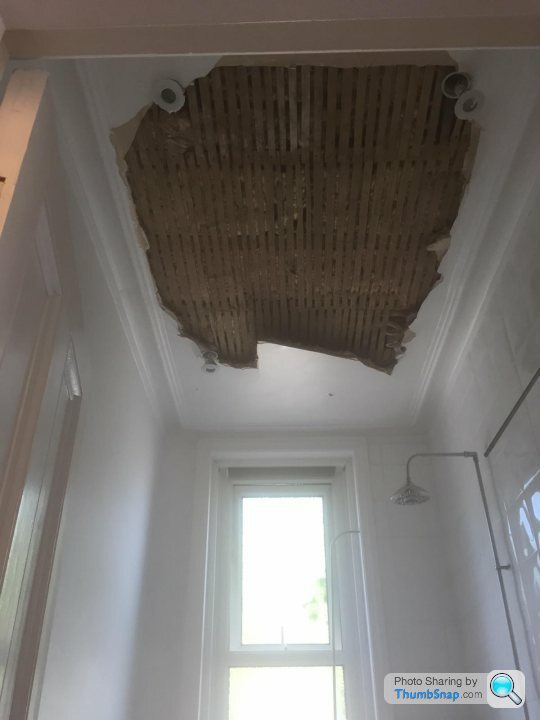
I'm after some advice in relation to a plaster and lath ceiling that has collapsed in the flat under mine. For context I live in a period conversion flat that was originally a single house (Edwardian built).
So the ceiling has collapsed in the bathroom that is directly below my bedroom. Neighbour spoke with insurer who said as it's a plaster and lath ceiling they would only cover the repair if a cause was found. There isn't a leak from our flat, everything is bone dry. Neighbour has said she would like to claim on the building insurance blaming the cavity insulation that was installed between our floor and her ceiling around 10 months ago.
I am a property investor and work within property refurbishments but I am not a surveyor and nor do I regularly deal with insurers so I am seeking additional opinions.
My opinion is:
1. Ceiling collapse happened a few days after ceiling was re- painted
2. Collapsed two weeks ago on the hottest day of the year (38 degrees C)
3. Has cracked around the lights, these are IP65 rated and so probably installed fairly recently and have exacerbated the cracking
4. Plaster and lath ceilings are bloody heavy and tend to collapse on their own anyway
5. Bathroom is a high moisture area and this doesn't correspond well in general to a plaster and lath ceiling
6. Battens are intact and undamaged so struggle to see how quite light insulation lying on top of the battens could have caused the plaster to crack and collapse beneath it (especially as the insulation was done nearly a year ago)
My concern is I've seen the rest of the flat (it's a big flat) and there are cracks in the ceiling everywhere. I feel the neighbour is seeking a scapegoat and blaming the bathroom ceiling collapse on me will spiral into going down a path of either me personally or our insurer replacing the ceilings in her whole flat.
Keen to hear honest opinions.
Thanks
If it had recently been repainted, I would put a pound to your penny that someone has used a roller on a pole to do it.
The plaster had probably sagged a little from the laths previous to paint and someone has come along and used a fair bit of pressure rolling the ceiling and this is the result.
It’s an old house, s t happens, it’s £500-ish to sort it. I wouldn’t even bother hassling the insurance over it.
The plaster had probably sagged a little from the laths previous to paint and someone has come along and used a fair bit of pressure rolling the ceiling and this is the result.
It’s an old house, s
t happens, it’s £500-ish to sort it. I wouldn’t even bother hassling the insurance over it. Thank you for the opinions so far, and it seems I'm on the right lines.
The neighbour has apparently instructed a surveyor to visit and they have noted the cause as the insulation. I haven't seen the report but it doesn't sound legitimate to me. As another poster has said I don't understand why even bother with the insurer, it's not a big job to repair and once plasterboarded that's the issue dealt with forever.
I wanted to know whether to dig my heels in or allow her to claim on insurance, conscious that she'll most likely try to get all the ceilings done.
I'm not keen on being blamed for something I genuinely believe was not the cause of the issue, and especially not keen on her own admittance that if I allowed myself to be blamed she could claim off the insurance.
The neighbour has apparently instructed a surveyor to visit and they have noted the cause as the insulation. I haven't seen the report but it doesn't sound legitimate to me. As another poster has said I don't understand why even bother with the insurer, it's not a big job to repair and once plasterboarded that's the issue dealt with forever.
I wanted to know whether to dig my heels in or allow her to claim on insurance, conscious that she'll most likely try to get all the ceilings done.
I'm not keen on being blamed for something I genuinely believe was not the cause of the issue, and especially not keen on her own admittance that if I allowed myself to be blamed she could claim off the insurance.
I had a ceiling collapse around me - not fun. It did a lot of damage to what it landed on, too!
In my case I was in the middle of boarding the loft above.
Initially I thought it was my fault - but I realised afterwards that the ceiling was already worn out before I even moved in and severely bowed as most of the plaster had detached from the laths.
Yes, I had been up there - but a functional ceiling should support that level of use.
In my case I was in the middle of boarding the loft above.
Initially I thought it was my fault - but I realised afterwards that the ceiling was already worn out before I even moved in and severely bowed as most of the plaster had detached from the laths.
Yes, I had been up there - but a functional ceiling should support that level of use.
Hi,
I've been meaning to join for a while, but I just made an account to reply to your post.
The damage is between the four spot lights, I would say that they've weakened an already weak (due to age) ceiling, as said before the pressure from a roller could have easily flexed the ceiling. It looks like earthwool (or similar) has been used as the insulation, spread out as it is would carry next to no load on that ceiling. The battens look in good condition, so I can't see how they've noted it down as that being the issue.
If it was me, I wouldn't go through insurance, I would just have it repaired (meaning them paying not you) and any other cracks rectified. The lady may be worries the rest are going to come down, so she might be thinking the insurer will do them all. I would argue it for sure.
Good luck!
I've been meaning to join for a while, but I just made an account to reply to your post.
The damage is between the four spot lights, I would say that they've weakened an already weak (due to age) ceiling, as said before the pressure from a roller could have easily flexed the ceiling. It looks like earthwool (or similar) has been used as the insulation, spread out as it is would carry next to no load on that ceiling. The battens look in good condition, so I can't see how they've noted it down as that being the issue.
If it was me, I wouldn't go through insurance, I would just have it repaired (meaning them paying not you) and any other cracks rectified. The lady may be worries the rest are going to come down, so she might be thinking the insurer will do them all. I would argue it for sure.
Good luck!
Edited by WishIWasAJoiner on Tuesday 6th August 20:49
Edited by WishIWasAJoiner on Tuesday 6th August 20:52
It doesn’t look like the laths have detached from the joists, so it can’t possibly be the lightweight insulation (which is resting on top of the laths). If it was the insulation then the laths would have fallen down as well.
I’d be asking the surveyor how the insulation has not caused the laths to detach from the joists but has caused the plaster (and the snots) to detach.
If it is just insulation causing it then why hasn’t every single lath and plaster ceiling across the land with insulation in the loft not fallen down. It would be raining lath and plaster ceilings across the land if insulation causes this type of issue.
it must be something else (likely just old age).
I’d be asking the surveyor how the insulation has not caused the laths to detach from the joists but has caused the plaster (and the snots) to detach.
If it is just insulation causing it then why hasn’t every single lath and plaster ceiling across the land with insulation in the loft not fallen down. It would be raining lath and plaster ceilings across the land if insulation causes this type of issue.
it must be something else (likely just old age).
Edited by Notreallymeeither on Tuesday 6th August 22:08
Gtom said:
If it had recently been repainted, I would put a pound to your penny that someone has used a roller on a pole to do it.
The plaster had probably sagged a little from the laths previous to paint and someone has come along and used a fair bit of pressure rolling the ceiling and this is the result.
It’s an old house, st happens, it’s £500-ish to sort it. I wouldn’t even bother hassling the insurance over it.
This all day long coupled with the lights. The plaster had probably sagged a little from the laths previous to paint and someone has come along and used a fair bit of pressure rolling the ceiling and this is the result.
It’s an old house, s
t happens, it’s £500-ish to sort it. I wouldn’t even bother hassling the insurance over it. I appreciate this must have been converted before my time but I’m under the impression that should be double plasterboard + skim or fire rated board as it’s between flats and whichever electrician (has to be electrician in a bathroom unless that ceilings so high it doesn’t count?) fitted those lights should have insisted the ceiling was brought up to current regs first or stuck with surface mount lighting?
Gassing Station | Homes, Gardens and DIY | Top of Page | What's New | My Stuff